Dr. Sandra Trappen

  • Home
  • Curriculum Vitae
  • Publications
  • Current Research
  • Talks & Paper Presentations
  • Contact
  • Policing
  • Juvenile Justice
  • Current Social Theory
  • Organized Crime
  • Criminology
  • Race & Ethnicity
  • Race, Crime & Justice
  • PSU Study Abroad
    • PSU Study Abroad

Policing

Welcome to Policing in America (CRIMJ 210)! The goal of this course is to foster critical thinking and encourage new perspectives on the nature of policing and its place as an institution in civil society. The course materials are designed to provide a broad overview of some of the current issues in American policing. Specific assignments are tailored to align with student interests, so that they can engage more deeply with particular problems that interest them.

Kerner Commission

Comment

What was the Kerner Commission?

The Kerner Commission (an 11-member panel officially known as the National Advisory Commission on Civil Disorders) was a presidential commission established by President Lyndon B. Johnson in 1967. The aim of the commission, chaired by Illinois Gov. Otto Kerner, was to investigate the causes of the urban race riots that occurred during the summer that year and to recommend solutions. The final report, published in 1968, concluded that racism and social inequality were the primary causes of the civil unrest.

To this end, the commission famously warned that the nation was moving toward “two societies, one black, one white—separate and unequal.”

The Long Hot Summer

What caused civil unrest in 1967? During a period of 9 months, culminating in the summer, more than 150 riots occurred across the U.S., most notably in the cities of Detroit, MI and Newark, NJ.

The report cited there were numerous grievance “triggers.” Among them were wide-spread racial discrimination and segregation, police brutality, discriminatory practices in the criminal justice system, unfair consumer credit practices, inadequate housing and public assistance programs, poverty, and high unemployment. All of them worked together in ways that effectively led to the systematic exclusion of communities of color from the democratic process.

The most common triggering event was a dispute between Black citizens and white police officers that escalated to violence.

Five Days of Unrest That Shaped, and Haunted, Newark - The New York Times

Conflicts with the Police

The poor treatment of residents of black communities in particular proved to be highly consequential during this time period. Such treatment, of course, finds its roots in American history, beginning with the 19th-century slave patrols and culminating in the Jim Crow era ” Black Codes,” the enforcement of which was purposefully designed to facilitate the arrest of Black people so that white “owners” could continue to profit from their free labor. This, in turn, often gave way to police-involved lynchings.

Fast forward to the 1960’s, when it was widely reported that residents of cities in places like Detroit and Newark felt threatened by the “Black invasion” to their neighborhoods. New York University historian Thomas Sugrue, author of The Origins of the Urban Crisis, documented this in his book. With that, decades of racial conflict and economic inequality boiled over and set off the 1967 riots; though to be clear, it was police action that provided the triggering spark. (Evans, 2021).

The Newark uprising began on July 12 when a Black cab driver was beaten by two white police officers for a minor traffic offense. The five days of rioting and looting that followed produced 26 deaths, 700 injuries, and more than 1,400 arrests. Ultimately, the National Guard and state troopers were called in to restore order (Evans, 2021)

To quote the Kerner report, “White racism is essentially responsible for the explosive mixture which has been accumulating in our cities since the end of World War II.” According to Nathaniel Jones, the Assistant General Counsel for the Commission, “white society created it, perpetuates it, and sustains it.” Not surprisingly, many white politicians and members of the news media voiced strong disapproval for that  finding.

The commission, likewise, attributed the uprisings to a combination of complex social, psychological problems, and poverty worked together to create feelings of despair among people. This created further problems with trust, as many felt they could no longer place their trust in the police and authority figures. And as it turns out, it was only three months prior to the beginning of the unrest in Newark and Detroit, that Dr. Martin Luther King, Jr. warned of coming the violence, even as he was encouraging nonviolent direct action: “All of our cities are potentially powder kegs,” said the 1964 Nobel Peace Prize winner in a speech at Stanford University entitled “The Other America.”

The 1967 Riots: When Outrage Over Racial Injustice Boiled Over | HISTORY

Why Were the Commission’s Findings Ignored?

Now, nearly five decades later, the Kerner Commission’s report is considered to be one of the more  insightful documents on race relations and solutions for discrimination that was ever be published by the U.S. government. In the view of one scholar, Michigan State University Professor Joe T. Darden, the cost of ignoring the Kerner Report has meant further decades of less opportunity for African-Americans. Had the commissions findings been implemented, it “would have eliminated this separation we have: central city/suburb, white suburb/black central city, white affluent/black poverty.

So, what got in the way?

Political conservatives disliked the fact that blame was placed on white institutions and society; they believed that black rioters were “let off the hook” for violent behavior.

Significantly, President Johnson, who had previously pushed through the Civil Rights Act and the Voting Rights Act, famously rejected the Commission’s report. Many believed he disliked it for a variety of reasons, chief among them was a belief that the report did not adequately acknowledge the previous accomplishments of his administration.

To make matters worse, the funding that would have been  required to implement the report’s recommendations was also viewed to be an obstacle, given how Johnson’s policies exploded the budget to support the U.S. escalation of the war in Vietnam. According to Darden, this likely caused President Johnson to worry that supporting implementation of the commission’s findings could damage the Democrat party’s  chance to keep the White House in the next election. Increasing spending was thus deemed to be impractical, despite it being necessary.

Conclusion

As the report predicted, incidents of police brutality continued to spark riots and protest marches even after the 1960s had ended; many of its recommendations have still not been yet been enacted as of 2024. Head Start, for example, an early education program for youth, was never fully funded at the level that the Commission desired nor were the Commission’s major welfare and job training recommendations adopted.

Alternatively, congress did manage to pass the Fair Housing Act about one month after the report’s completion, and within a few years, it allocated funding for the nation’s two largest urban aid programs (Model Cities and urban renewal), and increased federal aid for education. Congress also passed the Community Development Act to build on the Fair Housing Act towards helping housing equality.

Finally, regarding police policy initiatives, many of the report’s major policing and riot control recommendations were  adopted: police forces are now comparatively more racially diverse than they were in 1967, formal grievance processes are now in place in almost every city, and many cities have implemented community policing program models, which are focused toward getting officers out of the patrol car so that they can build a rapport with the people in their local communities. Despite this, police brutality remains a major ongoing unsolved problem.

With that, it can fairly be said of the report that it wasn’t fully ignored or forgotten, so much as its implementation failed to respond to the urgency of the moment that gave rise to its formation. As a result, U.S. society continues to struggle with many of the same problems that have plagued it throughout its history, with each successive generation continuing to pose the same questions about marginalized communities – why are they rioting? why can’t they seem to get ahead?

Sources

The 1967 Riots: When Outrage Over Racial Injustice Boiled Over, by Farrell Evans, 2021.

Questions for Reflection

The Kerner Commission of 1968 identified problems with social inequality, especially as this relates to policing practice in the 1960’s – problems that caused issues with people living in racial and ethnic minority communities. Has anything changed since that time? Discuss one or two of these major issues/problems.


Course: Policing, Race & Ethnicity

Policing in the Age of Social Media

18 Comments


Media Matters

With the rise of social media in addition to the fact that almost everyone is carrying a camera device in the pocket (cell phone) the question arises: What impact is social media having on the world of policing?

As your course book points out, some people argue that the increased scrutiny of police officers is a positive development. And one, quite frankly, that is long overdue. In many respects, the result is better law enforcement and support for civil rights, as officers are now more accountable to the public for their behavior.

Others argue, like the former FBI Director, James Comey, that this scrutiny is potentially having the effect of increasing crime. Officers are worried about being filmed and thus avoid confrontations with the public. This, he says, sends the wrong message to criminals. When the police retreat, crime steps in to fill the void.

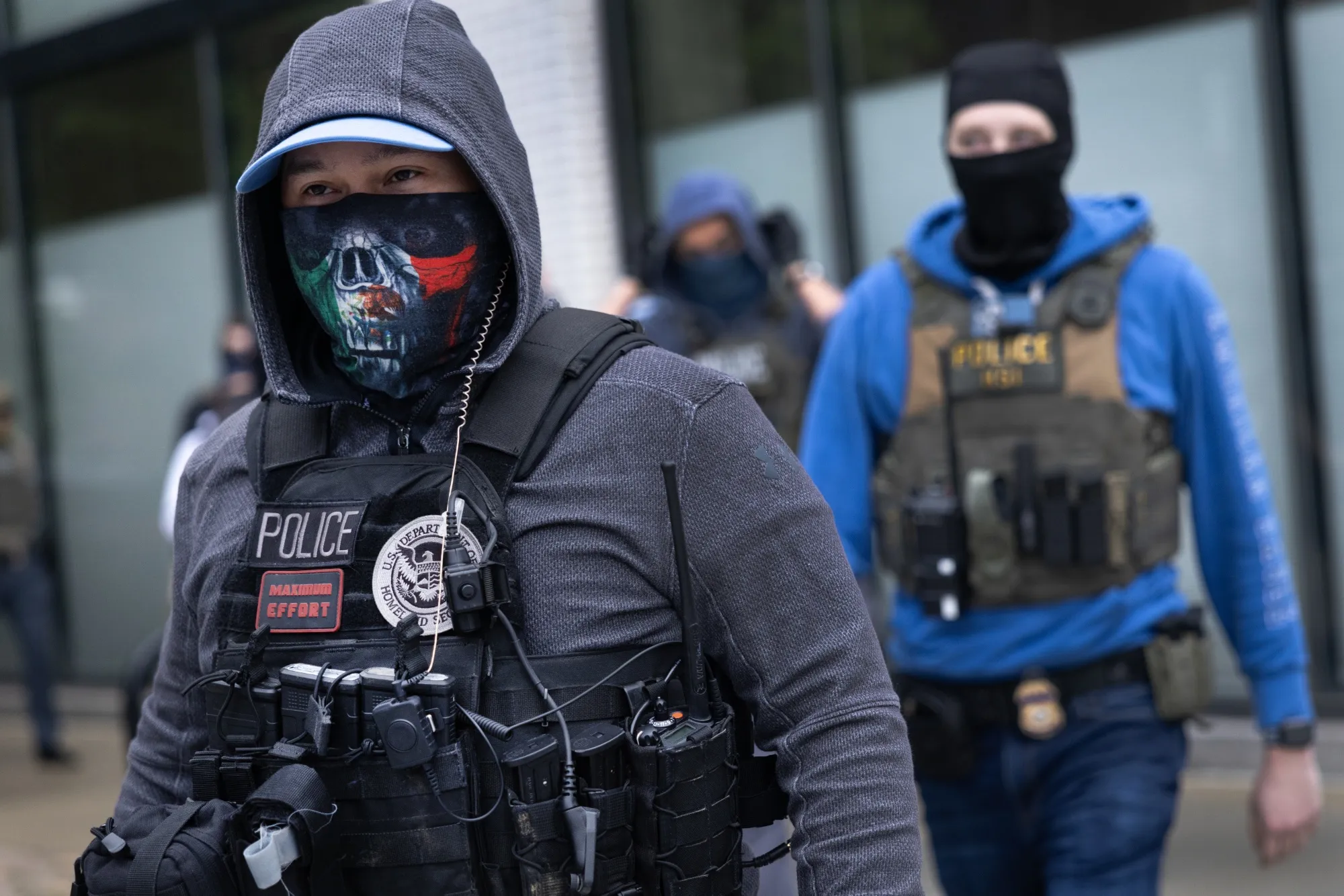
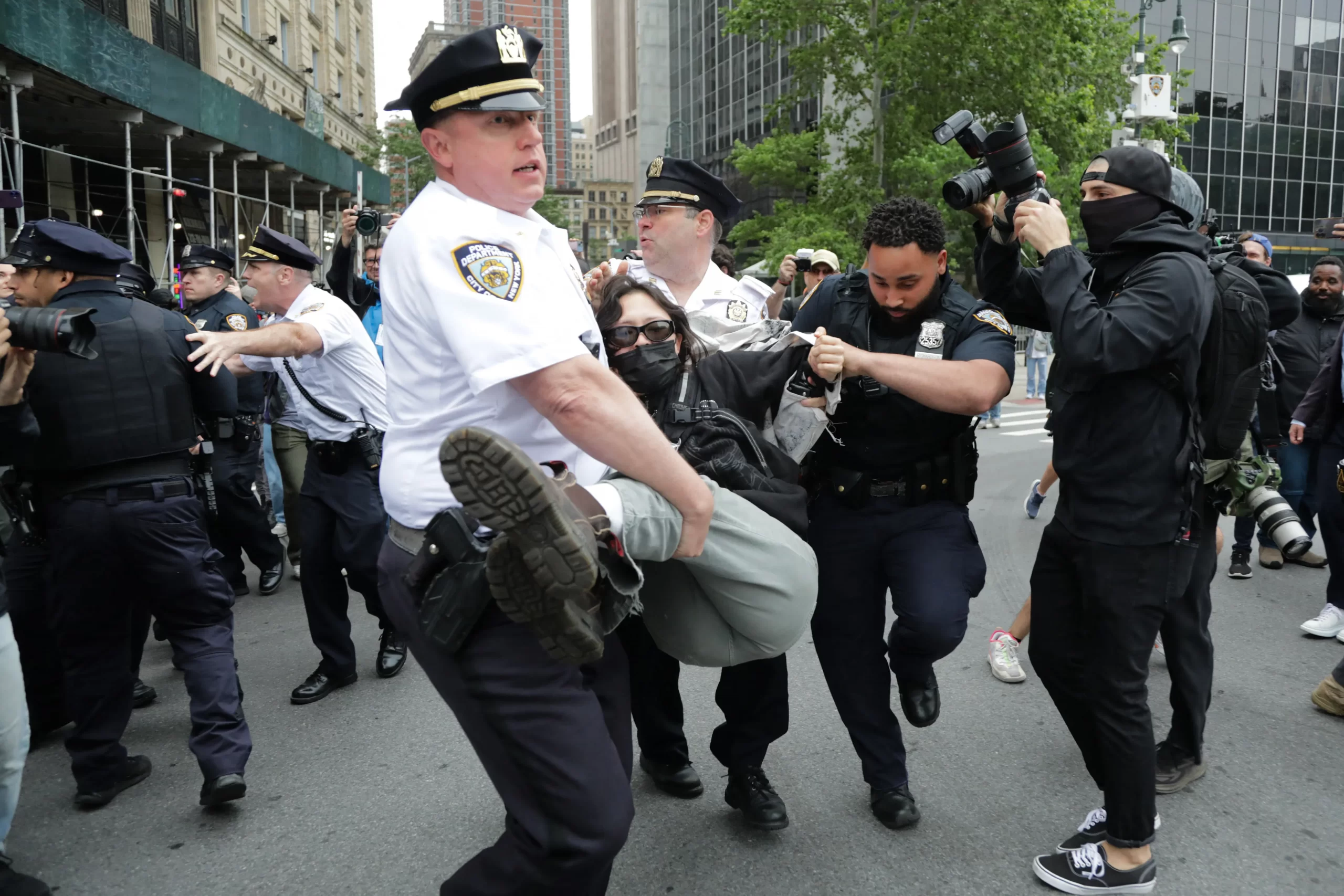
A protester is arrested during an “ICE Out of NYC” protest in New York City on June 9. Photo: Leonardo Munoz/AFP via Getty Images

Social Media as a Tool to Build Relationships

When the FBI Director takes such an oppositional stance to the developing media landscape, opportunities to fight crime can be missed. More recently, there are calls to moderate this view, as social media can be understood to be a tool that law enforcement agencies might leverage to reach more people than ever before.

Customarily, the mission of the police is stated as one focused on “to serve and protect.” Police departments are further required to have a deep understanding of their community — one that includes the “digital town square,” which encompasses platforms like X (formerly Twitter), Facebook, and Instagram. Given this, there may be new opportunities for agencies to connect with wider audiences and forge strong relationships with the public through messaging and education. The question is though, how can law enforcement find ways to get beyond screen names and anonymity to connect in ways that will  resonate? How can they improve communication and, in the process, become better crime fighters?

Implementing techniques like researching an audience’s demographic and psychographic characteristics can help agency communicators craft higher impact messages that can fundamentally shift the reception of a post from “listening to someone shout into a crowd with a megaphone” to “information meant just for me.” (Mendoza, 2024). Ultimately, learning how to target an audience to develop insights to create better messaging is a skill that should be cultivated, as this can transform the social media landscape from a simple tool used to share announcements, post cat pictures, and other memes, to one that is a critical asset that be used to build and strengthen community relationships.

Reflection & Discussion

What do you think about these developments? Do you think social media helps or harms the police? Does it make them more accountable to the public? Or does it increase crime?

Sources

Social Media Spotlight: A Tool for Relationship Building, by Marin Rulas Mendoza, 2024

Course: Criminal Justice, Policing

What is Critical Thinking?

12 Comments


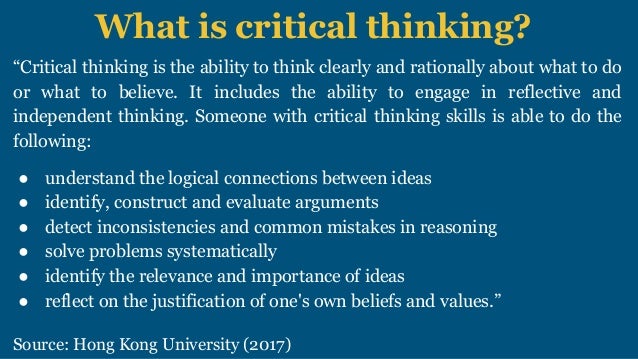
The term “critical thinking” is probably one of the most cliche terms in higher education today (“rigor” runs a close second).  Given this, there’s a pretty good chance that every time you walk into a new classroom, your sage professor will at some point emphasize how one of the goals of their class is to “help students engage in critical thinking”- commence eye rolls. Unfortunately, the meaning of words becomes eroded when they are used as much as this.

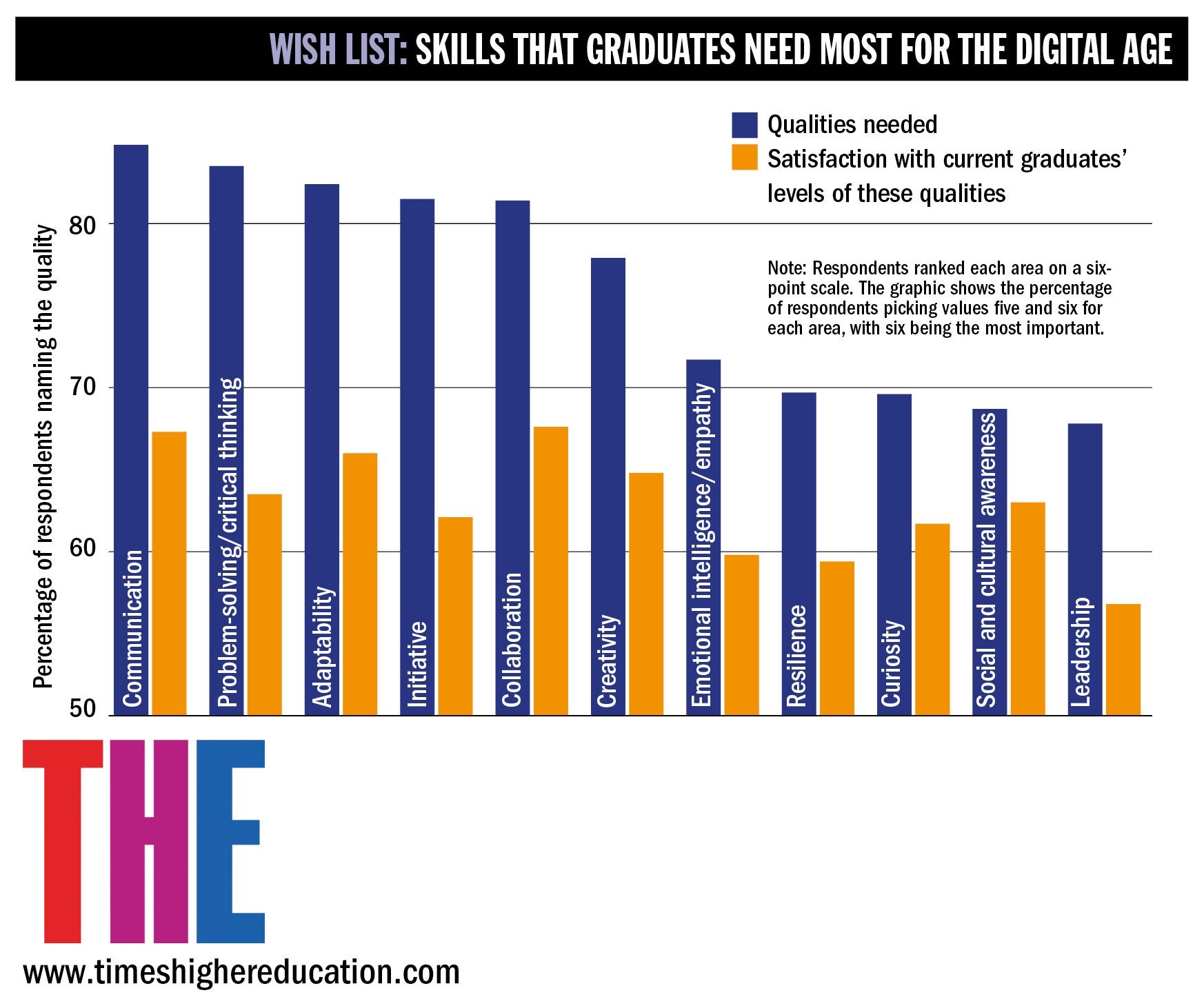
No doubt, this is frustrating for students, who I imagine may have buzzword fatigue. School Administrators and Ed Tech companies in particular love to hype critical thinking. And while there is ample evidence that suggests employers find critical thinking skills to be desirable, no similar evidence indicates that colleges and universities are delivering on their promise as such.

But of course, none of this is surprising when you take into account the history and evolution of public education in the United States. As it turns out, public schools continue to excel at what they were originally designed to do — they train obedient workers (not thinkers). The comedian George Carlin has a particularly famous riff one this (albeit it is very explicit), which you can check out on your own time on YouTube.

While education holds out great promise to be be an engine of social mobility in the United States, it remains deeply embedded in what sociologists refer to as the “social reproduction” of class privilege. This is why despite there being much evidence that attests to the ability of education to serve as a great engine to combat social inequality, there is similar competing evidence that suggests it can also reproduce and deepen pre-existing social inequalities.

One development that has contributed to the downfall of education in the U.S. in particular is the emphasis on testing and evaluation. This approach is far more rigidly ingrained in public schools, who have less autonomy than their private school counterparts to determine curriculum. Moreover, when testing does occur, its content and rigor are weighted heavily in favor of the middle classes and their offspring. The result is that the entire system of “objective testing”  is essentially rigged against working-class and poor students (for complex reasons that are too lengthy to discuss here).

In the interest of staying on point, let’s just say that middle and upper-class families with resources, who can help prepare their kids for exams in ways that less advantaged families can not. In the case of the former, kids benefit from access to private high schools and they have the money to pay for tutors and extra-curricular activities, all of which supports access and admittance to higher education institutions. They are more likely to benefit from curricula in private schools that are more comprehensive and flexible (they’re not narrowly focused on testing), making it easier to teach those students critical thinking and leadership skills.

As a college professor, I work on the front lines where I am a witness to what our education system produces. I have seen changes occur over the years that trouble me. For one, I notice that an increasing number of high school graduates who enter my classroom exhibit difficulty expressing themselves clearly in speech and in writing. They similarly struggle when they attempt to execute what appear to me to be basic intellectual tasks (i.e. independently read a syllabus). Many of these same students could not pass a basic argument literacy test.

Even more concerning, there are relatively few students who can distinguish the difference between fact vs. opinion; they can’t tell you how science differs from non-science, or how natural science differs from social science, and so on down the line. “Fake News” barely scratches the surface in describing the problems that exist with media and information literacy in our present-day social landscape.

Put it different terms, critical thinking – defined more broadly as abstract reasoned thinking – has become an unfortunate casualty of the era of standardized testing. Testing regimes privilege memorizing facts and learning how to play word analogy games as a way to measure and assess “knowledge.”

What if I were to tell you that real life is not going to present you with options that are consistent with the choices presented on standardized tests? What if you took a class with me and I told you that I wasn’t going to test and grade your memorization skills? The latter should feel liberating, but students often feel intimidated because they haven’t been taught to think in a rational disciplined way.

Some of you, I hope, are nodding your heads in agreement, having already experienced the utter pointlessness of the test-taking trap. I imagine you  have always sensed this. You knew something wasn’t right. But what could you have done to resist? Sadly, not too much.

When people are forced to forego more substantive approaches to education in order to play intellectual word games, they will at some point be left out in the cold. Their desire to learn will at some point become blunted and thus their learning potential will not be fully realized; they won’t be able to develop the thinking “muscles” required to engage in abstract reasoning (or they will become easily exhausted when they try).

Absent  critical thinking skills, students will be ill-equipped to question and challenge the status quo. They may even give up on the idea of education altogether and quit as soon as they are able to work. Sneaky, yes? This is how obedience and conformity are learned, as resistance appears to be futile.

Rather than engaging in a fully developed critical analysis (which they most likely have not been taught how to make), students compensate by investing time and effort into trying to figure out the “correct” answer to a given problem. This has been, in their experience, the tried and true path to make the grade and to be rewarded and recognized as a “good student.”

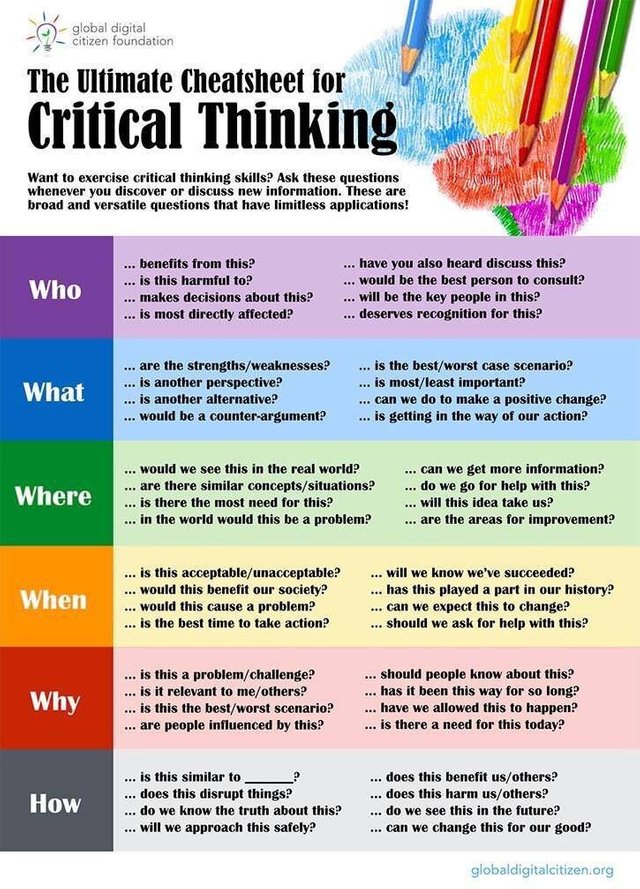
Image result for critical thinking

Another unfortunate result of the standardized approach to learning is that it encourages people to assign too much importance to their own thinking. Given how critical thinking skills are weakened/not developed, they sometimes cannot (will not) try to see problems objectively, as they prefer instead to rely on their own personal subjective “experiences.”

They trust their “gut” feelings and only that which they’ve seen with their own eyes because their reasoning skills are so poorly developed that they cannot think.

Given this, many students find it difficult to execute advanced learning tasks that require them to perform analysis/synthesis of information, as opposed to performing memorization and recall (they prefer the latter because they know how to do it).

All of this, for obvious reasons, can produce frustration. And as I mentioned already, it causes many young people to become cynical and give up pursuing education. Disinterested and discouraged, they are less likely to pursue advanced learning (like higher education). They might feel they are not smart enough and they may even harbor a residual resentment towards so called “experts.” They may go so far as to cultivate a preference for  media sources that tell them not to value expert knowledge.

That being said, I would be remiss if I didn’t call attention to the fact that everything that I just described here remains the students’ problem to solve (which seems unfair right?). In light of this, we have to do some work together to address where we go from here. But first, let’s examine some of the specific pitfalls that get in the way of critical thinking. The path is a bit long and winding. Along the way, we’ll look at some famous sociologists who called attention to these  problems and proposed solutions.

Binary Thinking

Binary thinking distinguishes an approach to problem conceptualization  that reduces problems to two competing sides in order to arrive at a simple truth (i.e. right vs. wrong, left vs. right, liberal vs. conservative, pros vs. cons, good vs. evil). This framework tries to impose order and control on problems that are, more often than not, complex, nuanced, and dynamic.

A derivative of binary thinking is what has come to be known in our contemporary moment as “both sides” journalism. This is the favored thought paradigm of the television era, where the best examples of this can be found on 24-hour cable news programming. The stars of these shows are pundits and talking heads who take two sides of an issue/problem and get into heated arguments with each other. Conflict is the “spice” that enlivens  entertainment presented as information.

This development in our media landscape has been exacerbated by the proliferation of online news and political opinion outlets, including social media.  As one study put it:

“this raises concerns anew about the vulnerability of democratic societies to fake news and other forms of misinformation. The shift of news consumption to online and social media platforms has disrupted traditional business models of journalism, causing many news outlets to shrink or close, while others struggle to adapt to new market realities. Longstanding media institutions have been weakened. Meanwhile, new channels of distribution have been developing faster than our abilities to understand or stabilize them” (Baum et. al. 2017).

It further calls into question the notion that American journalism should operate on the principle of objectivity. In the contemporary era, we have seen a noticeable shift, where journalists who once endeavored to be dispassionate about the subjects they cover, now operate like neutral referees in a cage fight.

In taking pains not to take sides, they “both sides” every topic, where they contrive a match-up of two distinctly opposed sides of a given issue. But here is where the danger lies: in the process of doing so, they confirm each side has equal weight (false equivalency). That they do this, even in cases where one of those sides represents an extreme or fringe view (or simply a view that has been shown to be nonfactual/disputed by evidence), is plainly absurd. The result is that people with an appetite for conflict, dogma, and ideological thinking are left vulnerable to manipulation.

Illustration:

Do you believe in one or both sides of the flat vs. round earth debate?

Do you believe that there are two sides to every problem?

Do you believe that both sides have their own facts?

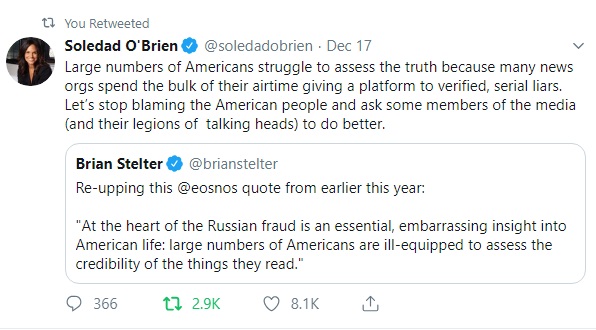
Again, while all of this might seem pointless if not ridiculous to many people, there are many in our society for whom this kind of thinking makes perfect sense. A large number of Americans have been ill-served by our corporate media. Their approach to discussing major social issues and problems is either so simplistic that it serves no particular value, or they give up, portraying problems as too difficult to solve.

The “all problems have sides” approach remains particularly problematic, for reasons that it is intellectually dishonest. Even worse, this framing has become normalized in our public discourse. Juxtaposing a liar opposite to an ethical professional, as if the two represent two legitimate sides in a debate, is a farce.

The Baum study authors conclude that the cognitive, social and institutional constructs of misinformation are complex and that we must be vigilant and seek input from a variety of academic disciplines to solve the problem, as the “current social media systems provide a fertile ground for the spread of misinformation that is particularly dangerous for political debate in a democratic society” (Baum et. al. 2017).

Jay Rosen, a journalism professor at New York University, points out: “The whole doctrine of objectivity in journalism has become part of the [media’s] problem” (Sullivan, 2017). When journalists use binary constructs to create structural and moral false equivalency, they become complicit agents, who undermine truth and understanding. All of this is a predictable outcome, given that understanding was never the goal here – manufacturing conflict is the aim of the game. These news programs don’t exist to inform you; they’re here to entertain you and sell advertising.

A better and infinitely more responsible approach would be to report things fairly, accurately, and comprehensively. Journalists might further acknowledge their biases upfront instead of trying to exist in a magical bias free-zone.

One of the problems that we are left with here, even when we aim to do better, is that sharing factual data with the public does not always change strongly-felt but erroneous views that conflict with people’s personal beliefs and feelings (facts being immaterial).

Image result for stop saying I feel like

“I feel like” and Using the Personal Pronoun “I”

Ever notice how often a problem comes up for conversation or discussion and instead of addressing the problem objectively people respond by saying something like “yes, but I feel like” and they proceed to relate the problem to their own personal experiences? Notice how those same people are more committed to defending their feelings much harder than facts?

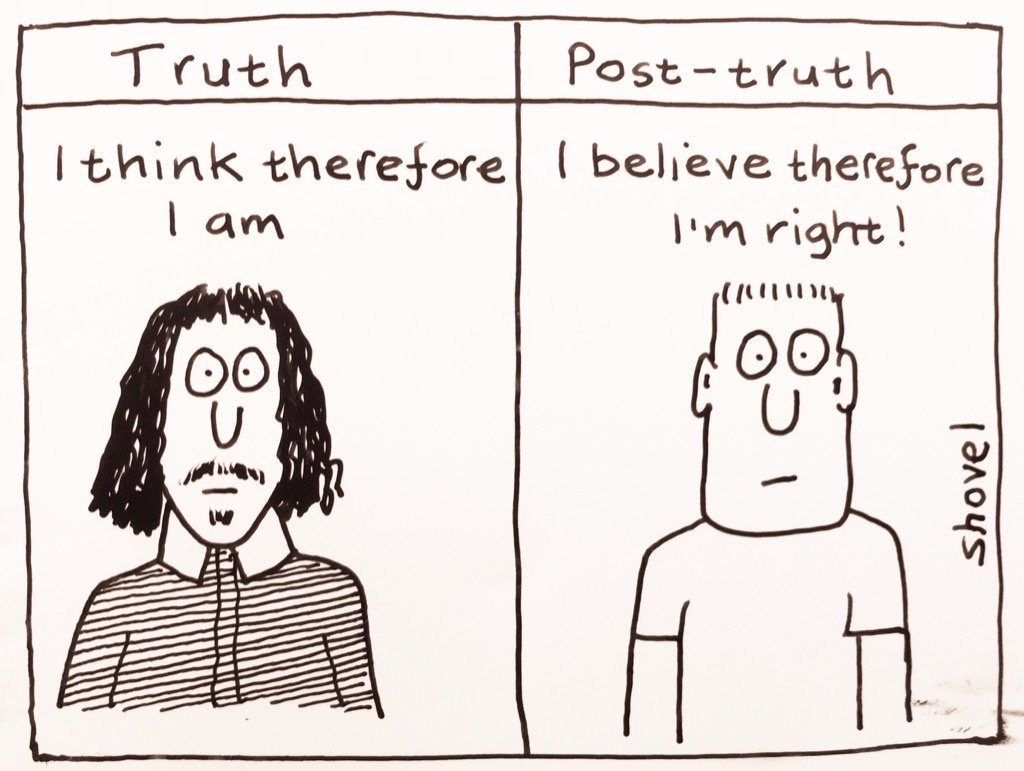
Lots of people do this. Yet to be frank, the very act of centering knowledge about a subject it within the cozy confines of one’s “feelings” is a subtle form of narcissism; one that lets the individual side-step a controversial issue, diverting attention instead to subjective feelings. Expressing “big feelings” doesn’t help advance knowledge about a topic. Worse, it defaults to a subject that one is more comfortable talking about – their self!

To be fair, I am not at all surprised that my students default to this, considering how many of them have come of age in a time of divisive politics and political polarization. No one should blame them for wanting to back away from confrontation (Worthern, 2016).

In North American English, “I feel like” and “I believe” have in the last decade come to stand in for  “I think” (Worthen, 2016). Sociologist Charles Derber describes this tendency as “conversational narcissism.” Often subtle and unconscious, it betrays a desire to take over a conversation, to do most of the talking, and to turn the focus of the exchange to yourself (Headlee, 2017).

To illustrate, people say things like “I feel X about XYZ problem.” What would be better is for them to say something like: “I think, based on XYZ evidence, that the idea of X appears to be supported.”  In the case of the latter, the speaker “de-centers” themselves (emphasizing evidence and conclusions, not personal beliefs) and uses objectified scientific language.

Note: if you are taking my courses and writing formal papers, you will need to demonstrate to me that you can write using objectified scientific language.

Worthen points out that when we use language like “I feel like” we are playing a trump card.  And that’s because when people cite feelings or personal experience, “you can’t really refute them with logic.” Why not? Because that’s like saying they didn’t have that experience or that their experience is not valid. “It halts an argument in its tracks” (Worthen, 2016).

The recourse to feelings is problematic because you are limiting what you can discuss/engage within the narrow confines of your own personal experience. This is not a solid ground upon which you can build knowledge of a subject; subjective perspectives and personal “feelings” are not frameworks that facilitate the analysis of complex problems.

I write this with full knowledge of the fact that there are, of course, long-standing debates in the social sciences about objectivity and the role value judgments play and, more importantly, about whether or not value-laden research is possible and even desirable. In his widely cited essay “‘Objectivity’ in Social Science and Social Policy,” Max Weber argued that the idea of an “aperspectival” social science was meaningless (Weber 1904a [1949]).

Nevertheless, in the spirit of compromise, I would argue that we are well served when we can simultaneously reflect on how our personal experiences/feelings connect to a problem we are trying to understand, even as we aspire to think about those problems critically. The ethic that guides us here should be to cultivate a degree of professional detachment from what we are studying, while also acknowledging our biases. Trust me when I say this – it’s hard. And that’s okay.

Political Thinking vs. Critical Thinking

With the advent of 24-hour cable news, young and old alike have become enthralled by the theatrical banter of entertainment news media, which thrives on conflict and encourages demagoguery as part of the process of discussing important social issues.

Political thinking, such as what we often see featured in our MSM (mainstream news media) can contribute to the cultivation of a closed mindset; one that is rigid, dogmatic, defensive, and most of all not critical (to be sure, there is plenty of criticizing – but that’s different from how I am using the term “critical”).

This process of relying on entertainment media to become “informed” has proven to be deeply satisfying for many people. Politics, is in many respects, a performance that is experienced like a “television show.” People have their favorite characters, as political news is both rendered and experienced like a “story.” That it sometimes “informs” is merely tangential to the process.

Some experts have speculated that our media have become addictive. This is because political parties and our MSM all traffic in audience-tested (focus group) simple frameworks – sound bytes – that operate like intellectual short-cuts. They encourage simple solutions to complex problems that help give people a feeling of control that is connected to a deeply held desire/belief that they understand everything. And so it follows, people don’t have to think very hard. And guess what – that’s attractive to many people!

A perfect example of this is when a person accepts a political party’s full roster of beliefs, which is often coupled with a tendency to defend all of its policy positions. This is not at all unlike being a sports fan and rooting for a sports team. The ongoing contest between the Democrats and Republicans is in many ways similar to the Steelers and Ravens rivalry. Such thinking, oddly enough, shares common elements with religious belief (see Durkheim below). Again, you don’t have to think very hard about the issues. Rather, you simply need to identify with and support your team.

Not surprisingly, individuals who desire political affinity are attracted to people who hold their same views.  As long as they stay within the confines of their social group, their views won’t be challenged, they can feel like they are “in the know,” and they almost always “get to be right.” 

Identity confirming behavior like this further generates strong feelings of belonging, which may, in some instances, constitute a vital aspect of a person’s self-concept. In this instance, confirming social identity is more important than exercising rationally informed, independent, critical thinking! Mind blown!

The powers of affinity that drive identity politics are powerful precisely because they enable individuals to solidify their social group membership when they identify with issues and problems in conforming ways that mirror party-line thinking. The attraction here – and I can’t emphasize this enough – is that political thinking helps people to not feel alone; in sacrificing their independence to the group, they relieve themselves of the burden of thinking on their own.

One interesting issue that I want to call attention to is the case where people are forced to confront information that they cannot reconcile with their deeply-held political beliefs. This conflict is identified by psychologists, who study it, by the term cognitive dissonance.

Cognitive dissonance usually involves feelings of discomfort that most of us would prefer to avoid. In order to reconcile the mental discomfort and to restore balance, people with strong political beliefs may actively resist and dismiss critical facts and information that conflict with their cultivated worldview.

Critical Thinking in the Social Sciences

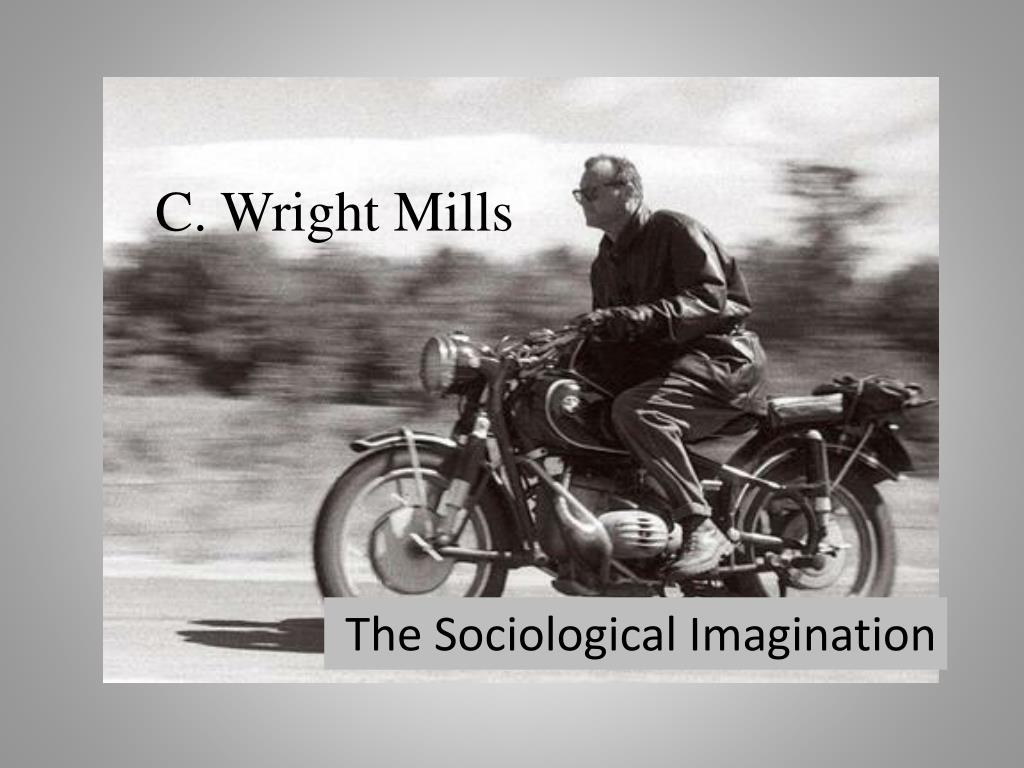
C. Wright Mills & the Sociological Imagination

The American sociologist, C. Wright Mills, coined the term the “Sociological Imagination” in his 1959 book of the same title to describe a type of critical insight that could be offered by the discipline of sociology. The term itself is often used in introductory sociology textbooks to explain how sociology might help people cultivate a “habit of mind” with relevance to daily life; it stresses that individual problems are often rooted in problems stemming from aspects of society itself. 

Mills intended the concept of the sociological imagination to describe “the awareness of the relationship between personal experience and the wider society.” More specifically, he intended the concept to help people distinguish “personal troubles” and “public issues.” To this end, an individual might use this cultivated awareness to “think himself away” from the familiar routines of daily life. We will use this concept in our work together to critically think about social issues and problems.
Personal troubles are problems that affect individuals, where other members of society typically lay blame for lack of success on the individual’s own personal and moral failings. Examples of this include things like unemployment/job loss, eating disorders/overweight, divorce, drug problems.
Public issues find their source in the social structure and culture of a society; they are problems that affect many people. Mills believed it is often the case that problems considered private troubles are perhaps better understood to be public issues.

Let’s take Mills example of unemployment. If it were the case that only a couple of people were unemployed, we could then perhaps explain their unemployment by saying they were lazy, lacked good work habits, etc.  That is to say, their unemployment would be their “personal trouble.”  To be sure, there are some unemployed individuals who are no doubt lazy and/or lack good work habits. Notwithstanding, when we find millions of people are out of work, unemployment is better understood as a public issue. Which is to say, a structural explanation that looks at the lack of  opportunity in connection with the economy is better suited to explain why so many people might be out of work. (Mills, 1959, p. 9). 

By following Mills and developing a sociological imagination, people might develop a deep understanding of how one’s personal biography is the result of a historical process. Everyday experiences are connected to a larger social context.

Individual vs. the Social (Agency vs. Structure)

The root of a given problem, according to Mills, is almost always found in the structure of the society and the changes happening within it. Put another way, Mills is saying that many of the problems individuals confront in society have social roots. Moreover, the problems that people assume are theirs and theirs alone are, in reality, shared by many other people. This is why sociologists spend so much time trying to illustrate the  sociological roots of problems, because it helps people to understand how their biography is linked to the structure and history of society.

So why do we bother with all of this? Well, for some of us (researchers included), it is because we want to empower individuals to transcend their day-to-day personal troubles, to see how they are public issues and in the process help facilitate social change.

Let’s look at a practical illustration. Take, for example, a person who can’t find a job, pay the mortgage, pay the rent, etc. These are problems that are typically (and sadly) often seen to be the result of a personal failing or weakness. The individual is thought to be the cause of their own problem due to some failure or error.

In the same manner, unemployment can be an extremely negative private experience. Feelings of personal failure are common when one loses a job. Unfortunately, when the employment rate climbs (any number about 6 percent is considered high in the United States) people often see it as the exclusive result of a character flaw or weakness, not the result of larger and more overwhelming structural forces.

Now, for the record, Mills is not arguing that individuals are never responsible for some of their own problems – that they don’t have the ability to make choices, even bad ones, or that they that they have no personal responsibility for their actions. It’s just that many of their decisions don’t occur in a void. They are socially structured.

The same holds true for people who commit crime. Rather than focusing only on individual pathology alone, we should also look at the social and political context within which crime occurs. That is, we need to look at the role that structure plays in determining who commits a crime and who becomes a victim of crime.

Mills would ask: is there is something within the structure of society that is contributing to the problem?

As it turns out, the answer is often YES! In many countries today, unemployment may be explained by the public issue of economic downturn (deindustrialization), caused by industry failures (mortgage, banking, manufacturing). In other words, the problem is social and institutional – not simply the result of the personal shortcomings of one person or a group of people not working hard.

Again, this is why it is important to distinguish that Mills is not saying people shouldn’t work hard. The sociological imagination should not be used as an excuse for an individual to not try harder to achieve success in life, or for people to not claim some measure of personal responsibility for their problems.
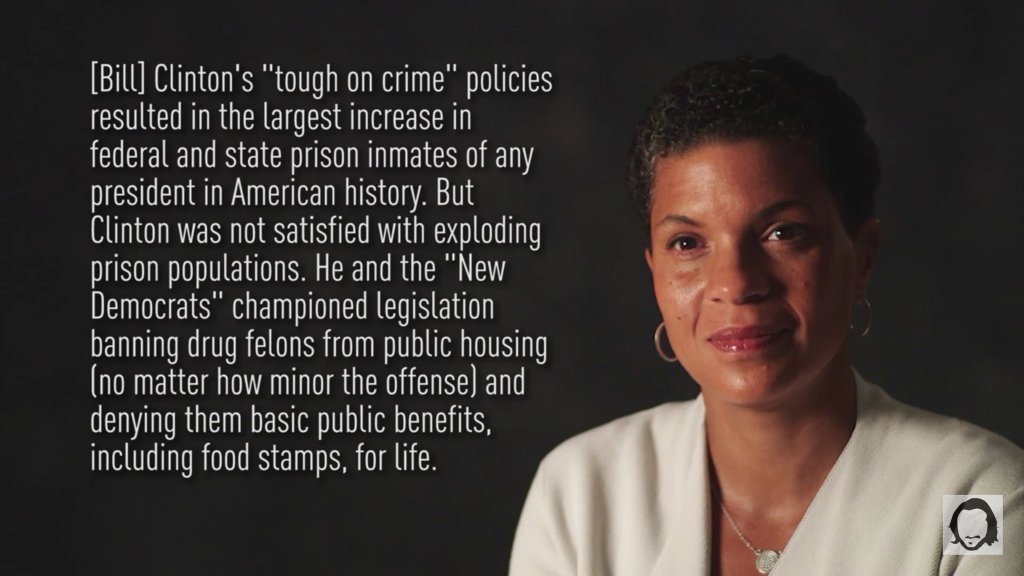
Rather, what Mills is saying is that in many situations a person may fail even if they try to do everything right, work hard, go to school, get a job, etc.

When it appears that many people or social groups in society lack the ability to achieve success, instead of being quick to assign blame, Mills says we should dive in and identify the roots of the structure, such as inefficient political solutions, the racial, ethnic, and class-based discrimination of groups, and the exploitation of labor forces.

We should all be reminded that there are problems that cannot be solved by individuals alone (by individuals working harder).

In light of this, it is important that we use our sociological imagination and apply it in our daily lives, this way we might be able to change our personal situation and in the process create a better society.

Emile Durkheim (note: this passage about Durkheim is reblogged here from an article by Galen Watts sourced below)

Globally, we are currently experiencing tremendous social and political turbulence. At the institutional level, liberal democracy faces the threat of rising authoritarianism and far-right extremism. At the local level, we seem to be living in an ever-increasing age of anxiety, engendered by precarious economic conditions and the gradual erosion of shared social norms. How might we navigate these difficult and disorienting times?

Emile Durkheim, one of the pioneers of the discipline of sociology, died just 101 years ago this month. Although few outside of social science departments know his name, his intellectual legacy has been integral to shaping modern thought about society. His work may provide us with some assistance in diagnosing the perennial problems associated with modernity.

Whenever commentators argue that a social problem is “structural” in nature, they are invoking Durkheim’s ideas. It was Durkheim who introduced the idea that society is composed not simply of a collection of individuals, but also social and cultural structures that impose themselves upon, and even shape, individual action and thought. In his book The Rules of the Sociological Method, he called these “social facts.”

A famous example of a social fact is found in Durkheim’s study, Suicide. In this book, Durkheim argues that the suicide rate of a country is not random, but rather reflects the degree of social cohesion within that society. He famously compares the suicide rate in Protestant and Catholic countries, concluding that the suicide rate in Protestant countries is higher because Protestantism encourages rugged individualism, while Catholicism fosters a form of collectivism.

What was so innovative about this theory is that it challenged long-standing assumptions about individual pathologies, which viewed these as mere byproducts of individual psychology.

Adapting this theory to the contemporary era, we can say, according to Durkheim, the rate of suicide or mental illness in modern societies cannot be explained by merely appealing to individual psychology, but must also take into account macro conditions such as a society’s culture and institutions.

In other words, if more and more people feel disconnected and alienated from each other, this reveals something crucial about the nature of society.

The Shift from Premodern to Modern

Born in France in 1858, the son of a rabbi, Durkheim grew up amid profound social change. The Industrial Revolution had drastically altered the social order and the Enlightenment had by this time thrown into doubt many once-taken-for-granted assumptions about human nature and religious (specifically Judeo-Christian) doctrine.

Durkheim foresaw that with the shift from premodern to modern society came, on the one hand, incredible emancipation of individual autonomy and productivity; while on the other, a radical erosion of social ties and rootedness.

An heir of the Enlightenment, Durkheim championed the liberation of individuals from religious dogmas, but he also feared that with their release from tradition individuals would fall into a state of anomie — a condition that is best thought of as “normlessness” — which he believed to be a core pathology of modern life.

For this reason, he spent his entire career trying to identify the bases of social solidarity in modernity; he was obsessed with reconciling the need for individual freedom and the need for community in liberal democracies.

In his mature years, Durkheim found what he believed to be a solution to this intractable problem: religion. But not “religion” as understood in the conventional sense. True to his sociological convictions, Durkheim came to understand religion as another social fact, that is, as a byproduct of social life. In his classic The Elementary Forms of Religious Life, he defined “religion” in the following way:

“A religion is a unified system of beliefs and practices relative to sacred things, that is to say, things set apart and forbidden — beliefs and practices which unite into one single moral community called a Church, all those who adhere to them.”

The Sacred and the Quest for Solidarity

For Durkheim, religion is endemic to social life, because it is a necessary feature of all moral communities. The key term here is sacred. By sacred Durkheim meant something like, unquestionable, taken-for-granted, and binding, or emitting a special aura. Wherever you find the sacred, thought Durkheim, there you have religion.

There is a sense in which this way of thinking has become entirely commonplace. When people describe, say, European soccer fans as religious in their devotion to their home team, they are drawing on a Durkheimian conception of religion. They are signaling the fact that fans of this nature are intensely devoted to their teams — so devoted, we might say, that the team itself, along with its associated symbols, are considered sacred.

We can think of plenty of other contemporary examples: one’s relationship with one’s child or life partner may be sacred, some artists view art itself — or at least the creation of it — as sacred, and environmentalists often champion the sacrality of the natural world.

The sacred is a necessary feature of social life because it is what enables individuals to bond with one another. Through devotion to a particular sacred form, we become tied to one another in a deep and meaningful way.

This is not to say that the sacred is always a good thing. We find the sacred among hate groups, terrorist factions, and revanchist political movements. Nationalism in its many guises always entails a particular conception of the sacred, be it ethnic or civic.

But, at the same time, the sacred lies at the heart of all progressive movements. Just think of the civil rights, feminist and gay liberation movements, all of which sacralized the liberal ideals of human rights and moral equality. Social progress is impossible without a shared conception of the sacred.

Durkheim’s profound insight was that despite the negative risks associated with the sacred, humans cannot live without it. He asserted that a lack of social solidarity within society would not only lead individuals to experience anomie and alienation but might also encourage them to engage in extremist politics. Why? Because extremist politics would satiate their desperate desire to belong.

Thus we can sum up the great dilemma of liberal modernity in the following way: how do we construct a shared conception of the sacred that will bind us together for the common good, without falling prey to the potential for violence and exclusion inherent to the sacred itself?

This question which preoccupied Durkheim throughout his entire life — remains as urgent today as ever before.

~ end blog post

Contrarianism is a Helluva drug – The Devil’s Advocate 

Playing the “Devil’s Advocate” (DA) is not a very good way to exercise critical thinking. That is because this particular approach to debate is premised on the idea that every intellectual idea can be explored through a discussion of its opposite.

One tell you will notice is that the DA often advocates for viewpoints that have already been discredited or ones they are not prepared to offer critical evidence to support (…and I might add here, often ones that they personally believe but they are embarrassed to say as much). 

This is a Game

The devil who proposes a game of “Devil’s Advocate” in a debate are actively circumventing/undermining critical thinking under the guise of being reasonable; they’re playing a game and the goal of the game is to  “win.”

People who play DA are not helping to advance a discussion of a problem or situation. Even though they may profess an interest in political neutrality by evaluating “both sides” of an argument, what they are doing with this pedagogical approach is indulging in binary thinking. Playing game of “point-counterpoint,” the DA aims to limit perspective (confining it to the two poles of the binary) even as they are pretending to open it up. And as it has already been pointed out, real problems that are worth solving are generally more complicated than “two-sides.”

I will concede one point here, however, which is that the Devil’s Advocate (DA) approach can be a legitimate debating tool if it helps integrate a perspective that is not being considered, where the aim is to get someone to consider new information. In this aspect, the DA might help if the goal is to help overcome ideas perceived to be one-sided and biased (Fabello, 2015).


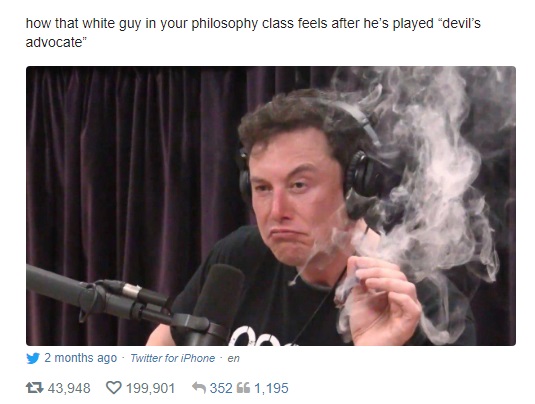
Righteous dude, Elon Musk, hits a blunt with Joe Rogan, while workers in his Tesla plant are subject to drug testing. Like Hegel before him, he is smart but he’s a walking contradiction (no one likes him either). Don’t be Elon.

Where groups of students are concerned, debate games are admittedly a good way to learn about a topic. This approach can help “juice up” classroom dynamics beyond what might be accomplished by a traditional lecture approach, as it gives give students an opportunity to compete,  inform, and have fun with each other.

Unfortunately, in real life, when the Devil’s Advocate shows up to argue, it doesn’t work out like this. The debate tends to play itself out and quickly becomes tiring for those relegated to the role of witness.

The Dialectics of the DA

The DA is a master of contradiction. Unfortunately, constant contrarianism does little to foster understanding of a problem. In a classroom it can be downright annoying for those forced to listen on the sidelines.

When the DA joins the debate, their true objective is to provoke conflict. Mistaking antagonism for skepticism and critical inquiry, the DA is often the consummate polished bully.

DA’s like zero-sum combat. Nothing delights them more than dragging a room full of spectators through seemingly endless, fruitless, and circular discussions, which ultimately never serve to help anyone change their point of view.

That’s why this approach cannot be dismissed as only a tiresome debate tactic; it’s far more than that – it’s a malignant thought paradigm that aggressively works to shut down critical thinking.

Reducing problems to two sides – the formula for a classic conflict   paradigm – is a Hegelian exercise in futility; it’s designed to wear you out. As a result, you may be tempted to give up on critical thinking and side with the bully in the room if only for reasons of wanting to avoid sheer exhaustion!

Image result for hegel and dialectics

The Devil in Disguise

A typical DA positions himself as a well-meaning “honest broker,” who merely wants to provide us with “the other side of the story.” To recap, DA thinking goes something like this: by arguing from an opposite, contrarian perspective, I will contribute a much needed missing perspective and help achieve a new level of understanding. 

Efforts are made to signal neutrality when discussing the topic at hand. Convinced of their own earnestness, the DA will often emphasize how they want to intelligently and rationally debate a topic (even if they have zero experience with the said topic). Sounds legit. But hold on. There’s more.

In some instances, a DA may go as far as to politely assert that viewpoints outside of their own are not wrong; they are just uninformed or misguided. No doubt, they are convinced they are flexing their critical thinking muscles when debating this way, as they attempt to wrestle people to the mat to  bring them around to accepting their simple truths. Sadly, this debate tactic screams bush-league; it’s high school-level debate.  Hint: this is why no one ever likes the devil’s advocate. 

In reality, DAs advocate for, and even perform to some extent, a combination of the following:

1) They advocate popular/ conventional “status quo” viewpoints.

2) They advocate polarized “contrarian” thinking.

3) They accuse others who don’t espouse their point of view of being biased.

4) They aim to shut down conversation and discourse – not add to it.

5) They aim to “mainstream” retrograde (out of favor) philosophies.

When I encounter the devil’s advocate, more often than not I find someone who is actively trying to interrupt and, in some cases, dominate my presentation of a problem/idea. But it’s not the fact that they asked me to consider new information that I find to be a problem; it’s their assumption (conceit) that I did not already consider alternative ideas before making my presentation. It’s as if they are telling me they don’t trust my ability to evaluate research and think critically (Fabello, 2015).

Gender & the DA

Shutting down conversation and discourse with debate tactics does not add to learning; it subtracts from learning and that’s oppressive. Nevertheless, the DA is not one who gives up easily.

As is often typical with DAs, sometimes they will go so far as to accuse their debate partner of having a personal bias (even though it never seems to occur to them that they may also be biased). This happens a lot. Sadly, more often than not, it happens with men in particular [even sadder is the fact that men talking down to women remains a common classroom occurrence].

Journalist Melissa Fabello, explains: “men are used to living in a world that affirms and validates their experience as ‘the way things are’ and they are almost never are asked to consider those biases.” When they accuse others of being a victim of their own subjectivity they do so while proclaiming they are, in fact, the one who is demonstrating critical thinking (Fabello, 2015).

What the devil’s advocate offers, more often than not, are feelings and personal opinions stated with confidence, which are disguised as reasoned, conventional, contrarian positions. In a final act of projection, they tend to accuse the very people who are practicing critical thinking of offering personal opinions.

Unable to engage problem-solving based on the actual substance of research and evidence, the DA may resort (when they are at their laziest) to suggesting that the other person’s position or argument be dismissed. In keeping with this, they may go so far as to suggest we consider the radical position that we do nothing at all to solve the problem. 

It’s Easy to be a Devil’s Advocate

To put it simply, a DA is a performance artist; one who puts a lot of effort into telling people they are wrong. They are so obsessed with being rational, that they consistently mistake their own feelings for objective logic, on the basis that simply believing in rationality makes their feelings magically rational; thus, their logic system remains a closed circle – and they always get to be right!

Keep in mind that it’s easy to play the role of the Devil’s Advocate. It’s easy to be a contrarian and say “let’s  go to opposite land and look at the opposite of what you proposed.” You know what’s hard? Solving a problem. It’s far more difficult to say “yes, we may not be doing it right, so let’s try to think through some different approaches that will allow us to think about this problem from different perspectives and maybe do something new.” 

Just to be clear, I want to state for the record that debate and dissent are useful, valuable, and indispensable to the pursuit of knowledge;  dissent can help sharpen and sculpt our efforts to achieve knowledge and understanding. Unfortunately, many DA-type contrarians are not interested in these things.

Understanding different points of view, respecting people for those views, and still having the courage to advance your views based on evidence is the goal of rationally informed critical inquiry. The best of us study for years in order to learn about the efforts and approaches others have tried in the service of solving problems. Standing on the shoulders of giants, we look for ways to make a contribution to the research – that means we must do some heavy lifting first, where we evaluate the best ideas and research methods and subsequently devise a new plan to move the research forward. Success here is often achieved in small increments.
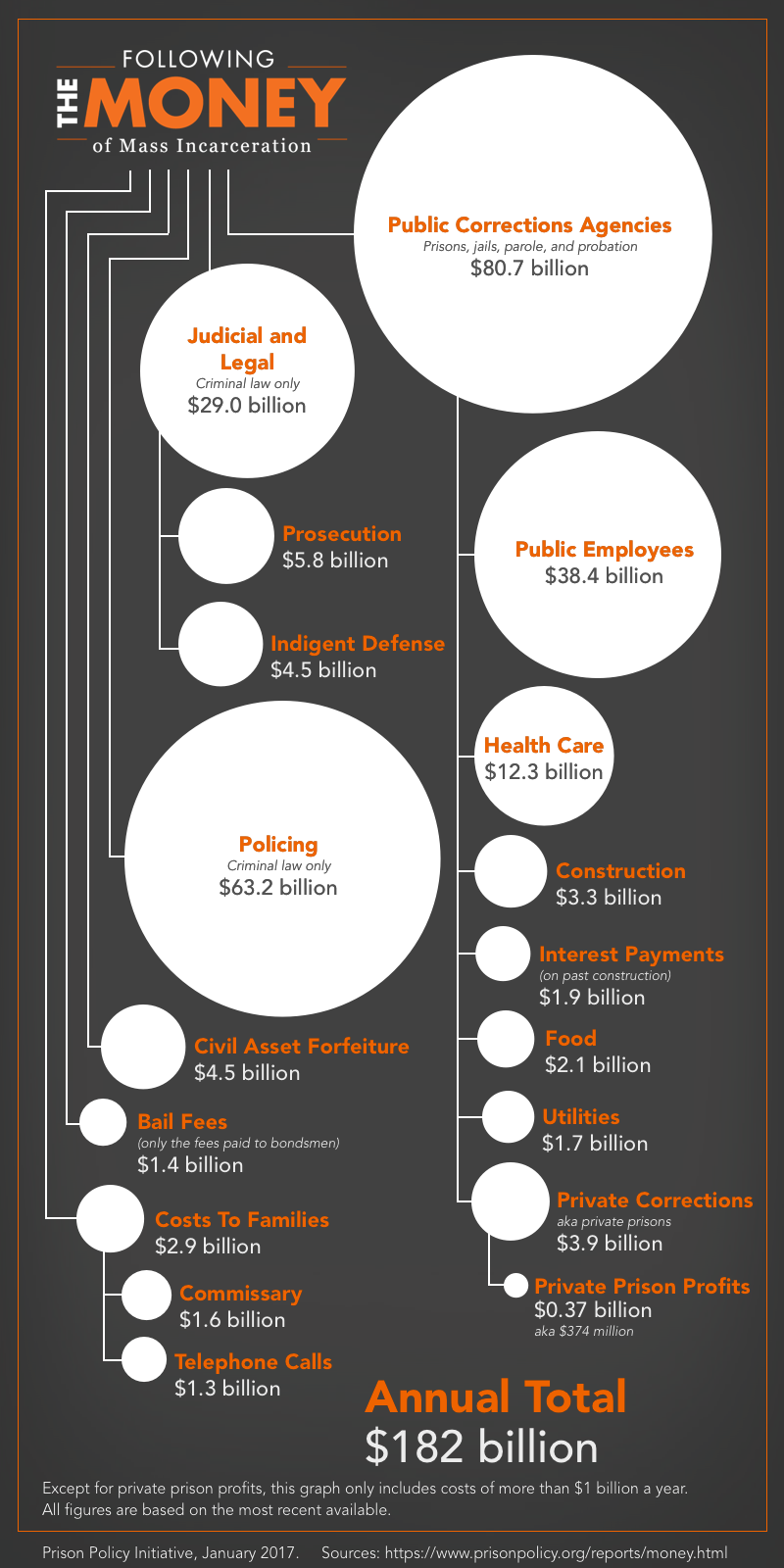
In the end, we may or may not make a significant contribution. But we try. Even if we are only one step closer to solving a problem that’s still something to be proud of. The point is that thinking critically about the different steps in the process, collecting the best data and evidence, and even revising our approach along the way is more important than winning a debate or scoring points in the court of public opinion.

Remember that knowledge isn’t a one-way street. The more you treat knowledge acquisition as a competition, the more annoying you’re going to be as a person. You’ll find you won’t gain more wisdom,. You won’t influence anyone with your ideas…and you probably won’t make any friends.

Being smart isn’t about gamesmanship and proving someone wrong; sometimes it’s about fostering agreement through disagreement while getting someone to see your side of it. Wisdom is ultimately less about pride and being correct and more about having empathy and building bridges to knowledge.

What is the Solution?

There are no simple answers. We must begin the process of rational inquiry by putting the problem in the center of our efforts to solve problems. By taking ourselves out of the equation and attempting to begin from neutral ground (some people argue all research is ME-search), we might then set about the task of asking a critically informed question.
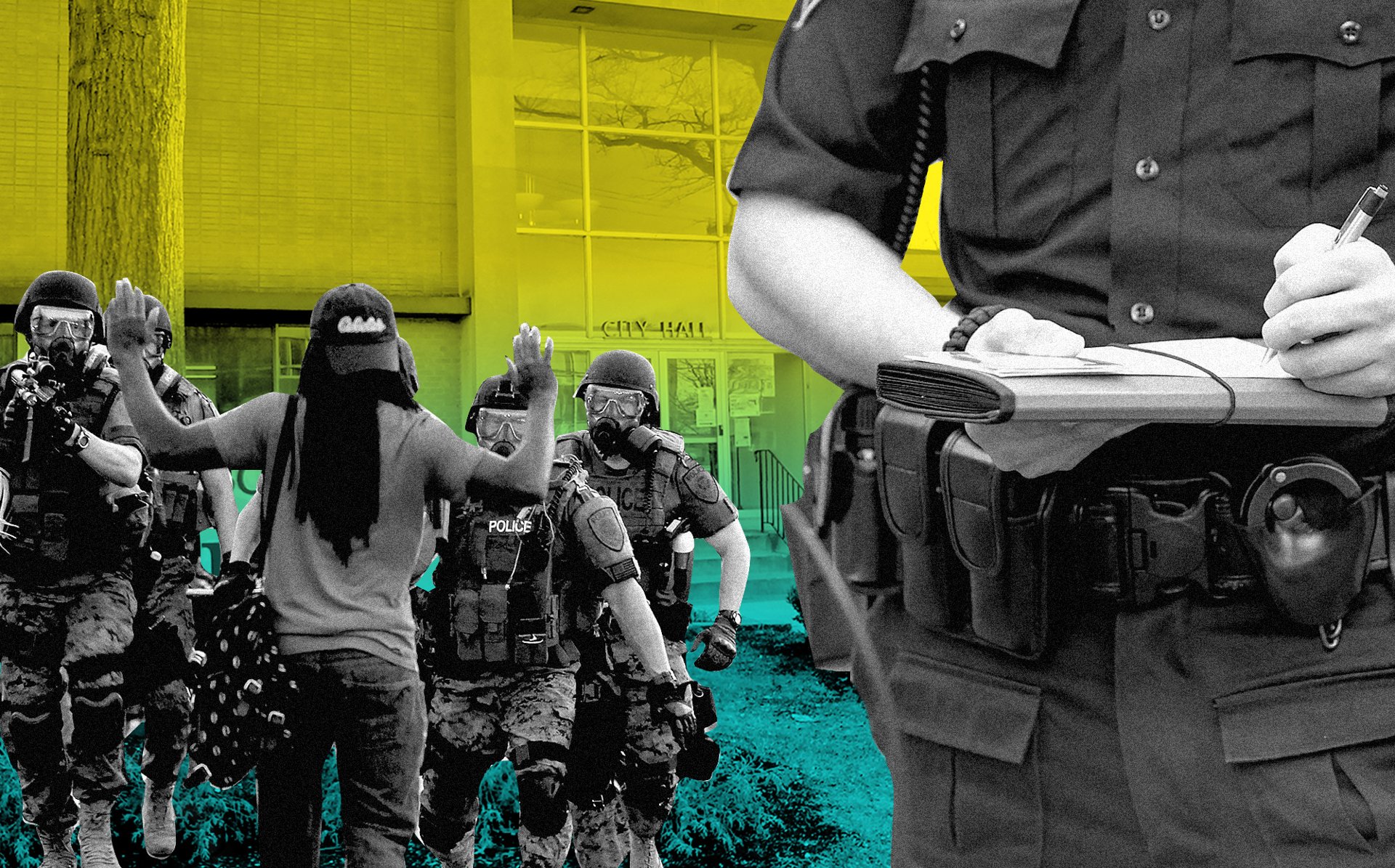
At this point, assuming there is intellectual curiosity, I hope we can move forward together to discover:

1) what experts have to say about problems; and

2) conceive of a plan (a research design) that can support the gathering of new data to advance understanding and suggest a solution to the problem.

Rinse and repeat as necessary.

Case Dismissed

It cannot be emphasized enough that this debating strategy is not driven by a desire to engage in rational inquiry to advance discourse and knowledge, even if it appears to do that. At its best, it’s an amusing parlor game. At its worst, it betrays an indication of disrespect. 

Summary

Critical thinking is more than a “buzz” term. It’s incredibly essential to one’s ability to exercise sound decision-making and function in modern complex societies. The pitfalls and barriers to critical thinking that were discussed here are important to distinguish because they are not only incredibly common, they are important as structures that govern how people understand the world around them – how they interpret their feelings and achieve agreement reality about important social issues and problems.  The thought paradigms that were discussed here are essential to how people develop logic systems and whether or not they can think; they have a profound impact on shaping everything that you know and what you think may be possible to know.

Finally, don’t avoid dissent. Don’t always seek out people who agree with you. Try to prove yourself wrong. Disagree. Debate. Admit mistakes. But be respectful.  Carve out time and space to consciously reflect. And never forget – if you are the smartest person in the room, you are in the wrong room!

Sources

“Pioneering Sociologist Foresaw Our Current Chaos 100 Years Ago,” by Galen Watts, 2018.

4 Things Men are Really Doing When They “Play Devil’s Advocate” by Melissa Fabello, 2015.

“Why We Should All Stop Saying ‘I Know Exactly How You Feel,’ “ by Celeste Headlee, 2017.

“Stop Saying ‘I Feel Like’ “ by Molly Worthen, 2016.

“Max Weber and Objectivity in Social Science”  

“This Week Should Put the Nail in the Coffin for Both Sides Journalism,” by Margaret Sullivan, 2017.

Discussion

What do you do when you have a certain understanding of what you know as Truth and others do not?

What do you do when others are operating under a belief system gained from what others have told them instead of basing their understanding on the knowledge of experts and/or research? Do you challenge them? Or do you “agree to disagree?” [Hint: do not concern yourself if others believe differently. Model what you are coming to know by means of accessing good sources of knowledge and information.]

When you were in high school did you feel prepared to take your exams? Did you do well on your exams? If you did not do well, how did this impact your interest in higher education and your assessment of whether or not you were “smart enough” to do well when you enrolled in college? 

How comfortable are you when it comes to discussing sensitive topics in the classroom? Do you ever feel intimidated by professors or classmates?

What would it take for you to feel more comfortable engaging in “difficult” types of conversations?


Course: Classical Social Theory, Criminology, Policing, Race & Ethnicity

Police Killings & Use of Force Research

48 Comments

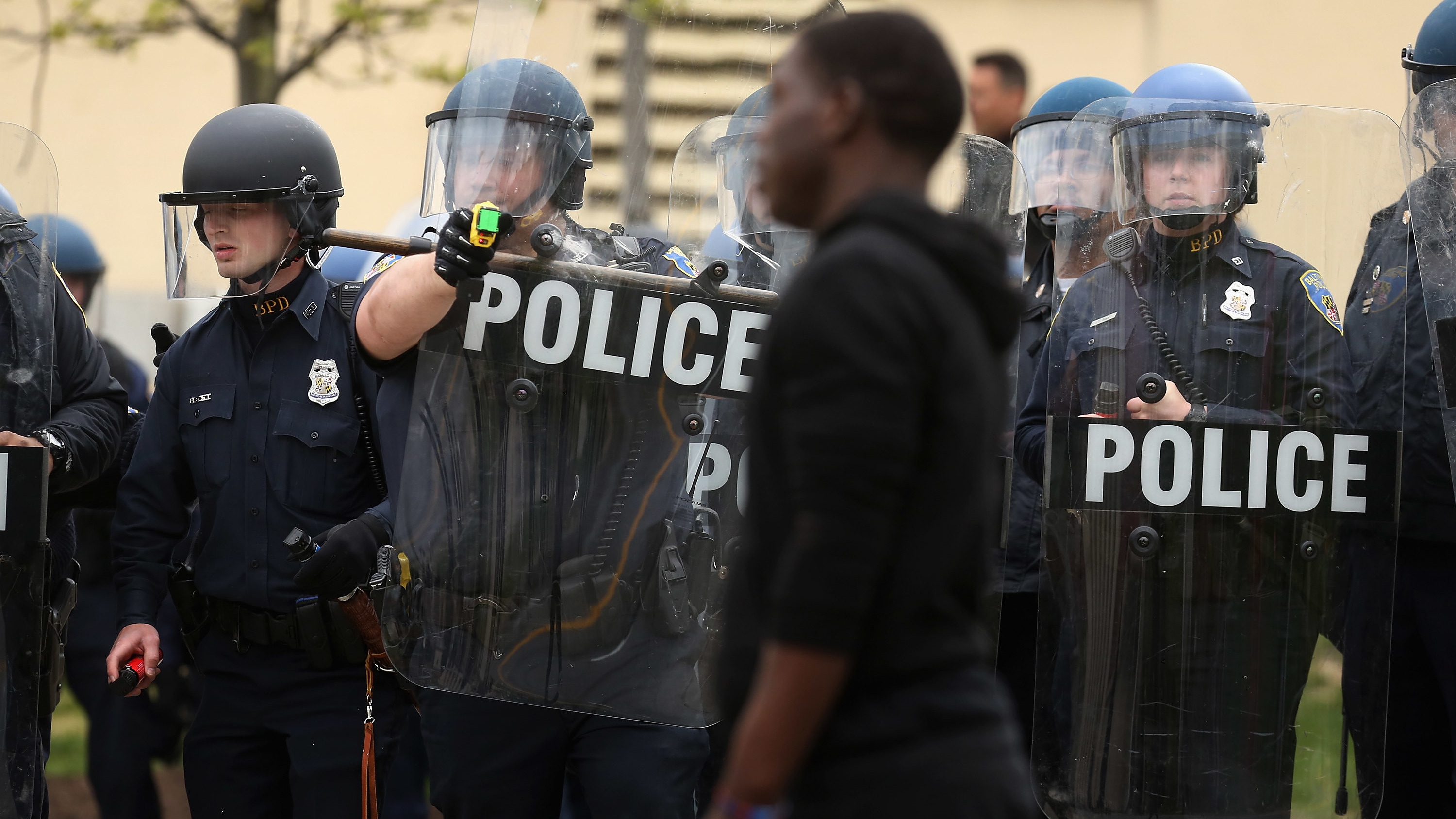
BALTIMORE, MD – APRIL 27: A Baltimore Police officer aims his taser at a demonstrator outside the Mondawmin Mall following the funeral of Freddie Gray April 27, 2015, in Baltimore, Maryland. Gray, 25, who was arrested for possessing a switchblade knife April 12 outside the Gilmor Homes housing project on Baltimore’s west side. According to his attorney, Gray died a week later in the hospital from a severe spinal cord injury he received while in police custody. (Photo by Chip Somodevilla/Getty Images)

To Kill or not to Kill?

Every time police officers are accused of killing a civilian — whether an officer shoots an unarmed man, as in the cases of Michael Brown, or an officer’s actions cause someone to die, as in the cases of Eric Garner or Freddie Gray — there are two questions that arise: Was it legal? and Was it appropriate? Often, what the public sees as appropriate force differs greatly from what police actually do in these situations (Lind, 2015).

The law gives police incredibly wide latitude to use force against civilians if they feel they’re under threat. In theory, it’s the job of police departments to come up with policies that hold cops to a higher standard for using force. And departments do give officers general instructions about using no more force than is necessary to resolve a situation, and trying to de-escalate situations before they turn into crises (Lind, 2015).

But when it comes to specifics — the training that officers are given and the policies they’re held to — departments don’t give clear instructions for what officers ought to do. Instead, for a variety of reasons, instructions focus on what cops can do. That creates a divide between police actions and the public’s perception of what is necessary or appropriate. And police officers themselves tend to feel that they should have even more flexibility in deciding when to use force, and how much force they can use, on civilians (Lind, 2015).

New Study on Police Use of Force

A new study has found that police kill twice as many people as reported in official statistics, and that black men are 3 1/2 times more likely to be killed by police than white men. The study, carried out by the University of Washington and Cornell University, used a variety of data sources and found that police officers are responsible for about 8 percent of all homicides of adult males in the United States – or about 2.8 homicides every day on average. However, official statistics released by the police departments themselves show a rate of less than 4 percent.

The study, published in the American Journal of Public Health, also shows that the risk of being killed by police is 3.2 to 3.5 times higher for black men than white men, and between 1.4 and 1.7 times higher for Latino men.

Researchers determined these probabilities with six years’ worth of data from a source that collects information from journalists, activists and researchers through public records and media coverage. This method is more reliable than police departments’ own reports, according to the federal Bureau of Justice Statistics. The study was led by Frank Edwards, a postdoctoral associate with Cornell’s Bronfenbrenner Center for Translational Research and co-authored by Michael Esposito, who did this work as a graduate student in sociology at the University of Washington. Hedy Lee, a former faculty member in the UW Department of Sociology who is now at Washington University in St. Louis, also contributed to the study.

Past research on police killings has been limited by the absence of systematic data, Edwards said. Such data, primarily collected through the Bureau of Justice Statistics’ Arrest-Related Deaths program or the FBI’s Supplementary Homicide Report, are widely acknowledged as unreliable due to the limited scope and voluntary data reporting.

“Police departments are not required by law to report deaths that occur due to officer action and may have strong incentives to be sensitive with data due to public affairs and community relations,” he said. “Effectively, we don’t know what’s happening if all we look at is the official data.”

Esposito, who is now a postdoctoral researcher at the University of Michigan, points to a 2014 article in ProPublica, which showed how some communities had not reported fatal shootings by police since 1997.

“Our ability to speak about police-involved deaths in the U.S. has really been hampered by shortcomings of official data sources,” he said. “We thought we could make a contribution here by just describing what police-involved homicides look like in our country.”

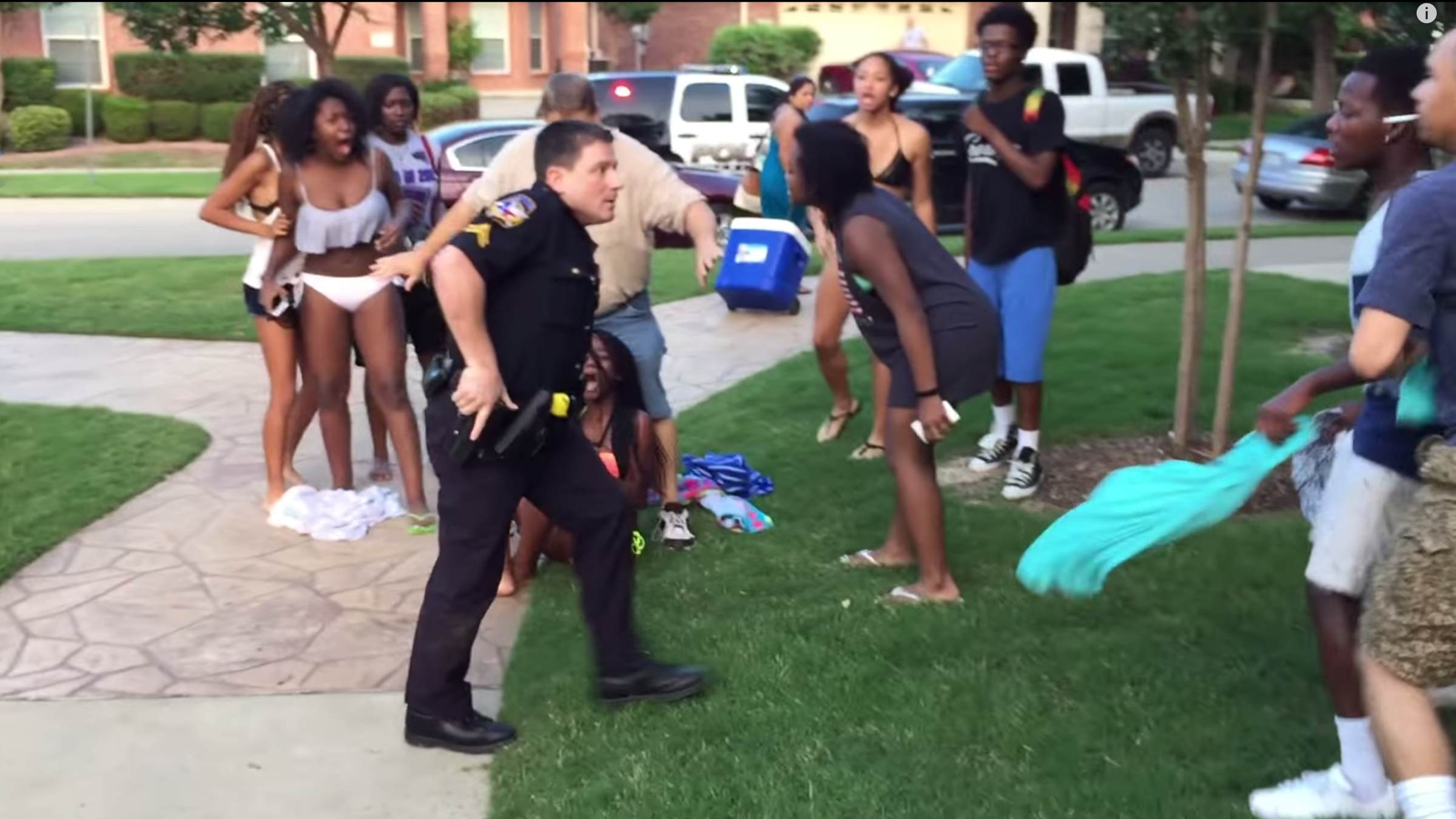
Eric Casebolt, a police officer from McKinney, Texas, wrestles a 14-year-old girl to the ground at pool party.

Research Methods & Findings

For the study, the researchers used public records and media reports to identify 6,295 adult male victims of police homicide over a six-year period between Jan. 1, 2012, and Feb. 12, 2018 — averaging about 1,028 deaths per year, or 2.8 deaths per day.

Of those 6,295 victims, 2,993 were white, 1,779 were black, 1,145 were Latino, 114 were Asian-Pacific Islander and 94 were American Indian-Alaska Native.

During the six-year period of the study, black men were killed at the highest rate: at least 2.1 per 100,000 men. Latino and white men had lower rates: 1 and 0.6, respectively.

In the Pacific region, which includes Alaska, California, Hawaii, Oregon, and Washington, black men in large metro areas were killed by police at a rate of 3.4 per 100,000, Latino men at 1.1 per 100,000, and white men at 0.9 per 100,000.

In Washington state, an average of a little more than three black men per 100,000 people are killed by police each year, compared to an average of about one per 100,000 among Latino men and fewer than one per 100,000 among white men.

Another surprising finding of the study was that the majority of police killings occur in less-populated regions outside large urban metro areas. “I think that there’s an idea that these events are constrained to large urban areas, but the data suggest that’s not the case,” Esposito said.

Policy Brutality is Good for Wall Street

When police use of force crosses the line into outright brutality, it is not only the victim who suffers – taxpayers are also paying a price. As the costs of police misconduct rise, cities and counties across the United States are going into debt to pay for it. Often this debt is in the form of bond borrowing. When cities, municipalities, or counties issue bonds to pay these costs, banks and other firms collect fees for the services they provide, and investors collect interest.

In light of this, the use of bonds to pay for settlements and judgments greatly increases the burden of policing costs on taxpayers, while producing a profit for banks and investors. Using bonds to pay for settlements or judgments can nearly double the costs of the original settlement. All of this is paid for by taxpayers.

These police brutality bonds quite literally allow banks and wealthy investors to profit from police violence. This is a transfer of wealth from communities–especially over-policed communities of color–to Wall Street and wealthy investors.

This is not a good public policy; it’s not good for citizens and it’s not good for cops, who lose respect in their communities and find their jobs are made more difficult and dangerous. Aside from it being morally wrong, these violent practices need to stop because they hurt everyone.

Reflection &Discussion 

What do you think about the statistics cited here?

Do you think that the police should be required to report use of force against the civilians (especially killings) to the UCR the same way that they report incidents of violence against police officers?

What do you think about taxpayers footing the bill for police violence? What might be done to change this?

Sources

KOMO News, Staff Report

“How Do Police Departments Train Cops How to Use Force?” Vox Media article by Dara Lind, 2015.

“How Wall Street Profits From Police Violence,” ACRE Report, by Alyxandra Goodwin, Whitney Shepard, and Carrie Sloan

Course: Policing

Inequality in the Criminal Justice System: A System of Racialized Social Control

20 Comments

Why Should I Care About Racial Social Inequality in the Criminal Justice System?

Race and racism are deeply entrenched in American society. To be more specific, systemic racism in America is a serious problem. Sadly, not everyone thinks its a problem. Others are more concerned about anti-white discrimination and problems that relate to the illegal immigration of people of color into the United States, which they associate with crime (pro tip: illegal immigration derives more from visa overstays than it does people running across desert borders – and the majority of those people arrive on airplanes; also, Americans commit more crime than immigrants). 

At any rate, this is not a topic that a lot of people feel comfortable talking about – even college students, in my experience, find it difficult to engage in conversations about social “structures” that they can’t see, as opposed to individual people and their decisions, which they feel they can see and have a better handle to grasp.

To be sure, social inequality in the criminal justice system might not be a problem that you believe affects you as an individual. But its a problem that ultimately affects everyone.

What is Mass Incarceration?

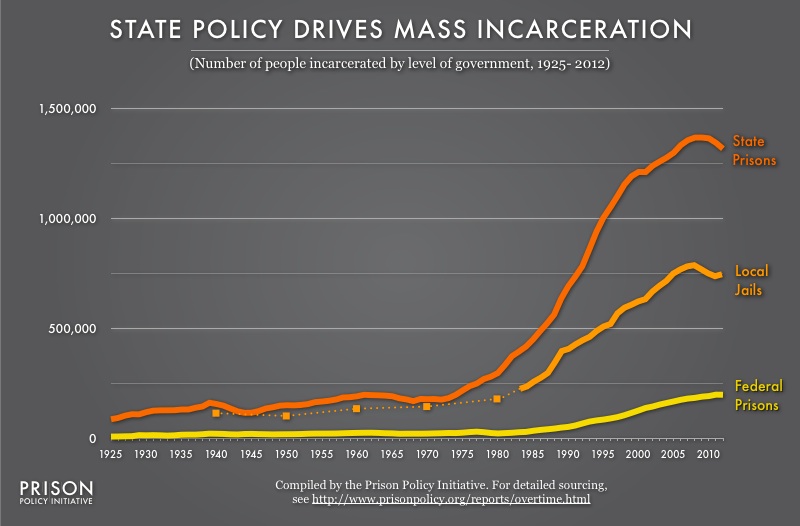
Mass incarceration has become so normalized in the American criminal justice system that unless you know someone who has been incarcerated, you probably don’t think much about it. Which is to say, it is not likely that you’ve paused long enough to think critically about how locking up so many people has become effectively normalized in the U.S., to the extent that it shapes almost everything about how you and many others perceive “what is a crime,”  “who is criminal,” “who is a citizen,” “who deserves rights,” and so on down the line.

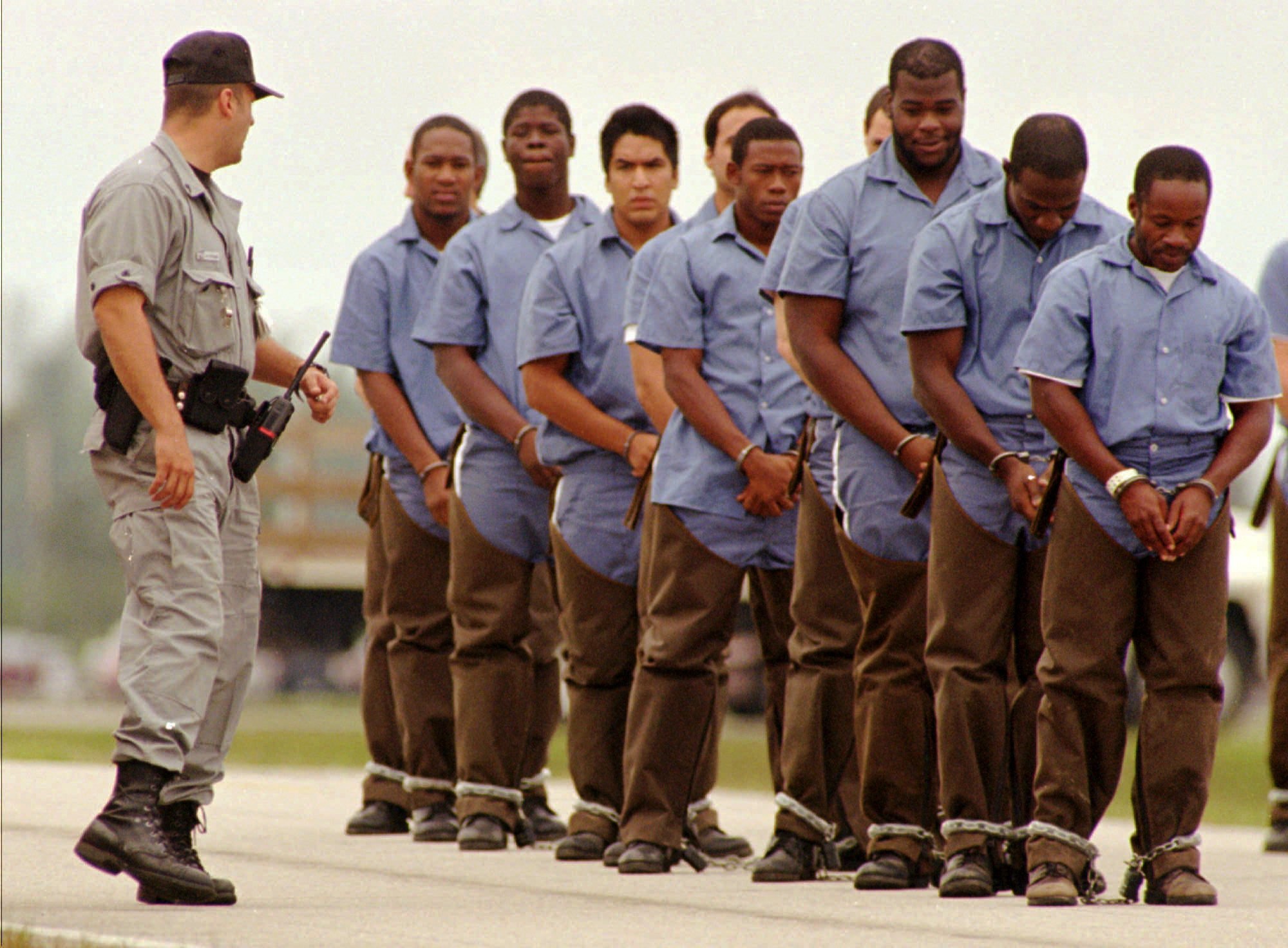
What does it mean to think critically about corrections? The term “mass incarceration” only scratches the surface. On the one hand, prisons are structures, like warehouses. More to the point, as critics have pointed out, they constitute a massive system of social control that is highly racialized, given how it primarily incarcerates disproportionate numbers of people of color.

To engage in critical thinking on this topic, you must step outside of your personal beliefs and experiences. Instead, you must engage your powers of abstract reasoning – which is to say you must think in terms of structures and institutions and how they function – not just individuals alone, the decisions they make, and the crime they do. This includes understanding how different policies, practices, and social processes are bound up together and produce what we have traditionally come to think of as “prison.”

Mass incarceration refers to the process by which people are swept into the criminal justice system and branded criminals and felons; they are effectively removed from society. Put another way, mass incarceration occurs because of “mass arrests.” In the United States, we lock up more people for small crimes and for longer periods of time than most all of the other countries in the world who incarcerate people. The crimes of the wealthy and powerful are not treated the same way as the crimes of poor people – not even close.

Prison barge, New York City, 2018

The consequences of this unfair system of justice are far-reaching and profound. When we remove people from their communities, warehouse them, and later release them, we consign them to permanent second-class/”underclass” status. Often, they are stripped of basic civil and human rights, like the right to vote, the right to serve on juries, and the right to be free of legal discrimination in employment, housing, and access to public benefits.

Probation officers, who are trusted to monitor previous offenders, too often are incentivized to play “catch and release” games, which have the effect of recycling people right back into the system they came from.

The Appalling Way the British Tried to Recruit Americans Away from Revolt -  HISTORY

British prison ship, circa 1700’s

This systematized activity calls into question the purpose of a system that aims to assert control over people from early ages so that virtually all aspects of their lives are put under scrutiny and surveillance, such that they are viewed as perpetual suspects for some kind of crime (Childress, 2014).

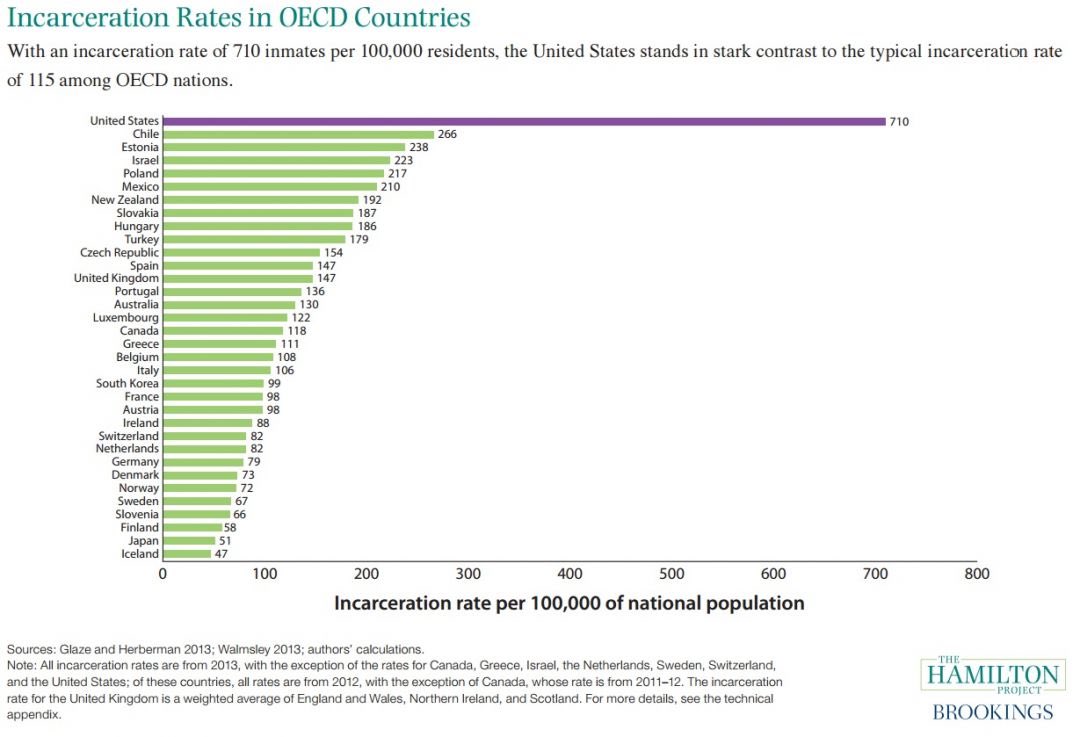
Check out the statistics that were recently published by the Organization for Economic Co-operation and Development (OECD). OECD is an intergovernmental economic organization with 38 member countries, founded in 1961 to stimulate economic progress and world trade.

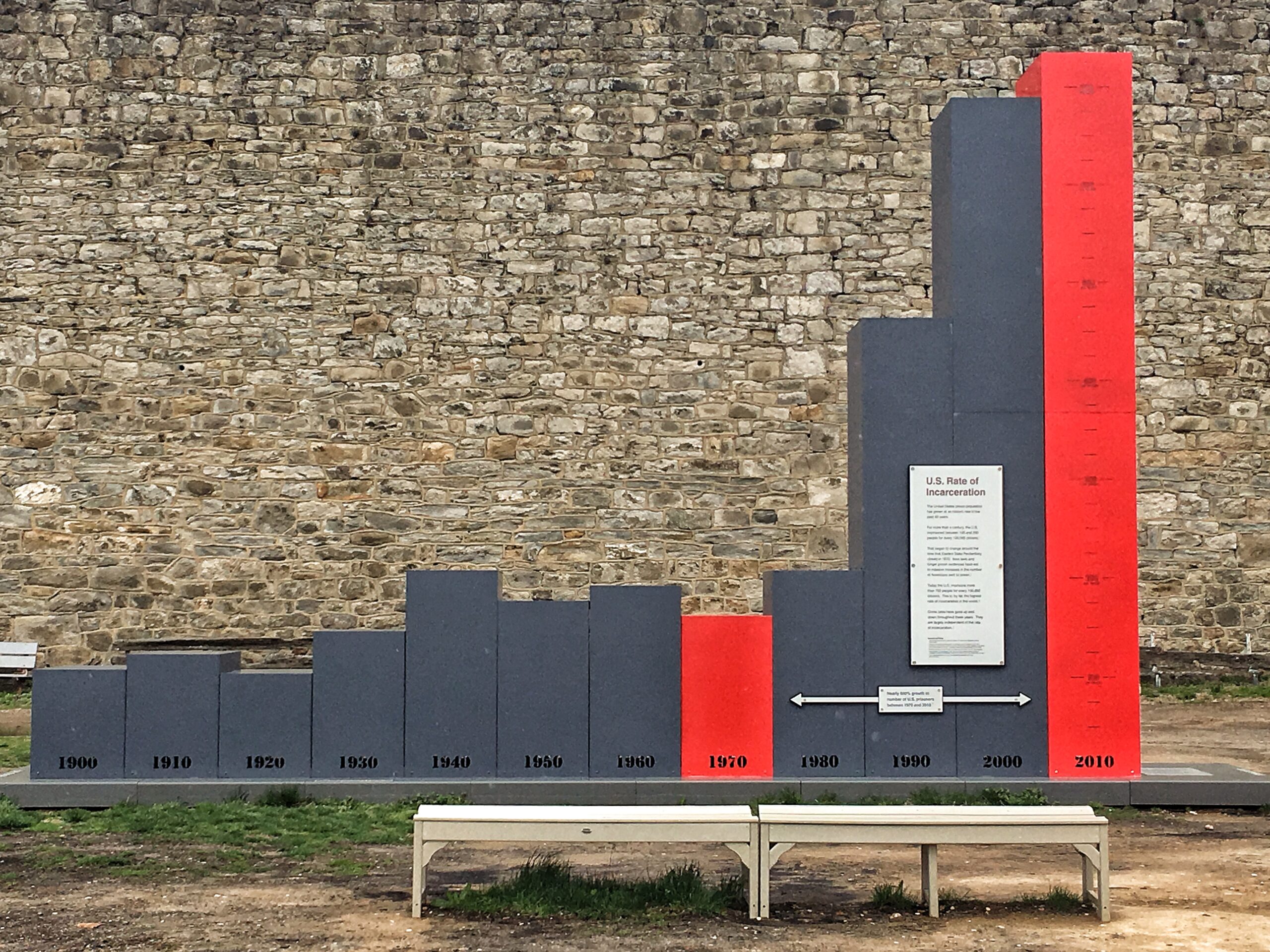
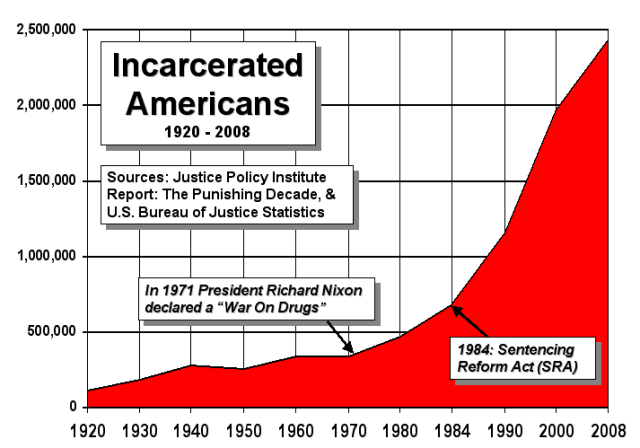
The US has the highest incarceration rate out of any OECD country, as it clocks in at about 700 inmates per 100,000 residents (Glaze and Herberman, 2013; World Prison Population List). This rate is about five times the OECD average. Notably, the primary reason for this is the War on Drugs. What is not shown here is an additional statistic that also weighs heavily: the U.S. also has the largest population of formerly incarcerated people in the world.

But why does the OECD, an international organization focused on promoting international commerce, care about incarceration? Because incarceration policies interact with labor-force participation and commerce. High incarceration rates have likely contributed to the US’s decline in prime-age labor-force participation rates relative to other countries. According to a 2007 paper by Georgetown University’s Harry J. Holzer, even if there are not administrative and legal restrictions barring employment, employers are less likely to hire someone with a criminal record.

Obviously, putting someone in prison has an immediate impact on short-term labor force participation. But it also affects long-term labor force participation, due to the stigma of incarceration, which impacts the ongoing demand for the labor services among the formerly incarcerated. This appears as a lagging effect that goes on for years after they reenter society. 

And if that’s not enough, it is further likely that due to both employment discrimination and the degeneration of employment social networks, the formerly incarcerated face long-term employment difficulties as well as earnings losses.

A Sociological Perspective

Sociology is not only an intellectual discipline. It provides us with a conceptual “tool kit” that we can use to think about larger social issues, where they come from, and how we can connect them public policy and real-world solutions.

As it was briefly mentioned, it’s hard to get people to think beyond their immediate personal situation and to further think critically about how events and problems are structured within not only the criminal justice system but also the larger social system. To make sense of this, as well as out individual role in it, we need to take stock of the larger social context and the influence it exerts on us, including how wealth and power are distributed, and how this interacts with our cultural beliefs and practices.

In other words, you must use you “sociological imagination” to some degree – you can’t simply limit yourself to thinking about policing and incarceration in simplistic terms, where  the cops are simply engaged in a value-free “colorblind” endeavor to lock up the people who break the laws – the “bad people.” While some might do this, when we begin to study social patterns, it becomes obvious that there’s more to the story of what is happening here. This will open the door to a more enriched understanding of the social world. Even better, it helps us to become more informed knowing participants within it. 

One of the things that gets in the way that I explore in other posts on this website is the U.S. cultural emphasis on individualism. For more on this, refer to posts on The American Dream and From the War on Poverty to the War on Crime.

Americans are culturally indoctrinated to think about the world in terms of decisions that individuals make and nothing else. Crime is framed as a problem of “bad decisions made by bad people.” But thinking about crime in solely individualistic terms is not only a logical fallacy; its flat out dangerous for reasons that it precludes an understanding of larger systemic social forces that are at work.

Developing a more balanced understanding that incorporates a way to see how individual decisions may be impacted by larger social forces can add much needed nuance and complexity to the study of crime. Yet people remain entrenched in their simple beliefs and world views, which I suspect are just more satisfying in the long run – because they’d rather go with their “gut” instinct and the views that they were taught by their communities. They get to be “right”…or so they think.

If the focus remains fixed on the question of “What’s wrong with those people?” Then emphasis in crime solving will remain fixated on individual solutions that try to change people’s behavior, instead working toward solutions that resolve the social conditions that actually foster crime. 

In stating this, it should be made clear that this is not the same as saying there are no individual, psychological, or biological perspectives that contribute explanation to our understanding of crime. Far from it. A sociological perspective serves to help balance these approaches, because it helps us to look beyond individuals.

If one can  accept that social factors are implicated in crime, then the question we are left with is: how do we, as a society, mobilize solutions for problems with structural roots? This question is both essential and crucial for crime prevention.

If we were to look at the problems related to crime that impact local area residents, we would find that they are enormous: persistent poverty, drug use/abuse, and gun violence. Yet if we were to look into the statistics, we would find that average and middle class white folks use illicit drugs as much as any other group.  Note that when other people (non whites) do this it is considered a “moral failing” for which they should be severely punished (or left to die from overdose). Yet when they do it, it’s considered a “health crisis” that calls for sympathy and attention.

Let’s look at another example. Blacks involved in shootings or gang violence are singled out for attention and sanction, even though most of the guns (and most of the high-profile shootings) are claimed by white people. In the case of the latter, incidents of mass shootings combined with gun suicides (statistically the biggest killer) are perpetrated overwhelmingly by whites as compared to other groups. Politicians, however, remain overwhelmingly focused on “inner-city” crime, gangs, and guns, and ignore the larger problem as it relates to guns. Venture a guess why? What are we to make of these contradictions?

Absent a  sociological analysis, many of us will never realize the different ways we too are participating in systems of oppression that produce consequences in other people’s lives, despite the fact that we may not have conscious intent when we do so.

A person may not feel like they are a racist, because they don’t speak or act like a racist. They may even go so far as to profess a hatred for racism. Despite this, if they vote for social policies that help organize society in racist ways, where privileges for some are achieved by subjugating others, then that person is participating in systemic racism. 

The Carceral State

The term “carceral state,” as a concept, is one that might also be used to understand racial, social, political, and economic relations in the United States. It can help us to think about the control dynamics of prisons and how they have come to exist within our current nation-state system. Think about the “carceral state” as a state built on the model of a prison.

In this conceptual model, the nation-state itself is understood to operate like/exist like a prison; it polices physical boundaries in order to gain control of the distribution of people across urban and suburban space.

According to this model, public space is not neutral ground. Rather, urban public space has become transformed into defendable space. That space features the installation of walls, gates, fences, surveillance cameras, and security checkpoints. It is a space where people are continuously monitored, actively as well as passively. Under this model, police are often equipped and act like military soldiers, only the targets are U.S. citizens.

Consequently, we have events today taking place across the country today which are virtually identical to the historic riots that took place in Chicago, Harlem, Detroit, Newark, and Los Angeles – for the same reasons. Despite this, people still question why people are rioting. They overlook the fact that policing in many places continues to look and act like a military occupying force, especially in communities of color. The murder of George Floyd in Minneapolis in 2020 is only the most recent event to shine a light on what we keep getting wrong.

Is Prison Slavery?

To call prison “slavery” doesn’t require a stretch of the imagination. Nevertheless, because the problem of mass incarceration is both enormous and far beyond the individual experiences of many people in society, there is a tendency to oversimplify. For example, people believe and say things like: if you commit a crime you have to deal with the consequences/do the time. If people would simply stop committing crimes the prisons wouldn’t be filled. Or, to put it in the words of one PSU student: 

“Prison is for the world to feel safe. Prison is the place where criminals go when they commit a crime.” – PSU student

This is an example of overly simplified non-critical thinking. Alternatively, when we start to think about prison as not merely a place where we warehouse lawbreakers, but rather as a structural system of social control, this is where things start to get interesting. In making this conceptual shift, you’ll begin to get a better understanding of what prisons are, how they function, and how they are essentially “made” in our contemporary moment.

Slavery in the U.S. context was, among other things, a system of racialized social control that was predicated on the notion of providing free labor for wealthy white landowners, who were, for the most part, located in the American South.

When you look at the maps below, look at the patterns of slave ownership mapped onto land and how they correspond to our current system of incarceration. What do you see? If mass incarceration were a simple function of bad people doing bad things, you wouldn’t see the spatial geographic patterns reflected as shown here. 

Just about every entry-level criminal justice textbook talks about the history of the founding of police forces in the United States. While the London metropolitan police forces of Sir Robert Peel certainly helped serve as a model for many U.S. cities, including Boston and New York, those textbooks tend to overlook another far less benign influence that was exerted on American policing by the former “Slave patrols” of the American South.

Although first established in South Carolina in 1704, the idea spread throughout the colonies. Slave patrols came about from a combination of colonial and/or state government legislation. They consisted of mostly white citizens and, in some southern states, the militia and army provided the manpower that served as slave patrols. These people were specifically hired to enforce discipline upon black slaves in the antebellum southern states. 

In addition to being white, most people who worked with the slave patrols came from working and middle-class conditions. Slave patrols typically rode on horseback in groups of four or five and sometimes even in family groups. Patrollers were often equipped with guns and whips. They worked from sun-up to sun-down and varied their times as well as locations of patrol in order to reduce the chances of slaves escaping.

The purpose of slave patrols was to intimidate and police the behavior of slaves and former slaves, where the primary aim was to “catch” the runaways and defiant slaves.  Initially, slave patrollers focused on breaking up slave meetings, mostly on holidays, when slaves would gather together to plot their escape. Eventually, patrols expanded to be year-round, not just on holidays. Slowly, new duties and rights of patrollers were permitted, including: “apprehending runaways, monitoring the rigid pass requirements for blacks traversing the countryside, breaking up large gatherings and assemblies of blacks, visiting and searching slave quarters randomly, inflicting impromptu punishments, and as occasion arose, suppressing insurrections” (Hadden, 2001).

Despite all of this, blacks developed effective methods of challenging slave patrolling, occasionally fighting back violently. The American Civil War itself would later create opportunities for resistance against slave patrols because the war made it easier for enslaved people to escape.

Even though slavery and patrols were legally ended, the patrol system still survived. Almost immediately in the aftermath of the war, informal patrols sprang into action. Later, city and rural police squads, along with the help of Union army officers, revived patrolling practices among free men.

During the post-Civil War Reconstruction period of 1865–1877, old-style patrol methods resurfaced and were enforced by postwar Southern police officers and also by organizations such as the Ku Klux Klan (Hadden, 2001).

Do African Americans Suffer From Systemic Discrimination?

Michelle Alexander’s work among others demands that we move beyond the confines of personal experience to think critically, deliberately, and methodically about the roots of mass incarceration, race, crime, and discrimination in American society. She traces a thread that goes all the way back to the Civil War and in the process illustrates how we have arrived at a point today, where there are more black men behind bars or under the control of the criminal justice system than there were enslaved in 1850.

Certainly, some might argue “slavery is over” or “Jim Crow laws were wiped off the books decades ago.” Nonetheless, there is an extraordinarily large percentage of African Americans in the United States who are being warehoused in community jails and prisons.  As prisoners, many find they are trapped in a parallel social universe, where they are denied basic civil/human rights, chief among them the right to vote. Similarly, even if they manage to escape confinement, they face a life of discrimination when it comes to employment, housing, access to education and eligibility for public benefits like student loans.

As Alexander argues in her 2010 book, “The New Jim Crow: Mass Incarceration in the Age of Colorblindness,” that it remains legal to discriminate against convicted criminals in nearly all the ways in which it was once legal to discriminate against African Americans. Once labeled a felon, even for a minor drug crime, the old forms of discrimination are suddenly legal again. In her words, “we have not ended racial caste in America; we have merely redesigned it.”

Alexander shows that, by targeting black men through the War on Drugs and decimating communities of color, the U.S. criminal justice system functions as a contemporary system of racial control, even as it formally adheres to the principle of colorblindness.

Why Are So Many People Incarcerated?

For a long period of time in the United States, about 100 of 100,000 people, on average, were incarcerated. That rate remained constant up until into the early 1970s. After this time, there was a dramatic increase in incarceration rates in the United States – a near 600% increase over rates demonstrated from the mid-1960s until the year 2000. Paradoxically, the research shows that incarceration rates increased even as crime rates decreased. During this time, the number of African American men who are behind bars has increased, mainly due to a single law enforcement policy.

“Most of that increase,” Alexander argues, “is due to the War on Drugs, a war waged almost exclusively in poor communities of color.” That crime-fighting measure “is a big part of the reason that a black child born today is less likely to be raised by both parents than a black child born during slavery” (Alexander, 2010).

U.S. Rate of Incarceration, Eastern Penitentiary, Philadelphia, Pa (photo credit: S. Trappen)

Where Are They Incarcerated?

State policy, more than federal policy, drives the current rate of mass incarceration. Additionally, federal mandatory minimum sentencing guidelines further add gasoline onto a fire that fuels the process.

The War on Drugs was declared in the 1970’s by President Richard Nixon, who ironically was himself a reformer until his re-election poll numbers started to plummet. The “War,” as such, has been carried out and increased under every president since Nixon. Who does this war target? For the most part, it targets nonviolent drug offenders.

Ironically, at the time that the war on drugs was declared, drug crime was not on the rise. Furthermore, even though President Nixon was the first to coin the term a “War on Drugs.” Later, it was President Ronald Reagan who turned that rhetorical war into a literal one (Childress, 2014).

The Law & Order Movement (reblog from Childress)

Our system of mass incarceration can be traced back to the law-and-order movement that began in the 1950s and continued throughout the 1960s. Keep in mind now that the 1960s was a time when violent crime in America increased. Before that time, federal government-level initiatives had not achieved any substantive widespread impact. Crime was thought to be a matter better handled by the states.

During the 60’s, segregationists like George Wallace started to worry there was going to be no way to stem the tide of public opinion that was increasingly registering opposition to the system of segregation. In light of this, they started labeling people engaged in nonviolent civil disobedience and public protest as criminals and lawbreakers. They warned that people who violated segregation laws were engaging in reckless behavior that threatened the social order. To this end, they demanded an immediate crackdown on these “lawbreakers” and civil rights protesters. “Y’all know about law and order,” one Wallace supporter said. “It’s spelled n-i-g-g-e-r-s.”

Note that it was the 1968 election, where Wallace effectively split the Democratic vote against Hubert Humphrey, allowing Republican nominee Richard Nixon to win the presidency despite carrying only 43% of the popular vote.

Timely "John Lewis: Good Trouble" reminds us all of the power in dignity,  perseverance - ARTS ATL

Former activist and later Georgia Representative John Lewis crossing the Edmund Pettus bridge between Selma and Montgomery Alabama, in the 1960’s 

This rhetoric of law and order evolved as time went on, even though the old Jim Crow system fell and segregation was officially declared unconstitutional. Segregationists used the get-tough rhetoric as a way to appeal to poor and working-class whites in particular, who were resentful of and fearful of what they interpreted were “gangs” of African Americans stirring trouble in the civil rights movement.

At the apex of this movement, White voters were concerned about what they saw as the familiar social order coming under attack. Conservative politicians strategized to come up with a way to tap into these voters’ fears without appearing to talk about race.  Talking about “Law and order” was determined to be an effective strategy for reaching suburban white voters. Best of all, it precluded saying the ugly part out loud. This was a seen as a necessary development , considering how it was no longer socially permissible for polite White people to say they opposed equal rights for Blacks. Instead, they complained about “the urban uprisings” (today’s equivalent is “Crime in Chicago”).

Pollsters and political strategists found that thinly veiled promises to get tough on “them,” a group easily recognizable by their race, were enormously successful in persuading poor and working-class whites in the South to defect from the Democratic New Deal coalition and join the ranks of the Republican Party, which they did in droves.

Unfortunately, this backlash against the civil rights movement occurred at precisely the same moment that
there was economic collapse in communities of color in many inner-city locations across America.

Note (image above) how the 1984 Sentencing Reform Act, which led Congress to enact mandatory minimum sentence guidelines for certain crimes, drastically increased punishments for repeat offenders and fueled the upward climb of the number of people behind bars.

Later in the 1980’s, Lee Atwater took the strategy even further, while working as an advisor to Ronald Reagan. Reagan aimed to consolidate political power by continuing with a revised version of Nixon’s Southern Strategy. The original Southern strategy required converting of conservative Southern Democrats, who harbored racial antipathy, to become members of the Republican party. While Nixon’s strategy was focused on the South, Reagan’s reboot was intended to be more broadly successful in areas outside the South (i.e. Pittsburgh); places where people might identify themselves as  Wallace voters who could be “Reagan Democrats.”

It was during this time that Atwater gave an anonymous (and now famous) interview to political scientist Alexander P. Lamis. On November 13, 2012, The Nation magazine released a 42-minute audio recording of the interview about how the strategy was intended to work:

Questioner: But the fact is, isn’t it, that Reagan does get to the Wallace voter and to the racist side of the Wallace voter by doing away with legal services, by cutting down on food stamps?

Atwater: Y’all don’t quote me on this. You start out in 1954 by saying, “Nigger, nigger, nigger”. By 1968 you can’t say “nigger”—that hurts you. Backfires. So you say stuff like forced busing, states rights, and all that stuff. You’re getting so abstract now [that] you’re talking about cutting taxes, and all these things you’re talking about are totally economic things and a byproduct of them is [that] blacks get hurt worse than whites. And subconsciously maybe that is part of it. I’m not saying that. But I’m saying that if it is getting that abstract, and that coded, that we are doing away with the racial problem one way or the other. You follow me—because obviously sitting around saying, “We want to cut this”, is much more abstract than even the busing thing, and a hell of a lot more abstract than “Nigger, nigger”.

Atwater thus advised Reagan that he no longer needed to make overt racial appeals. He suggested more “colorblind” subtle language that was less obviously racist.

To make things a bit more complicated, Harvard scholar, Elizabeth Hinton, challenges the belief that America’s prison problem simply originated with the Reagan administration’s War on Drugs. Hinton leans toward an understanding there may be bipartisan Federal roots for mass incarceration in the United States.

Kennedy & Johnson

In order to understand what went wrong, she argues that we have to go further back to the administrations of Johnson and Kennedy to learn about early programs: the era of liberal reform and the social welfare programs of Lyndon Johnson’s Great Society, that declared a “War on Poverty.” 

Before you lapse into thinking “Of course, welfare programs are a waste of money and they make people lazy/criminal” you should note that this is not Hinton’s position. She’s making a far more nuanced argument than is typically refracted through the lens of partisan politics by directing us to follow policy and law changes over time. The seeming need people have, which is to reduce understanding of important issues to mere partisan politics (left vs. right or liberal vs. conservative) gets in the way of attaining a full understanding of what went wrong and what continues to go wrong; consequently, this makes it difficult to fix the problems and achieve any sort of progress.

Hinton is not saying that social welfare programs and poor people themselves are the cause of poverty and mass incarceration. Nor is she reducing what are massive social problems to a technical debate over a narrow set of economic issues. The story she is telling is more complicated.

Hinton says that the expansion of the welfare state under Johnson coincided with a new era of law enforcement. The social welfare programs that Johnson intended to use to fight future poverty – the “War on Poverty” – was combined with a “War on Crime” – surveillance and policing patrol programs designed to deal with the immediate effects of racial social inequality (they conveyed the added benefit of monitoring future criminals). Unfortunately, the War on Poverty lost its momentum as Johnson was forced to divert funds to another war – the War in Vietnam.

Put another way, the War on Poverty was never fully realized, but the policing and crime control approach that characterized the War on Crime became deeply entrenched and led to the “War on Drugs” in the years that followed. These “Wars” constituted a major job creation program for policing and corrections that continues to this day. Social problems and inequities, however, continued unchecked. Individual people alone were blamed for their own problems.
When Work Disappeared

In an excellent book by William Julius Wilson, entitled When Work Disappears, the author describes how in the ’60s and the ’70s, work literally vanished in many communities. Hundreds of thousands of black people, especially black men, suddenly found themselves jobless (Childress, 2014)

His main argument is that job-flight (or what others have called “economic structural adjustment” and “deindustrialization“) produces a culture of poverty as an adaptive response to work disappearing. Once economic factors set everything into motion, this culture then takes on a life of its own and becomes self-sustaining, creating more deeply entrenched poverty.

In other words, where previously we would identify the economic factors to be the independent variable associated with poverty, once the culture of poverty became entrenched, “culture” became an independent variable on its own. Most people only look at the tail end of this process. They blame individual people for their problems, which they attribute to bad culture, as they fail to recognize that failed economic systems are the original root cause. 

Consequently, as factories closed and jobs were shipped overseas, deindustrialization and globalization led to depression and a “culture of poverty” in many communities, especially those in urban areas. Nationwide, crime rates began to rise. And as they rose, the backlash against the civil rights movement reached a fever pitch. The get-tough movement exploded into a zeal for incarceration, and a war on drugs was declared (Childress, 2014).

Isn’t Increased Incarceration the Result of Increased Crime? (reblog Childress)

Many people imagine that our explosion in incarceration was simply driven by crime and crime rates, but that’s just not true. That is sheer myth, although there was a spike in crime rates in the 1960s and 1970s.

During the period of time that our prison population quintupled, crime rates fluctuated….[such that] today, as bad as crime rates are in some parts of the country, crime rates nationally are at historical lows, but incarceration rates have historically soared.

In fact, most criminologists and sociologists today will acknowledge that crime rates and incarceration rates in the United States have moved independently [of] each other. Incarceration rates, especially black incarceration rates, have soared regardless of whether crime is going up or down in any given community or the nation as a whole

Surprisingly, the United States actually has a crime rate that is lower than the international norm, yet our incarceration rate is six to 10 times higher than other countries’ around the world.

Crack is Wack (reblog Childress)

Many people assumed that the war on drugs was declared in response to the emergence of crack cocaine and the related violence, but that’s not true. The drug war had already been declared, but the emergence of crack cocaine in inner-city communities actually provided the Reagan administration precisely the fuel they needed to build greater public support for the war they had already declared.

So the Reagan administration actually launched a media campaign to publicize the crack epidemic in inner-city communities, hiring staff whose job it was to publicize inner-city crack babies, crack dealers or so-called crack whores and crack-related violence, in an effort to boost public support for this war they had already declared [and to inspire] Congress to devote millions more dollars to waging it.

The plan worked like a charm. Millions more dollars flowed to law enforcement. There was a militarization of law enforcement of the drug war as the Pentagon began giving tanks and military equipment to local law enforcement to wage this war. And Congress began giving harsh mandatory minimum sentences for minor drug offenses, sentences harsher than murderers receive, more than [other] Western democracies.

#MeToo Democrats Get Tough on Crime (reblog Childress)

Soon Democrats began competing with Republicans to prove they could be even tougher on them than their
Republican counterparts, and so it was President Bill Clinton who actually escalated the drug war far beyond
what his Republican predecessors even dreamed possible.

It was the Clinton administration that supported many of the laws and practices that now serve millions into a
permanent underclass, for example. It was the Clinton administration that supported federal legislation denying
financial aid to college students who had once been caught with drugs. It was the Clinton administration that
passed laws discriminating against people with criminal records, making it nearly impossible for them to have
access to public housing. And it was the Clinton administration that championed a federal law denying even food
stamps, food support to people convicted of drug felonies.

So we see, in the height of the war on drugs, a Democratic administration desperate to prove they could be as
tough as their Republican counterparts and helping to give birth to this penal system that would leave millions
of people, overwhelmingly people of color, permanently locked up or locked out.

Who Pays For & Who Benefits From Mass Incarceration?

Mass incarceration costs a lot of money. Instead of paying for college, roads, and other things that benefit the public, we are paying enormous sums of money to keep people locked in cages. The cost of imprisonment — including who benefits and who pays — is a major part of the national discussion around criminal justice policy. Yet it is important to distinguish here that prisons and jails constitute one piece of the puzzle that is the criminal justice system.

Infographic from the Prison Policy Initiative

From Slave Patrols to Ferguson

In the case of Ferguson, most of the police there were engaged in targeting the behavior of the town’s people because operating revenue had been cut at the state level for municipalities (tax cuts = no revenue). Given that there were limits placed on the amount of revenue that could be generated by property taxes, the Ferguson police department had to figure out another way to produce revenue for itself. As a result, the cash-starved municipality relied on its cops and courts to extract millions of dollars in fines and fees from its poorest residents, issuing thousands of citations each year. They penalized the smallest infractions and targeted the least powerful citizens because 1) the town was flat busted broke and 2) it was the easiest thing to do (raising taxes is far harder and plenty of voters won’t let you do it). Put another way, the Ferguson police were “catching” poor blacks to help pay for their for their own operating expenses. Now think about the towns that you know. Do you think that happens there?

The systematic effort to target poor black people led to the deteriorated state of affairs in Ferguson, which led to the killing of Michael Brown, and set off public rioting. (whereupon people castigated the rioters). The police harassment intended to enhance revenue led to the death of a young person, who was executed for the crime of public disobedience. And as morally repugnant as all of this is, don’t forget there are “many Fergusons” in the United States.

Now that you have shifted your thought process to begin thinking structurally about prisons and police and, furthermore, now that you have been given some background in some important history, is there anything that has shifted in your thinking? Do you still find it is hard to think critically about the role of police violence in the the justice system and the way it systematically targets black people, even though experts agree this has become a defining aspect of policing in our contemporary political moment?

Clearly, the violence perpetrated by slave patrols is of a different era. But do you not see any points of resonance with how contemporary police forces, who may on one level working to reduce crime in black communities, are still a root cause of the problem?

The outcomes in Ferguson are the direct result of social inequalities in the town, further exacerbated by the unequal application of the law and unequal police policies and practices. This is what you get when a town becomes so revenue starved that they provide a monetary incentive for police to arrest poor black people; you get fines, bench warrants, and imprisonment for the poor and powerless. You get statistics that feed into the current imbalances that characterize the criminal justice system.

Does Locking People Up for Drugs Work?

In a word – no. After almost 50 years of waging war, drugs are cheaper and more readily available than ever. Yet in spite of the enormous expenditure and evidence of the policy failure, you will be hard pressed to find a politician that doesn’t advocate for defending the war on drugs and, in some cases, continuing to escalate [former President Trump proposed executing people for drug offenses].

John Ehrlichman, Nixon’s former domestic-policy adviser (who went to prison for his role in the Watergate affair) once  admitted to the journalist Dan Baum that Nixon’s criminalization of the Black community was a nakedly political tactic. “By getting the public to associate the hippies with marijuana and blacks with heroin, and then criminalizing both heavily, we could disrupt those communities,” Ehrlichman said in 2016. “We could arrest their leaders, raid their homes, break up their meetings and vilify them night after night on the evening news.” And the rest is history.

All of the research (and let’s face it, our eye balls confirm it too) arresting people simply doesn’t work. Alternatively, there is substantial evidence  to demonstrate that money spent on drug rehabilitation programs is effective. Likewise, by strengthening employment markets and increasing pay and wages for the poor, we can help mitigate the despair and despondency that often underlies drug abuse and addiction, as many people have essentially “given up” and shifted to placating their misery with drugs and alcohol.

“Law & Order” and the Trump Administration

Contemporary examples of politicians who use the “law and order” rhetoric coined in the previous era aren’t exactly in short supply these days. Trump’s speeches and Tweets document heavy use of the language employed by Goldwater and Nixon before him, as he has deftly woven the themes of “lawlessness,” “BLM” and race together to make claims that black people protesting and black criminality are cut from the same cloth. In one example, without ever making explicit reference to Blacks and the Black community, Trump Tweeted “America’s Suburbs will be OVERRUN with Low Income Projects, Anarchists, Agitators, Looters and, of course, ‘Friendly Protesters.’”

The former President has become notorious for the use of racist “dog whistles,” has failed to denounce white supremacy, even referring to white supremacists as “good people,” and has sometimes been explicitly and unapologetically racist, such as when he referred to Mexicans as rapists.

To be sure, Trump didn’t create racist politics in the United States. However, he has contributed to heightening divisions and tensions around race, to the extent that contemporary U.S. politics has become saturated in hate speech that will linger for years after he exits the center stage of politics. 

What is the Solution?

As we have seen here, the history of policing in the United States has been organized, that is, “structured” to produce the results we see before us. Nothing has changed fundamentally in that structure, which is producing what it was designed to produce.

Over and over, government commissions as well as other expert panels convened in cities and states across the country have examined mass incarceration, police brutality, and racial profiling; all of them have arrived at the same conclusion: in order to fix the problems associated with the criminal justice system and mass incarceration, we must simultaneously address the poverty and systemic racism that go hand in hand with policing communities of color. Progress is essential yet it remains slow and uneven.

Many have suggested a renewed focus on police professionalization, which includes additional training on implicit bias, mindfulness, de-escalation, and crisis intervention.  Further redouble efforts to diversify police departments and correction facilities management.  Likewise, adopt more rigorous use-of-force standards as well as standards for the use of body cameras, enhanced by added measures to foster police-community dialogues. Finally, implement enhanced early-warning systems to identify problem officers and expressly prohibit the “recycling/re-hiring” of problem officers. Sounds good right? The problem, unfortunately, is that all of these programs were in place in Minneapolis before George Floyd was killed. None of it worked.

This is why activists are increasingly calling for a top to bottom overhaul of policing organizations. We can’t simply intellectualize the problem and write up official findings and reports that are never implemented. Calls to divest funds from the police and direct them to other organizations better suited to address community social problems would eliminate the current one-size-fits all approach to combating social problems. As part of this process, there should be a recognition of the economic structural roots of many problems, accompanied by decriminalization and  reinvestment in communities of color. Additionally, you could incentivize the police to solve actual crimes, which could potentially result in the police actually accomplishing what we all hope for them to do: to serve and protect the interests of all citizens. For more on this, see Alex Vitale.
One of the major roadblocks to finding and implementing solutions to structural problems is one of recognition. For if you go so far as to recognize that structures are among the root of causes of social problems and crimes, then at some point have to allocate public money to fix/change those structures. Those structures are not only inclusive of police forces; they include judges, probation officers, Mayors. as well as County Executives. Opposition occurs naturally, because there are many people who are invested in the current structure staying the way it is (because they and others like them benefit from this arrangement). This needs to change.

Finally, it is only by taking a comprehensive look at history of racism in policing and incarceration that we can better understand why it’s not only  reform that is necessary, but a full transformation of the criminal justice system, which includes a substantial re-allocating of public resources. Nothing short of this will suffice. The problems discussed here are vast but they are fully known to anyone who has been paying attention. The solutions are also not a secret. What is required now is the political will to act. It is long past the time to do this.

Sources:

“Michele Alexander: A System of Racial and Social Control,” by Sarah Childress, 2014

Slave Patrols: Law and Violence in Virginia and the Carolinas. Harvard University Press, by Hadden, Sally E. (2001).

Learn More:

Here are some texts you can refer to in order to learn more on some of the subjects discussed here:

“The New Jim Crow: Mass Incarceration in the Age of Colorblindness,” by Michelle Alexander (2010).

“When Work Disappears: The World of the New Urban Poor,”  by William Julius Wilson (1996).

Discussion Questions:

Do you think that prison is a modern day form of slavery?

What do you see in policing that has changed from the past? What appears to be the same?

Do you think current problems with regard to mass incarceration, police racism, and police violence are different from the previous times in our history? If so, how so?

Do you think we have to choose between “law and order” and racial justice in America? Can we achieve both or are they necessarily opposed? 

What does this history contribute to our understanding of contemporary problems with regard to the use of force and violence in the modern police force?

What do you think about the concept of “profit” as it applies to prison? Should private companies be able to profit from locking people up in prison? 

Note: if your answer is yes to this, please explain what you think happens when they can’t fill the prisons with the typical sorts of criminals (violent, theft, drug dealing and using). Who will be next? Because the profit model demands (by contract) that the prisons stay full. Are you okay with creating a mechanism that operates to keep prisons full rather than working to find ways to reform criminals and empty prisons? Does this make moral sense? Does this make financial sense, considering that it costs more to keep someone in prison than it does to send them to college (or any training program)?

What does it mean to live in a democracy, where there are large financial incentives to lock people up? Who do you think will be the natural targets of such a system? What social groups do think might be structurally positioned to escape it?

Course: Criminal Justice, Policing, Race & Ethnicity

Why Are Police Like This?

122 Comments

"A

What’s Going Wrong in the World of Policing?

It seems almost every day now there are high-profile incidents of police violence dominating the headlines. Social media in particular has led the way by showcasing video uploads of police misconduct, which are almost always taken by bystander witnesses to the violence. Studies demonstrate that racial bias in law enforcement and police misconduct are systemic problems. A Department of Justice report revealed that 84 percent of police officers have seen other officers use excessive force when making an arrest. A Human Rights Watch study concluded that race continues to play a role in police brutality in the United States and “have subjected minorities to apparently discriminatory treatment and have physically abused minorities while using racial epithets.”

This has prompted demands that police departments find new ways to train officers. To this end, there have been calls to upgrade training and credentialing, including requiring police to attend college. Research shows that college educated police are less violent and less prone to use excessive force. Similarly, there have been calls to increase hiring of women officers, as they have been documented in research to possess strong inter-personal communication skills, which means they rely less on the use of force when dealing with the public. Previously, the Congressional Black Caucus asked former President Obama to require sensitivity training of all police departments who are receiving federal grants.

Who Is Policed?

Early police departments in the U.S. were mainly focused on policing the crimes of immigrants, labor activists, and Left political activists. As Alex Gourevich notes, “in places like Chicago, Irish and Germans tended to be the ones thrown in the “paddy wagon,” but soon other Eastern and Southern Europeans, like Poles and Hungarians, were added to the mix. Who faced the worst of it varied depending on the ethnic and racial hierarchies internal to the working classes of different cities” (Gourevich, 2020). Locally here in Pittsburgh, steel magnates like Andrew Carnegie employed police to crack down on striking workers. During the famous Homestead strike in 1892, a well-organized group of gun-wielding steel workers overwhelmed the Pinkertons, who were hired by Carnegie to put down the strike.

We are continuing to live in the shadow of this history. Police have been and continue to be use as a blunt object to combat the most marginalized in society. This holds true especially for poor black people. Blacks and other nonwhite people are disproportionately targeted for policing. White people, of course, are also caught up in this system. And while their numbers may exceed that of nonwhite people, it is the disproportionality of police contact that points to a deeper more systemic problem when we look at police use of force.

But as it turns out, police continue to refuse to collect and share national data on how often, when, and against whom they use force. That is, policing organizations make it difficult to study them. Researchers like myself are often refused access to observe anything but the most mundane of activities. Better transparency would go a long well in helping experts and policy makers, who are attempting to solve the problem.

Why Are Police So Violent Toward Black Men?

One question for sociologists and criminologists to consider is why are police so violent toward black men? Recent research demonstrates how the police are implicated, actively as well as passively, in preserving racial hierarchies. This occurs in part through the disproportionate use of force black people. Scholars like W. E. B. Du Bois recognized this. He theorized that the ruling class used racial ideology to divide workers who shared economic interests. By keeping workers fighting among themselves, they had less time to sit around and think about how they were commonly oppressed by the wealthy classes.

Khalil Gibran Muhammad argues in his book, The Condemnation of Blackness: Race, Crime, and the Making of Modern Urban America, that the idea of black criminality has been crucial to the making of modern urban America, as well as to African Americans’ own ideas about race and crime.

Some researchers attribute the evasive behavior to police culture. Tribal group loyalty (thin blue line) often prevents police officers from criticizing each other or their departments publicly— the tendency too often is to lie (sometimes under oath) to protect a fellow officer when they faces charges of misconduct.

Refusing public accountability with regard to how they operate has unfortunately become a hallmark of contemporary policing. Absent new laws and policies, the problems are likely to continue.

Michael Wood Jr., a retired Baltimore cop, has been a frequent critic of law enforcement culture. His voice has been a rare one, as he speaks with the knowledge of an insider while maintaining the unforgiving skepticism of an outsider. Check out the video below, where we meet Wood (a military veteran) while he drives the streets of the city where he served as a police officer for 11 years. Take note as he lays out his view of what’s going wrong in the world of policing and what he thinks may be our best opportunity to make it right.

Ingroup/Outgroup Social Dynamics

As the former officer in the video explains here, social group dynamics play a key role (sociologists and psychologists often refer to this using the terms ingroup/outgroup). The contradictions embedded in human social relations – especially the desire to “belong to” and identify with social groups – may explain why officers don’t treat everyone the same.

An  ingroup is a social group with which a person psychologically identifies as being a member. By way of contrast, an outgroup is a social group with which an individual does not identify. Social identity categories become meaningful to the extent that they signify group membership –  the most easily identifiable group membership is often based on what we see first when we encounter people – race, social class, gender, nation, and religion. The terminology was made popular by Henri Tajfel and forms the basis of social identity theory.

People in general, not just police officers, are often very quick to identify people on the basis of how they perceive them as either in-group or out-group members. Tajfel and colleagues found that people can form self-preferencing ingroups within a matter of minutes and that such groups can form even on the basis of seemingly trivial characteristics (such as, they found, things like preferences for certain paintings). It could also be things like preferences for sports teams or music. Not surprisingly, in-group members were found to be treated more favorably than those who are assessed to lie outside the boundaries of in-group relations.

Police and Social Control

Recent protests have awakened the public to the social control function of police. Policing is not simply about catching criminals in this model; it’s about controlling public behavior, channeling it in such a way that it cannot pose a threat to the current social order, which again is set up to serve those who have wealth and power. This has caused people to ask other fundamental questions about police: Why are there police? Who (whose interests) do they “serve and protect,” and why have they become so militarized? (Gourevich, A., 2020).

Sources:

“Police Departments are Literally Staging Conflict,” by Keola Whittaker. Last accessed 1/18/2016.

“Why Are The Police Like This?” by A. Gourevich, 2020. Last accessed 7/18/2021.

Note:

Header photo depicts an NYPD police lieutenant swinging his baton at Occupy Wall Street activists in New York. The photo was one among many posted to Twitter in response to a New York Police Department’s request for Twitter users to share pictures of themselves posing with police officers. Occupy Wall Street protesters tweeted photographs of cops battling protesters with the caption “changing hearts and minds one baton at a time.” (AP Photo/Mary Altaffer, File)

Discussion Questions:

Why do you think police officers are sometimes violent?

Are you concerned (especially if you may be a future police officer) about the current policing climate?

What would you do if you saw an officer hurting someone? Would you film it? Would you say something to the officer or file a report?

What kind of steps and/or policies do you think might be undertaken to correct the problem?

How might we use E. Durkheim to explain the different ways police officers relate to people?

Course: Policing, Race, Crime & Justice

Social Class & Crime

34 Comments

Social Class & Crime

Social class divisions in the United States are not always clear to many people. Not only do they change over time, they may also change from place to place. How do you define your social class? Is it simply a matter of your individual or household income? Do you define it based on your profession or level of education? How might your residence explain your social class? Or, to borrow from Marx, how does your relationship to the means of production (worker or owner) determine your social class?

When we look at the effect social class divisions have on crime, the results are similarly not always clear. Annual reports of people arrested in the United offer many compelling insights when it comes to demographic characteristics like gender, age, race, and ethnicity; however, they don’t tell us much about social class characteristics such as income, occupation, or residence.

Some of the best information that we might consult regarding the social class characteristics of people in jails and prisons is derived from surveys of inmates. Unfortunately, the last detailed survey of prisoners serving felony sentences in state penitentiaries, who make up the majority of those incarcerated in the United States, was conducted in 1993.

Locking Up the Lower Classes

Members of the lower classes are overrepresented in U.S. prisons. Why? Is it because they commit more crime? Or are they more likely to be targeted?

Research on the U.S. correctional population leaves little doubt that most of the people serving time for criminal offenses come from the lower end of society’s socioeconomic continuum. Statistics from government reports reveal that those in prison tend to be less well educated and are more likely to be unemployed and earn far lower incomes than the general population.

In one 2002 survey conducted on inmates incarcerated in local jails revealed a similar pattern, the following finding was reported: only about half of jail inmates were employed full-time at the time of their arrest (even though the national unemployment rate was below 5%). Likewise, more than half of jail inmates earned less than $15,000 a year (Bureau of Justice Statistics (BJS), U.S. Department of Justice, 2004). Although statistics may be skewed by the fact that better-off offenders who are charged with street crimes are more likely to avoid imprisonment, there is little reason to believe the degree of error is substantial. All one has to do is observe any urban police station or city court to know that very few middle- or upper-class citizens are arrested and prosecuted for common street crimes.

Briefly put, the U.S. Criminal Justice System effectively incarcerates the poorest of the poor. Although wealth and power do not preclude arrest and sentencing, they certainly make it statistically more likely that the person will not see the inside of a prison cell.

Police Discretion, Arrest, and Incarceration

The police officers’ decision-making process, where they decide whether or not to approach and arrest someone plays a big role in who shows up in our jails and prisons. The term for this is “police discretion.” And the research shows us that the perceived social class of a potential offender has a major impact on how the officer ultimately responds (i.e., when to file an official police report, whom to approach, whom to arrest, whom to charge, and whom to send to prison). This impact is without a doubt reflected in arrest as well as incarceration statistics.

Self-reports from police document that the police are more likely to arrest low-class offenders and offer leniency to higher class offenders. In this instance, it is not so much the specific criminal behavior that drives arrest statistics so much as it is the impact of social class on policing practices, which produces a “classed” outcome.

Debates & Perspectives

Despite the fact that our prisons and jails are full of poor people, the link between social class and criminal behavior remains controversial. To explain the high rates of incarceration among the poor, some scholars argue that the disproportionate representation of poor people in jails and prisons is indicative of their overinvolvement in crime. Alternatively, others suggest this disparity is the result of a criminal justice system that unfairly targets the poor. Take a moment to reflect on your own thoughts here. How have you typically come to resolve the notion of social inequality as it relates to arrest and incarceration?

The contradictory perceptions about the relationship between social class and criminality are, in part, the product of disparate research findings. There is no shortage of research studies that have examined this relationship; however, there is little consensus because of inconsistent findings and inclusive results.

For example, some scholars argue that crime is more likely among people in higher social classes, yet others argue criminality is more prevalent among the lower classes. Some of the inconsistencies here can be traced to the different research methods used to study the relationship between social class and crime, including different data collection methods; different conceptual categories, ways of measuring social class and crime, different population samples; and different analyses.

Some critical criminologists have argued that ALL categories of crime and social class are ideological constructs, which is to say, the categories themselves are biased/ideological from the outset, so no true quantitative measure is possible (see the work of Jock Young).

An examination of the past research reveals that the earliest of these studies (those conducted before the 1950s) tended to find more criminality among the lower classes than the upper classes. These findings, in turn, provided the foundation for numerous theories of crime and delinquency that attempted to explain why poverty was criminogenic.

Factors singled out for study included: individual and cultural deficiencies, lack of opportunity, and differential (harsher) treatment of individuals in poorer communities by the criminal justice system. Many of these early studies and theories, however, were only tenuously rooted in empirical research. That is to say, they didn’t follow the rigorous standards set for research that are in effect today.

Critique 

Although the social class–crime link was widely accepted, there are criminologists who took issue with the research methods that produced the correlation between social class and criminality. Most commonly, they argue that measuring crime through the use of official data (i.e., arrest data, prison statistics) represents a biased picture of crime. This measure of crime did not take into account the reality that many crimes go unnoticed or unreported, or simply that recorded statistics reflect the whims and intentions of those who wish to count some but not others.

This unknown and uncounted crime is referred to as the dark figure of crime. The problem, as these criminologists see it, is  that there is no way to determine whether accurately measuring the dark figure of crime would or would not show crime to be more broadly distributed.

Some criminologists also argued that official measures of crime may actually better measure police practices than actual levels of crime; that is, in reality, they may simply reflect, at least in part, the discretionary practices of police officers concerning whom to arrest and whom not to arrest, or a judge’s propensity for sending particular offenders to prison while reserving alternative, community-based sanctions for others.

The development of self-reported data in the 1950s intensified the debate. Researchers administered surveys to individuals randomly selected from the population and asked them to report their criminal behaviors. Although many of the earliest of these studies did not support the belief that lower social classes were more criminal, there was  enough research that found contradictory results to ensure that the issue would not be resolved. In short, the results were mixed and inconclusive on the question of social class.

Many sociologists and criminologists attacked the validity of self-reported data. Others took issue with the validity of official measures of crime (i.e. FBI statistics/UCR). Their argument was that there is no way to determine whether people in self-report studies are telling the truth about their criminal behavior. Doubters suggested that self-report surveys were better measures of a participant’s willingness to tell the truth about his or her criminality. They  speculated that people from the lower classes were underreporting their deviant and criminal behavior while those in the upper classes were overreporting, thereby artificially reducing the magnitude of the correlation between lower-class status and criminality.

Tittle, Villemez, and Smith (1978) reviewed 35 research studies that examined the social class–crime link and concluded that there was an extremely small relationship, with the members of the lower classes exhibiting slightly more criminality. They also noted that this relationship had become smaller over the past four decades. This research, however, by no means settled the debate.

The inconclusive results became the impetus for even more extensive and complicated empirical research efforts. Much of these later efforts attempted to discover the conditions under which social class influences criminality. One set of studies attempted to determine whether the manner in which social class and crime were measured impacted the likelihood of discovering a link between social class and crime. In terms of social class, several studies suggested that this relationship may exist only among people in the lowest economic strata, the group sometimes referred to as the underclass. These studies measured social class by dividing populations into dichotomous categories such as welfare recipients and nonrecipients or, for school-age children, those who receive free lunches and those who do not.

Other studies used a composite measure of social class, which often included education, occupation, and income. Still, other studies used Marxian classifications of social class, conceptualizing social class in terms of an individual’s (or his or her parents’) relationship to the means of production— specifically, whether they owned some means of production or sold their labor for a wage. And still, others expanded the Marxist framework to include other variables, such as whether one has control over the means of production and/or control over the labor of others. The emphasis on control helped to distinguish between wage workers who have managerial positions and those who do not, which is an increasingly prevalent distinction in modern society.

Crime was also measured as part of an effort to determine whether it conditions the social class–criminality relationship. For example, studies have examined whether the negative relationship between social class and delinquency existed only for the most serious criminal offenses or the most frequent offenders.

The source of crime data was thought to have an effect on whether a relationship between social class and crime was uncovered. Some criminologists held that crime would be shown to be more prevalent among the lower class if official police data or court records are used to determine criminality. As previously mentioned, they argued that people from lower classes are more likely to underreport their criminal behavior on self-report surveys.

A number of other studies sought to determine whether demographic and environmental variables had important conditioning effects on the class-crime relationship. For example, some studies examined whether the effect of social class on criminality was greater among blacks than it was for whites or among males than among females. Given the contradictory results of these research efforts, it would be difficult to suggest that the social class– criminality relationship was specific to a certain race or gender. Still another set of studies has examined whether this relationship was more likely in areas that were characterized as being more heterogeneous, more urban, or in higher status areas, and again produced mixed results.

Tittle and Meier (1990) reviewed the research literature that examined the relationship between socioeconomic status and delinquency and that attempted to specify whether any of the aforementioned conditions mattered. They concluded that there was little evidence that the link between social class and criminality existed under any of the conditions examined. The most recent and more sophisticated studies have generally arrived at similar conclusions, although some studies did help clarify the relationship. For example, Wright and his colleagues found that people in lower social classes experienced lower educational and occupational goals and more financial strain, aggression, and alienation, which in turn increased delinquency (B. R. E. Wright, Caspi, Moffitt, Miech, & Silva, 1999) .

Alternatively, delinquency in the higher social classes was thought to be the result of high socioeconomic status causing increased risk-taking. Lack of economic and social power, on the other hand, diminished the commitment to conventional values, which then predisposed many youth to delinquency.

Dunaway, Cullen, Burton, and Evans (2000) examined the relationship between social class (measured in a variety of ways) and criminality (based on self-report surveys) and found that, among adults, the correlation was weak for less serious offenses. They did, however, find a class effect for violent offenses and among non-whites. This study was distinctive in that it measured adult criminality, a surprisingly under-researched population.

Conclusion

In the end, the best conclusion that can be drawn about the relationship between social class and the commission of street crimes is that it tends to be weak and present only under certain specified conditions. In light of this, criminology researchers must continue to attempt to specify other circumstances that may influence this relationship.

What many of these studies do have in common is that most approached the definition of crime as being nonproblematic instead of acknowledging crime as a multifaceted concept that includes crimes of the disadvantaged as well as crimes of the powerful.

Unfortunately, the latter (studies of the powerful) were, and still are, less apt to be considered. This is important, because if studies included offenses that powerful individuals are more likely to commit (e.g., insider trading) and that those in lower classes are in no position to commit, then there would be little question as to whether criminality would appear more evenly distributed across social classes than has traditionally been thought. Moreover, it is only by including a wider variety of offenses that we can consider the social class–crime link as having been more completely and fairly tested.

So, although there has been little advancement toward settling the social class–street crime questions, the introduction of self-report studies has generally confirmed that criminality is more broadly and equally distributed across social classes than previously suspected.

We’re All Criminals

Studies have consistently shown that nearly 90% of Americans have committed at least one crime for which they could have been sentenced to jail or prison.

Research findings confirm the use of official statistics does not provide a full accounting of who is/is not committing crimes. A lot of crime is never reported (dark figure of crime). Consequently, we are not always measuring and accounting for the true level of crime.

Instead, we are merely measuring the decision-making practices of the criminal justice system. 

Course: Policing

War on the Streets

152 Comments

The War at Home

From Occupy Wall Street to Ferguson Missouri and even today, in light of the current ICE raids, the work of photojournalists increasingly are revealing a stark truth: the United States is engaging in a wide-scale re-engineering of its domestic police forces.

Creeping militarization, however, did not occur in a vacuum: this development has been gradual. Or to put it in other words, it has a well-documented history that represents a martial miscegenation of sorts, where the ethic of “serve and protect,” once associated with civilian police, appears to have become merged with the “hunt, kill, destroy” ethos of military forces.

Slave Catchers

Historically in the United States, private police forces were first employed by wealthy plantation and landowners. These “slave catchers” were hired and paid to hunt African-Americans. This occurred even after emancipation, as many Southern land owners among others did not want to comply with the terms set during the Reconstruction period. From the original slave patrols conducted in the wake of the U.S. Civil War, through the policing of Jim Crow laws in the old South, and now the involvement of U.S. soldiers in wars overseas (many of whom have become police offices upon return), policing forces, not surprisingly, have become militarized as a result.

Critics today argue that we never escaped this past, even if the legacy connections are not always obvious. To trace these developments, we have to follow the money and ask ourselves – Who are the police protecting and serving? That is, we have to examine U.S. power relations. Traditionally, wealthy corporations and allied powerful interests have always employed the police to protect their assets. During slave times, of course, those assets did not simply include material goods they also included people, who were considered property.

Today, the same people continue to pay for private security and  invest in public police forces to protect private property [local example: The Waterfront shopping plaza on the river in Homestead is protected by a full-time local police police officer, whose expenses are reimbursed (paid for) to Homestead borough by the shopping complex].

In another example, almost all of the private prisons in the U.S. are focused towards the mission of containing Latin migrants, increasingly many of whom have not committed any crimes at all, they simply were taken off the streets by ICE forces without due process.

Though it may be an ugly truth, it is impossible to not acknowledge there continues to be a racial ideology operating here  (spoken and unspoken) that drives these developments, and this includes policy debates about resource allocation for police forces. Debates rage in the U.S. with regard to police funding, as some people say we need more funds and others say there is too much funding (or that we should “defund” them. Sadly, there are, there are no easy answers.

This problem, is not merely a “technocratic” problem, that is, one that can be fixed by simply changing a policy here and there – for the problem is deeply socially entrenched. What you think about police funding (and what you think about private prisons and ICE raids) is going to derive in many respects from your own personal experiences. For example, do you have police in your family? Were you the victim of a crime? Do you live in a deteriorated neighborhood? Do you live in a racially homogeneous social space? We’re not simply talking about public safety. The problem is much bigger than that.

Police Funding

The police funding equation is not as simple as “more cops (funds) = less crime.” As the research indicates, money is not always an effective predictor of public safety.  The data, in fact, demonstrate in a fairly consistent way over time that  fewer than half of serious crimes are reported to police. Few, if any arrests are made in those cases. Only about 11% of all serious crimes result in an arrest, and about 2% end in a conviction (Nissen, 2020).

Data similarly show that the public almost always perceives crime to much higher than it really is. This is driven in many respects by the consumption of public media, which is primed to generate fear and “clicks” in order to generate profits.

Simply put, there are many local complex social factors that impact the degree to which police can be effective in their jobs.

Police Militarization

Scholars have documented the trend in the outfitting of local domestic police with military-style gear (the exorbitant costs of which are paid by the U.S. taxpayer) as having started with the Reagan administration’s “war on drugs. This policy failure is, however, by no means consigned to the past, as it rages on, fueled by another policy disaster – the amorphous “war on terror,” which was launched to coincide with the invasions of Iraq and Afghanistan.

It is worth noting that we cannot blame one political party while holding the other blameless. Police militarization is truly a bipartisan project; one that has occurred within a socio-political context, where up-armoring of police is but one manifestation of a comprehensive plan to address a wide range of security issues in the wake of 9-11. Both Democrats and Republicans in Congress have embraced a politics of fear in order to 1) motivate voters and 2) avoid being seen as soft on crime and terrorism. The results are staggering in scale to the extent that they encompass NSA surveillance, drone wars, and the increasing privatization and expansion of the prison/carceral state.

IMG_5111

The New Military Urbanism

Author Stephen Graham (2011) discusses the multiple ways in which the “new military urbanism” might be seen in cities like New York City, Baltimore, and London. The development is typified by the increasing proliferation of large militaristic SUVs on city roads, an increase in the number of militarized borders and surveillance zones within and around urban areas, amplified collaboration between military, intelligence and police organizations, as well as patterns of linking neoliberal logics with security infrastructure (i.e. EZ Pass monitoring, photo enforcement of traffic laws). Perhaps most disturbing among these developments is the tendency to conflate internal urban ethnic minority groups with external enemies of the state (Graham, 2011).

Recent research on public attitudes toward police and policing suggests that the Mayberry R.F.D. notion of “officer friendly” has been profoundly ruptured and perhaps along with it the shared public sense of a social contract. Public trust, not surprisingly, goes out the window when policemen patrol neighborhoods as if they are in the middle of Iraq or Afghanistan.

SWAT

In a report entitled “War Comes Home,” the American Civil Liberties Union called attention to how, over the course of the last 25 years, the number of SWAT team raids in the United States dramatically escalated. Their report found that nearly 80% of all SWAT raids it reviewed between 2011 and 2012 were deployed to execute a search warrant. Bear in mind now, this type of “invasion” tactic is being routinely used against people who are only suspected of a crime. Police, in other words, are using a tactic proven to result in significant injury and property damage as a first option and not as an option of last resort.

Who are the targets of these raids? Statistics reveal, more often than not, it’s the doors of blacks and Latinos that are broken down. The same ACLU report found that when they could identify the race of the person/people whose homes were broken into, 68% of the SWAT raids against minorities were undertaken in order to execute search warrants for drugs. The figure dropped to 38% when it came to whites. This pattern was established in spite of the well-documented fact that blacks, whites, and Latinos all use drugs at roughly the same rates. SWAT teams, it would appear, are disproportionately applying their specialized skills to communities of color. What this essentially does is take racial profiling and “stop and frisk” to a terrifying new level.

Police Organizational Culture

Given these developments and that fact that cities can be dangerous places for everyone. There are questions that remain to be answered. What do we want our police departments to accomplish? As it was mentioned earlier, is their mission “Serve and Protect?” or is it “Search and Destroy?” The public seems unsure.

Many among the public prefer to live in the land of nostalgia. Policing, in their view, resides in a mythical past, where the police are always helpful and friendly – like a neighbor to be trusted. Doubtless, there are individual police who are committed to upholding these ideals. Statistical patterns, however, indicate a different reality is experienced by many Americans.

Good Cop – Bad Cop

Policy accountability efforts are often painted with the broad brush of being “anti-cop.” Strong opinions that exist on both sides of the “good cop”/”bad cop” divide. On the one hand, there are those who defend the “blue line” as they argue #bluelives matter and #notallcops.

The problem with the #notallcops argument is that it reduces systemic institutional violence to an individual behavior problem.

That is, it suggests we might simply remove the few “bad apples” to fix the problem. This type of thinking, unfortunately, gets in the way of prudent action to bring about meaningful institutional level reform through policy change.

Consequently, many argue that police behavior has jumped the shark; that norms for professional conduct are deteriorating and people are being needlessly harmed and in many cases killed due to police violence, leadership failures, and the failure of police organizations to regulate themselves. From the never-ending stream of videos, showing unarmed black men, women, and children being shot, including the strong-arming/bullying of a nurse, Sandra Bland (whose crime was that she refused to put out her cigarette for a police officer), critics allege the cops are out of control and nothing is being done about it.

Increased Use of SWAT

In addition to these developments, statistics document contemporary uses of SWAT occur at a rate that is 25 times more frequent than in the 1980s. Again, these happenings did not occur in a vacuum. Violence has a history and a memory.

The policy apparatus that contributed the most to the funneling of millions of dollars into militarizing local law enforcement was the Federal 1033 Program. The 1033 Program provided surplus military equipment to state and local policing agencies. According to a report published by The Guardian, the 1033 program has provided 12,000 bayonets, 5,200 Humvees and 617 mine-resistant ambush protection vehicles (MRAPs) to local police agencies across the United States.

The Boomerang Effect

Originally intended for use in counter-narcotics and counter-terrorism operations, military equipment is increasingly being used against political protesters and other local civilian populations. These weapons of war did not magically “appear” on our streets–they proliferated because the federal government paid for them and facilitated their use.

With that, local law enforcement reveals signs they are evolving into a domestic army. Things like bodily comportment, equipment, tactics, command structure, a willingness to lay hands on the public and disregard for basic constitutional protections all indicate that this is happening. Ironically, aggressive foreign policies exercised by the United States that were once universally applauded by Americans, who saw the activity as necessary to “keep us safe” and “spread democracy,” produced what philosopher Michel Foucault called a “boomerang effect.” Violence exercised abroad ran it’s course and finally came home to roost (Graham, 2011).

mjub

jhbhvgtc

Here are a few statistics worth noting:

In 1980, there were approximately 3,000 SWAT raids in the United States. Now, there are more than 80,000 SWAT raids per year in this country.

79% of the time, SWAT teams are deployed to private homes.

60% of SWAT raids in one ACLU study were shown to target homes for drugs/drug use, not to save a hostage, respond to a barricade situation, or neutralize an active shooter.

65% of SWAT deployments feature the deployment of a battering ram, boot, or other explosive device to gain forced entry to a home.

62% of all SWAT raids involve a search for drugs.

50% of the victims of SWAT raids are either black or Latino.

36% of all SWAT raids indicate that no contraband is found by the police.

35% of the time, in cases where it is suspected that there is a weapon in the home, police do not find a weapon.

7% of all SWAT deployments are for hostage, barricade or active-shooter scenarios.

More than 100 American families have their homes raided by SWAT teams every single day.

Even small towns deploy SWAT teams now: 30 years ago, only 25.6 percent of communities with populations between 25,000 and 50,000 people had a SWAT team. Now, that number has increased to 80 percent.

hbhgvgfc

This is a Public Policy Failure

When the police are used as the “one size fits all” policy arm to address racial injustice, poverty, homelessness, opioid overdose, mental health problems, and inadequate access to healthcare, neither the public nor the police are served. The police are set up to fail and be hated by the public. In this environment, no one can ever feel “served and protected.” Everyone is at risk.

Essentially, we’re putting all our human resources and funding into one bucket (the police) and asking them to do everything (that they are not trained to handle) that more specialized institutions could address for far less money with higher rates of effectiveness. The police, in turn, ratchet up the violence and try to contain problems with the only tool they have – mass incarceration.

Put another way, we “defunded” education and healthcare and gave it all to the police without ever loudly proclaiming that we did this; we provisioned one institution with funds from the others and made our problems worse, not better. That the public largely continues to support this failed approach (obviously, there are pockets of resistance) says something important about the public. What drives them to support failed policy? Why do people time and again choose  righteous indignation over support for interventions to change the system?

Sources

Cities Under Siege: The New Military Urbanism, by Stephen Graham (2011)

War Comes Home: The Excessive Militarization of American Policing, published by the American Civil Liberties Union (2014)

For more on the history of SWAT, link to the New York Times report “SWAT: Mission Creep” w/video.

Discussion Questions

What do you think about these statistics? Do these developments alarm you?

What do these trends say about what it means to live in American society?, considering how rapidly we are transferring the weapons of war into the hands of police to be used on U.S. citizens?

Do you think it is a good idea for so many police to have access to/deploy weapons of war on our streets? (to be used on U.S. citizens)?

War

Course: Criminal Justice, Policing, War & Society

“F*^k You I Like Guns”

44 Comments

I wanted to share this blog post for the following reasons: 1) TRUTH BOMB 2) it resonates a lot with my own lived experience.

Like the author, I’m an Army veteran. I spent 4 years on active duty (plus 2 more in the reserves), where I  attained the rank of Captain. I didn’t join the military to fight for anyone’s freedom but my own – I needed money for college, and books, and well, to eat. Basic stuff. My dad was a steelworker who lost his job when I was in high school.  I knew I was headed to college, but I didn’t have the slightest idea how I would pay for it. The Army fixed that.

When I was in the Army, we shot M-16s, the forerunner of what is the now standard issue M-4. Both of these rifles are AR-style (ArmaLite) rifles. Like a lot of women, I discovered I was good at shooting this rifle. I was awarded expert skill badges throughout my time in service. The skill seems rather useless now and far removed from the skills I require to be a professor. Today, outside of my research, I don’t have much to do with firearms or sport shooting.

Like a lot of people in the military, I enjoyed shooting my rifle. I even liked taking it apart and cleaning it.  In hindsight, and based on preliminary findings in my research, guns and target shooting give people a sense of power and mastery (even if these are false notions). In other words, this activity offers some people an opportunity to “fake mastery,” especially mastery over their own lives (I feel powerful, despite not having any money or real power).

In some instances, it can be argued that guns may help some people firm up their gender performance when it is suspect (i.e. I don’t project masculinity through my embodied representation (not characteristically masculine enough); or, or I’m a woman who wants to claim “male” power and play the “big boys” game). Guns in this respect, offer both men and women (or boys and girls) a way to  compensate for perceived personal deficits. They are a prop that helps them “fake it til they make it.”

All military people are introduced to basic weaponry skill training in Basic training, where they are given an opportunity to demonstrate (or not) gun mastery. This intensive period of training and socialization, which is designed to break down individuals and in the process remove all claims to dignity and personal autonomy [no one, by the way, escapes this], can leave a lot of people feeling shook and uncertain about how to get their power back.

Put another way, Basic training is the place where everyone is forced to confront their own existential weakness; this is where they find out pretty quick how or even “if” they can measure up. As the social deck is effectively “reshuffled,” the austere training environment socializes people to organize themselves into ranked hierarchies. Recruits, who have no actual rank, claim “social rank” by demonstrating weapons mastery, through technical training and marksmanship performance, as well as body mastery, through extreme body conditioning and physical domination of others. This process of socialization with respect to weapons training and physical training has no analog in the civilian world.

What Does the Gun Research Say?

Researchers have documented that men in particular, who have experienced economic setbacks or worry about their economic futures, are the group of gun owners who demonstrate the most attachment to their guns. In a study by Moyer, those men who indicate “high attachment” said that that having a gun made them a better and more respected member of their communities” (Moyer, 2017).

This research offers insight into one of the major reasons that guns appeal to many people – and not just military people. They are fearful and looking for a way to actively manage their anxiety. Or perhaps they simply want to climb on board the self-esteem train. The price of a gun is their cheap ticket to ride.

Although there is comparatively less work on college students, it stands to reason that this logic retains appeal with this group as it does men in general. So without further preamble, let’s check out the following blog post.

Me doing a middling job of hitting a target. I better not quit my day job.

“Fuck You I Like Guns”

(re-blogged from the blog “Engineering, Parenthood, and a Solid Attempt at Adult Status”)

America, can we talk? Let’s just cut the shit for once and actually talk about what’s going on without blustering and pretending we’re actually doing a good job at adulting as a country right now. We’re not. We’re really screwing this whole society thing up, and we have to do better. We don’t have a choice. People are dying. At this rate, it’s not if your kids, or mine, are involved in a school shooting, it’s when. One of these happens every 60 hours on average in the US. If you think it can’t affect you, you’re wrong. Dead wrong. So let’s talk.

I’ll start. I’m an Army veteran. I like M-4’s, which are, for all practical purposes, an AR-15, just with a few extra features that people almost never use anyway. I’d say at least 70% of my formal weapons training is on that exact rifle, with the other 30% being split between various and sundry machineguns and grenade launchers. My experience is pretty representative of soldiers of my era. Most of us are really good with an M-4, and most of us like it at least reasonably well because it is an objectively good rifle.

I was good with an M-4…really good. I earned the Expert badge every time I went to the range, starting in Basic Training. This isn’t uncommon. I can name dozens of other soldiers/veterans I know personally who can say the exact same thing. This rifle is surprisingly easy to use, completely idiot-proof really, has next to no recoil, comes apart and cleans up like a dream, and is light to carry around. I’m probably more accurate with it than I would be with pretty much any other weapon in existence. I like this rifle a lot. I like marksmanship as a sport. When I was in the military, I enjoyed combining these two things as often as they’d let me.

With all that said, enough is enough. My knee-jerk reaction is to consider weapons like the AR-15 no big deal because it is my default setting. It’s where my training lies. It is my normal, because I learned how to fire a rifle IN THE ARMY. You know, while I may only have shot plastic targets on the ranges of Texas, Georgia, and Missouri, that’s not what those weapons were designed for, and those targets weren’t shaped like deer. They were shaped like people. Sometimes we even put little hats on them. You learn to take a gut shot, “center mass”, because it’s a bigger target than the head, and also because if you maim the enemy soldier rather than killing him cleanly, more of his buddies will come out and get him, and you can shoot them, too. He’ll die of those injuries, but it’ll take him a while, giving you the chance to pick off as many of his compadres as you can. That’s how my Drill Sergeant explained it anyway. I’m sure there are many schools of thought on it.

The fact is, though, when I went through my marksmanship training in the US Army, I was not learning how to be a competition shooter in the Olympics or a good hunter. I was being taught how to kill people as efficiently as possible and that was never a secret.

As an avowed pacifist now, it turns my stomach to even type the above words, but can you refute them? I can’t. Every weapon that a US Army soldier uses has the express purpose of killing human beings. That is what they are made for. The choice rifle for years has been some variant of what civilians are sold as an AR-15. Whether it was an M-4 or an M-16 matters little. The function is the same, and so is the purpose. These are not deer rifles. They are not target rifles. They are people killing rifles. Let’s stop pretending they’re not.

With this in mind, is anybody surprised that nearly every mass shooter in recent US history has used an AR-15 to commit their crime? And why wouldn’t they? High capacity magazine, ease of loading and unloading, almost no recoil, really accurate even without a scope, but numerous scopes available for high precision, great from a distance or up close, easy to carry, and readily available. You can buy one at Wal-Mart, or just about any sports store, and since they’re long guns, I don’t believe you have to be any more than 18 years old with a valid ID. This rifle was made for the modern mass shooter, especially the young one. If he could custom design a weapon to suit his sinister purposes, he couldn’t do a better job than Armalite did with this one already.

This rifle is so deadly and so easy to use that no civilian should be able to get their hands on one. We simply don’t need these things in society at large. I always find it interesting that when I was in the Army, and part of my job was to be incredibly proficient with this exact weapon, I never carried one at any point in garrison other than at the range. Our rifles lived in the arms room, cleaned and oiled, ready for the next range day or deployment. We didn’t carry them around just because we liked them. We didn’t bluster on about barracks defense and our second amendment rights. We tucked our rifles away in the arms room until the next time we needed them, just as it had been done since the Army’s inception. The military police protected us from threats in garrison. They had 9 mm Berettas to carry. They were the only soldiers who carry weapons in garrison. We trusted them to protect us and they delivered. With notably rare exceptions, this system has worked well. There are fewer shootings on Army posts than in society in general, probably because soldiers are actively discouraged from walking around with rifles, despite being impeccably well trained with them. Perchance, we could have the largely untrained civilian population take a page from that book?

I understand that people want to be able to own guns. That’s ok. We just need to really think about how we’re managing this. Yes, we have to manage it, just as we manage car ownership. People have to get a license to operate a car, and if you operate a car without a license, you’re going to get in trouble for that. We manage all things in society that can pose a danger to other people by their misuse. In addition to cars, we manage drugs, alcohol, exotic animals (there are certain zip codes where you can’t own Serval cats, for example), and fireworks, among other things. We restrict what types of businesses can operate in which zones of the city or county. We have a whole system of permitting for just about any activity a person wants to conduct since those activities could affect others, and we realize, as a society, that we need to try to minimize the risk to other people that comes from the chosen activities of those around them in which they have no say. Gun ownership is the one thing our country collectively refuses to manage, and the result is a lot of dead people.

I can’t drive a Formula One car to work. It would be really cool to be able to do that, and I could probably cut my commute time by a lot. Hey, I’m a good driver, a responsible Formula One owner. You shouldn’t be scared to be on the freeway next to me as I zip around you at 140 MPH, leaving your Mazda in a cloud of dust! Why are you scared? Cars don’t kill people. People kill people. Doesn’t this sound like bullshit? It is bullshit, and everybody knows. Not one person I know would argue non-ironically that Formula One cars on the freeway are a good idea. Yet, these same people will say it’s totally ok to own the firearm equivalent because, in the words of comedian Jim Jeffries, “fuck you, I like guns.”

According to Jeffries, the “I need to protect my family” argument is simply ridiculous. He similarly objects to owning assault rifles. The reasoning, in his view, constitutes what are more or less “bullshit arguments.” Especially the “I need to protect myself; I need to protect my family” argument.

Yes, yes, I hear you now. We have a second amendment to the constitution, which must be held sacrosanct over all other amendments. Dude. No. The constitution was made to be a malleable document. It’s intentionally vague. We can enact gun control without infringing on the right to bear arms. You can have your deer rifle. You can have your shotgun that you love to shoot clay pigeons with. You can have your target pistol. Get a license. Get a training course. Recertify at a predetermined interval. You do not need a military grade rifle. You don’t. There’s no excuse.

“But we’re supposed to protect against tyranny! I need the same weapons the military would come at me with!” Dude. You know where I can get an Apache helicopter and a Paladin?! Hook a girl up! Seriously, though, do you really think you’d be able to hold off the government with an individual level weapon? Because you wouldn’t. One grenade and you’re toast. Don’t have these illusions of standing up to the government, and needing military-style rifles for that purpose. You’re not going to stand up to the government with this thing. They’d take you out in about half a second.

Let’s be honest. You just want a cool toy, and for the vast majority of people, that’s always an AR-15 is. It’s something fun to take to the range and put some really wicked holes in a piece of paper. Good for you. I know how enjoyable that is. I’m sure for a certain percentage of people, they might not kill anyone driving a Formula One car down the freeway, or owning a Cheetah as a pet, or setting off professional grade fireworks without a permit. Some people are good with this stuff, and some people are lucky, but those cases don’t negate the overall rule.

Military style rifles have been the choice du jour in the incidents that have made our country the mass shootings capitol of the world. Formula One cars aren’t good for commuting. Cheetahs are bitey. Professional grade fireworks will probably take your hand off. All but one of these are common sense to the average American. Let’s fix that.

Be honest, you don’t need that AR-15. Nobody does. Society needs them gone, no matter how good you may be with yours. Kids are dying, and it’s time to stop fucking around.

Lethal Logic – “Guns don’t kill people; people kill people!”

The slogan has become a broken record at this point – “guns don’t kill people; people kill people!” Everyone’s heard it; it often is played like a trump card. Some people even think it settles the whole gun control debate.  Shut down the argument. This may be why it’s the NRA’s slogan (Johnson, 2013). But these two things are not mutually exclusive. The reality is that people with guns kill people. We can’t just simply separate the two.
Do we really need to argue semantics and philosophy here? The “guns don’t kill people” argument is deeply flawed. First, because it sidesteps the debate. The issue is not whether guns can spontaneously kill people on their own. The issue involves how incredibly easy a modern weapon makes killing (Shammas, 2017). And second, because it indulges a logical fallacy.
Let’s take a closer look at this argument. The first thing to notice is that the argument has no stated conclusion. What follows? What is it suggesting? That there should be no gun regulation at all? That there should not be more gun regulation than there is? That the increase in mass killings done with guns is irrelevant to whether or not there should be gun regulations? We are left to wonder what this really means. No conclusion about gun regulation logically follows from the two statements. And any argument, if it is to be deemed effective, is going to posit a conclusion….or it’s not really an argument at all. What’s happening here is that someone is indulging in what is called a logical fallacy – they have mistaken the relevance of proximate causation. (Johnson, 2013).
The argument under consideration makes clear that, when it comes to murders, people are the ultimate cause and guns are merely proximate causes—the end of a causal chain that started with a person deciding to shoot/kill. But nothing follows from this semantic juxtaposition that suggests whether or not guns should be regulated. Such facts, furthermore, are true for all criminal activity and even noncriminal activity that harms others. In other words, the ultimate cause of the shooting/killing lies in some decision that a person made; the gun itself/object that did the harming was only a proximate cause. But this tells us nothing about whether or not the proximate cause in question should be regulated or made illegal (Johnson, 2013).
Here’s another example (consider it in the aftermath of a bad car accident):

“Cars don’t kill people; people kill people.”

Obviously, cars should not be illegal. But notice that this has nothing to do with the fact that they are proximate causes. Of course, they should be regulated; no one should be allowed to go onto the highway in a car with no brakes. But all of that has to do what cars are for (they are not made for killing people), what role they play in society (it couldn’t function without them) and so on. It’s a complicated issue—pointing out that cars are merely proximate causes to some deaths contributes nothing to our understanding of the problem (Johnson, 2013).

Here’s a suggestion. The next time you hear someone quote the NRA slogan – “Guns don’t kill people; people kill people” in an attempt to end a discussion about gun control, have some fun. Point out that they have “mistaken the relevance of proximate causation.” Pause briefly to enjoy the confused look on their face and then patiently explain the nature of the logical fallacy to them (Johnson, 2013).

Guns are tools that make killing more efficient. Limiting that efficiency is a legitimate goal. Purveyors of the “guns don’t kill people” argument should remember that, by their inane logic, F16s don’t kill people and nuclear missiles don’t kill people. Only the person “behind” the F16 or nuclear missile kills. Despite this, we still limit access to F16s and nuclear missiles. Why? Because these weapons have the potential to kill multiple people in seconds (Shammas, 2017).

Most people agree that guns should be regulated to some extent (at the least, most think that all gun sales should require a background check). But how strictly should they be regulated? Perhaps very strictly. After all, states with stricter gun regulations have fewer gun-related deaths. Then again, there may be philosophical issues related to the protection of liberty and individual rights that override more utilitarian concerns. It’s a complicated issue. There are lots of relevant factors involved, but the fact that guns are proximate causes isn’t one of them (Johnson, 2013).

Briefly put, this particular slogan makes an irrelevant point, which is not followed by any conclusion. Yes, people do kill people. So do nukes, machetes, grenades, knives and fists. The fact that, like guns, all of those tools require some sort of human action to function isn’t an argument against restrictions on their use. This is especially so for guns, which—unlike fists and knives—enable one person to slaughter others with a brutal efficiency that the Founding Fathers couldn’t even begin to comprehend in 1791 when the Bill of Rights was ratified; also a time when semi and fully-automatic firearms technology didn’t exist (Shammas, 2017).

People kill people, and guns make that killing easier. While knives often wound and sometimes kill, guns often kill. Efficiently. So enough with the inane word games. Until we do something—until we stop listening to pithy, bumper-sticker-worthy straw men like “guns don’t kill people; people kill people”—more Americans will die. Simply because of how obvious the solution is. And that’s a shame (Shammas, 2017).

No one is suggesting that we do away with the American constitutional right to own a gun.  Everyone, in fact, seems to be in agreement that there are responsible, law-abiding folks who just so happen to own guns. No one is saying these people should be sacrificed and suffer the consequences for the evil acts of a minority. It is being suggested, however, that people stop treating guns like they are toys and that we move past circular and fallacious arguments in order to enact some positive social change.

Sources

“Fuck You I Like Guns” blog post, by Anna

“Do Money, Social Status Woes Fuel the U.S. Gun Culture?” by Melinda Wenner Moyer, 2017

Gun Violence Archive 

Discussion

What are your general thoughts about guns?

Does the idea or the act of shooting a gun feel powerful?

Do you feel safe from guns at school?

What do you think should be done (or not done) to solve the current crisis?

When you were reading the blog post, did you assume the gender of the author was male? (hint: not!)

Course: Policing, Race, Crime & Justice, War & Society

The War on the Poor

172 Comments

Poor white

Most Americans that have lived a middle-class life have no idea how people living in poverty negotiate their lives. There is a tendency to think of “the poor” in the abstract – a group of unwashed masses who seem to always live in inner cities or trailer parks. When poor people are thought of as poor people as people at all, they are often referred to using terms like “slackers,” “losers,” “drop-outs” “takers” – the people who “just don’t want to work.”

Even when they do work, they don’t work the “right” jobs. They work in what are thought to be “unskilled” traditional “teenager jobs” – retail sales clerks, gas station attendants, McDonald’s counter work, etc.  And so the thinking goes, these are not the kind of jobs that serious people apply themselves to. People who have serious intentions to one day raise a family graduate from these jobs: they go to college, aspire to better jobs, and move up in the world. If poor people could simply grasp this common wisdom, they wouldn’t be doing what they’re doing AND they wouldn’t be poor. How many times have you thought this?

What you think about poor people and whether or not you believe we should help them probably boils down to your take on a single question: why don’t poor people work? As it turns out, there’s research on that!

But before we get into the research, let’s take a moment to consider how much one’s personal beliefs in this regard are in no small way influenced by their social ecology (family, friends, and neighborhoods where you grew up) and personal experiences. These traditional sources of knowledge are handed down and form a repository of what we call “common wisdom.” This kind of thinking is the opposite of critically reasoned, empirically informed, rational thinking. But it feels good because you get to share the views of everyone around you – confirmation bias – and so why change?

Research shows that the kinds of things your friends and family say about poor people are the primary sources of  influence when it comes to what you believe about poor people – far more than any knowledge based on research and data. When “beliefs” and “facts” don’t line up very well, the result is “cognitive dissonance.” In the case of politicians and policy makers, rather than do the heavy lifting required to explain contradictions and misunderstanding, they often take the easy way out (they go with which way the political wind is blowing). By validating constituent beliefs (even when those beliefs are misinformed and/or wrong), people feel gratified and vote accordingly. Ultimately,  the public is not well-served because legislators aren’t fixing social problems. Instead, they’re playing a game of crass politics calibrated to “what will get me re-elected?” 

In addition to the influence of friends and family, what you think about “the poors” is probably also shaped by your political ideology.  Thus it has been documented that people who identify as liberal will more often attribute poverty to social factors, like discrimination, whereas those who identify with social conservativism will more often point to individual choices (bad ones) that people make and subsequent failure to assume personal responsibility for their fate.

Political party ID also has a major impact on how people understand unemployment, welfare benefits, food stamps, etc. People tend to argue that short term unemployment, particularly as it impacts middle-class families, naturally fluctuates with the job market. Long-term unemployment, however, is thought to be more influenced by cultural forces and not the market – a “culture of poverty” associated with bad behavior. This sentiment reflects a simmering resentment that the poor could work if they wanted to, but a culture of sloth combined with a generous social safety net coddles them and acts as a disincentive to work. Put another way, political conservatives argue that government programs designed to alleviate poverty are doing the opposite: they encourage poor people to not work.

A key data point cited to support this belief in individual sloth comes from the Census. Every year, the Census Bureau asks unemployed Americans why they’re not working.  And traditionally, it is a small percentage of poor adults who say it’s because they can’t find employment. Census figures, however,  can be interpreted in a number of different ways. Taking the Census figures at face value, there are a few lessons are in order.

First, it is helpful to think of poverty and unemployment as not only a function of individual behavior, but also as a function of history and social context

poor2

The recession in 2008 changed poverty in many respects. From that point forward, we find more of the non-working poor are claiming they cannot find a job than at any point in the past two decades. Of course, unemployment rates fluctuate. However, this shouldn’t be much of a surprise. What is interesting is that when researchers took a closer look, they found that a lot of poor who “choose” not to work aren’t necessarily doing so out of laziness (the stereotype). Rather, it is due to other personal obligations: they’re trying to take care of relatives, they’re ill, or they’re attempting to make their way through school.

Poor people also tend to work jobs that are physically taxing; jobs that require a lot of lifting and standing. This puts them at a higher risk for suffering from disabling injuries. Chronic pain and reliance on pain medication opens the door to addiction for many of them, which leaves them in progressively increasingly worse situation.

The research also notes there are big differences with regard to gender. Women are more likely than men to cite family reasons for not working; men are more likely to cite their inability to find a job (Weissman).

Setting aside those people who don’t work for a moment, let’s take a look at the people who are working. Most of the poor who can work are working. The problem is wages remain low. Fifty-seven percent of the families below the poverty line in the U.S. are working families, working at jobs that just don’t pay enough to support them and their families.

Ask yourself: is it okay to pay people poverty wages (wages that can’t feed or support their families) when they are doing work that is socially necessary? Is service work the new “plantation” of the 21st century?

So  it’s not that the poor want to work like burger-flipping teenagers or that they’re lazy; they often do back-breaking and thankless work and work more than one job. Keep in mind, many of these low paid “unskilled” jobs fulfill important social needs. Caregiving and working in restaurants are are very much in demand from U.S. consumers. The real problem is that wages are too low.

Researchers have recently started to focus their efforts on understanding poor working people and what kind of work do they do. And this is what they have discovered. Occupationally, poor employed people tend to be childcare workers, home health care workers, janitors, house cleaners, lawn-service workers, bus drivers, hospital aides, waitresses, nursing home employees, security guards, cafeteria workers, and retail cashiers.

Sadly, not only do we expect them to do these incredibly important jobs, we expect them to also live in poverty while they do it. And we scream bloody murder if they don’t want to do the jobs that we all agree are thankless, difficult, and low-paid.

In should not need to be said (but it does) – these are not stupid lazy people performing unimportant jobs. They are, in fact, precisely the kinds of jobs that help make society work for everyone else; they enable other people to go to their jobs and earn a living. Nonetheless, people who perform this kind of work are summarily written off as socially unworthy, shiftless, lazy, and even stupid for making a “bad” career choice.

(Photo

History

For more than 30 years, politicians in the United States have worked to systematically undermine the poorest Americans. How did they do it? They prioritized tax cuts for the wealthy and engaged in unchecked military spending, all the while convincing average Americans (who don’t benefit from the tax cuts and military spending) that their way of life was in danger if these things were not accomplished. Both of the major political parties in the U.S. have done this to different degrees, with some more than others engaging in fear-mongering and the provoking of racial antipathy to get it done.

Put another way, they discovered that they way to get Americans to support their agenda was to push the narrative that the economy was being hurt by welfare slackers, unrestrained criminality, teen pregnancy, affirmative action recipients, and “illegal alien” criminal immigrants.

This narrative script still holds sway over our current politics. Now more than ever, as even middle class Americans are feeling the pressure. The mindset of middle class people tends to be one that is aspirationally focused: that is, they look up the economic ladder and aim to find ways to  share common cause with wealthy Americans, whose ranks they hope to join if the “work real hard.” They seek proximity to wealth through their jobs and their consumption habits. Part of doing so means they must also engage in efforts to socially distance themselves from the poor – this helps them to demonstrate by way of belief and personal practice that “I am not like them.”

In our recent history, attacks on the former President Barak Obama fit seamlessly into these developments. He was accused of not being American through a politics of fear that tries to generate suspicion of “enemy” others who are “not like us.” In the end, even Obama capitulated in many respects, advocating for social and monetary policies that benefitted banks more than they helped poor people.

Consequently, any attempts to fix social problems like poverty and social welfare programs through responsible governance (i.e. effective policy making) have been largely defeated by politicians who employ cynical politics to manipulate voters and by the voters themselves who have allowed their emotions to be captured by this process.

The Underclass 

Academic poverty studies are prolific. In the current era, Columbia University sociologist Herb Gans argued in his 1995 book “The War Against the Poor” that the label “underclass,” a term that we can apply to a variety of people—working poor, welfare recipients, teenage mothers, drug addicts, and the homeless, reduced members of these groups into to a single condemned “untouchable” class. As a result, poor people became feared and despised by the rest of society.

This label has proved to be powerful and long-lasting. Perhaps the most pernicious effect is how it effectively transformed the individual’s experience of being in poverty into what academics have referred to as a spoiled identity – an identity marked by personal failing and, in particular, a failure to make good choices in life.

On the policy front, all social welfare policies, but especially those popularly referred to as “food stamps,” have been effectively stigmatized and rendered highly controversial in the United States.

The entrenchment of negative stereotypes about poor people has helped political contrarians among others to call into question FDR’s legacy “Great Society” programs along with other civil rights era policies formulated during the 1960’s and 1970’s.  This has been greatly aided by the efforts of those in the political pundit class (big media mouthpieces paid to carry water for they wealthy who pay them) to criticize “welfare entitlements.” In recent years, the attacks have become vitriolic and relentless.

In what amounts to a piling-on effect, the efforts of politicians and the traditional media have been amplified a thousand times by the echo chamber of digital and social media. In social media, the ultimate currency is the “click.” In light of this, social media platforms have become notorious for click-bait images that provoke outrage. The promotion of negative cultural stereotypes has become valuable to efforts to drive clicks and thus revenue. Social media effectively monetizes anger and outrage.

Reagan’s Welfare Queen

There is no more significant political figure in this history than Ronald Reagan, who in the late 1970’s, during a period of significant economic adjustment, restructuring, and de-industrialization in the United States, managed to divert people’s attention away from larger macroeconomic issues by exploiting white working class fears about the expansion of social welfare benefits. For local reference, this is the same period in time during which many of the steel mills in Pittsburgh began to falter and good jobs started to become scarce.

ronald-reagan

The “Welfare Queen” of Reagan’s speeches was intended to provoke outrage; it was an affront to the political philosophy of personal responsibility and rugged individualism espoused by “hard working people” (racially coded white people), who were experiencing considerable economic pain as a direct result of his administration’s economic policies.

Reagan relied on what social psychologists refer to as “narrative scripts,” His 1976 campaign trail stump speech included the story of a woman from Chicago’s South Side arrested for welfare fraud. According to Reagan:

“She has 80 names, 30 addresses, 12 Social Security cards and is collecting veteran’s benefits on four non-existing deceased husbands. And she is collecting Social Security on her cards. She’s got Medicaid, getting food stamps, and she is collecting welfare under each of her names.”

The storyline proved to be extraordinarily effective for its ability to tap into entrenched race, class, and gender stereotypes dating back to the American Civil War about African American women (uncontrolled sexual appetites) and African-American work ethic (laziness).

Screen-Shot-2013-12-19-at-6.52.19-AM

Three falsehoods emerge from the “Welfare Queen” narrative:

1) most people living in poverty are women (they are children and the elderly)

2) most people on public assistance are urban (they are rural)

3) most people on public assistance are black (they are white).

None of these narratives hold up to research scrutiny, yet they prevail today and are perhaps as powerful as ever.

Who Is on Welfare?

Though many are shocked by this, whites are by far the biggest beneficiaries when it comes to government safety-net programs like the Temporary Assistance for Needy Families (TANF), commonly referred to using the short term “welfare.” If we were to break this down further, the largest sub-group of people who are presently living in poverty are white children followed by the elderly. And while black women represent more than one-third of the total number of women on welfare, data shows they account for only ten percent of the total number of welfare recipients.

The Temporary Assistance for Needy Families (TANF) program is the program that has most frequently been called welfare; it was created in the famous “welfare reform act” of 1996. As a result of that reform, the program that exists today is much smaller than its predecessor, Aid to Families with Dependent Children (AFDC), which only served 2.7 million people in 2016.

Of course, many of these facts run counter-intuitive to what many people have come to believe as social fact. As a new HuffPost/YouGov survey shows, the American public has wildly distorted views about which groups are the largest beneficiaries of government programs.

Fifty-nine percent of Americans say either that most welfare recipients are black, or that welfare recipiency is about the same among black and white people. Only 21 percent correctly said there are more white than black food stamp recipients.

Additionally, when survey respondents were asked to estimate who receives welfare, they provided answers that tracked closely to their estimation of who also gets food stamps.  Elizabeth Lower-Basch, a senior analyst with the Center for Law and Social Policy, says that people significantly overestimate the number of black Americans benefiting from the largest programs. She says “It’s not surprising because we all know people’s images of public benefits is driven by stereotype” (Delaney and Edwards-Levy, 2018).

In a similar fashion, the urban vs. rural dichotomy is also not sustained. Rural people receive benefits in far greater numbers than urban people. And here again, most rural people receiving public assistance are white. These social dynamics are visually rendered in both the map and table below. The map below shows the geographic distribution of food stamp recipients in the United States (dark shaded states have more people collecting benefits); the table under the map illustrates the racial identification of food stamp (SNAP) recipients.

Let’s use a sociological intersectional analysis to look at how race, social class, region, and education all work together and tell us something about who is on welfare.

Untitled999

Foodst

Black is Shorthand for Poor

What does poverty look like in America? Judging by how it’s portrayed in the media, it looks black.

That’s the conclusion of a new study by Bas W. van Doorn, a professor of political science at the College of Wooster, in Ohio, which examined 474 stories about poverty published in Time, Newsweek, and U.S. News and World Report between 1992 and 2010. In the images that ran alongside those stories in print, black people were overrepresented, appearing in a little more than half of the images, even though they made up only a quarter of people below the poverty line during that time span. Hispanic people, who account for 23 percent of America’s poor, were significantly under-represented in the images, appearing in 13.7 percent of them (Pinsker).

According to the USDA in their report for fiscal year 2013, 40% of aid recipients are white and 26% are black. While the food stamp program has one of the lowest rates of abuse than any other welfare program, many people find it easy to buy into the misconception that it’s the “lazy blacks” who account for the fraud woes of government assistance. Here again, the data above refute these narratives and common stereotypes.

White on Welfare

How many people – be honest now – are surprised to learn that the biggest recipients of federal poverty-reduction programs are working-class white people? This is a widely documented fact, even if it is not commonly understood.

White people without a college degree ages 18 to 64 are the largest class of adults lifted out of poverty by such programs, according to the Center on Budget and Policy Priorities (progressive policy think tank). Their 2017 report. based on U.S. census data stated that 6.2 million working-age whites were lifted above the poverty line in 2014 compared to 2.8 million blacks and 2.4 million Hispanics.

Whites

So the question remains – why is this not more widely understood? Unfortunately, the answer relates back to the enduring power of stereotypes and prejudices, which people tend to inherit when they believe traditional sources or trust “common knowledge” (i.e. friends and family). That this occurs testifies to the power of traditional narratives to act as a cultural shortcut – this help us fill in the gaps where our actual knowledge may be lacking.

Consequently, even though blacks and Hispanics have substantially higher rates of poverty (both in numbers and as a proportion of their respective social groups), whites receive the most benefits and populate the welfare rolls in higher numbers (see a new study published by the Center on Budget and Policy Priorities).

One of the significant study findings, in this particular case, was that the numbers do not simply reflect the fact that there are more white people in the country; they demonstrate a good deal more than this – that the percentage of poor whites lifted out of poverty by government safety-net programs is substantially higher compared to all other social groups – 44 percent of whites, compared to 35 percent of otherwise poor minorities ( CBPP study).

Whites2 According to Isaac Shapiro, a senior fellow at the Center on Budget and Policy Priorities (one of the report’s authors):

“There is a perception out there that the safety net is only for minorities. While it’s very important to minorities because they have higher poverty rates and face barriers that lead to lower earnings, it’s also quite important to whites, particularly the white working class.”

Research on Stereotypes of Poverty and Welfare

Researchers like Princeton Political Scientist Martin Gilens have documented how negative media portrayals of African Americans contribute to the perception that there are more blacks than whites who live in poverty and “take” benefits.

A Feb 2015 incident in Brushton New York illustrates that contrary to these stereotypes, the opposite case is often the reality. Police officers in Brushton arrested 30 people in connection with fraud. They were arrested for using their food stamp cards in a manner that was against the law. All were white.

maxresdefault (3)

Racial stereotypes not only harm the people they are intended to malign, such views also contribute to the under-estimating of the actual number of poor whites who live under these circumstances. Once entrenched, these narrative scripts can be particularly difficult to dislodge due to a phenomenon called “confirmation bias”(or confirmatory bias)–people incorporate the unsupported narratives into their belief systems and interpret ALL subsequent new information in ways that refer back to/confirm their pre-conceived beliefs.

Confirmation bias is demonstrated when decision makers actively seek out and assign greater emphasis to information/evidence that supports their pre-existing beliefs, while at the same time they conveniently ignore evidence that contradicts or undermines those beliefs. Some people (including your professor) refer to this biased selection process as “cherry picking.”

The Experiment

To prove the pernicious effect of Reagan’s stereotypical “Welfare Queen,” Franklin D. Gilliam, Jr., a professor in the Department of Political Science at the University of California, Los Angeles, conducted an experiment. Gilliam constructed a series of television news stories about the impact of welfare reform that featured a woman named Rhonda Germaine.

In his report, Gilliam had this to say:

“One of the more controversial issues on the American domestic agenda is social welfare policy. The near unanimity surrounding the “Great Society” programs and policies of the mid-to-late 1960’s has given way to discord and dissonance. Conservative thinkers and politicians first launched attacks on the “welfare state” in the aftermath of the civil rights disturbances of the late 1960’s and early 1970’s. While Barry Goldwater, George Wallace and Richard Nixon charted the course, Ronald Reagan encapsulated the white majority’s growing unease with the perceived expansion of the social welfare apparatus. In particular, Reagan was able to forge a successful top-down coalition between big business and disaffected white working-class voters. The intellectual core of the movement was a well-funded punditry class that offered a theoretical vision for the “New Right.”

While this perspective touched on the cornerstones of American political philosophy individualism and egalitarianism it also carried with it a heavy undercurrent of gender and racial politics. In the midst of this evolving political landscape on which new debates about welfare were taking place, the news media played and continues to play a critical role in the public’s understanding of what “welfare” is and what it ought to be. According to Gilliam:

Utilizing a novel experimental design, I wanted to examine the impact of media portrayals of the “welfare queen” (Reagan’s iconic representation of the African-American welfare experience) on white people’s attitudes about welfare policy, race and gender. My assumption going into this study was that the notion of the welfare queen had taken on the status of common knowledge, or what is known as a “narrative script.”

The welfare queen script has two key components: 1) welfare recipients are disproportionately women; and 2) women on welfare are disproportionately African-American.

What I discovered is that among white subjects, exposure to these script elements reduced support for various welfare programs, increased stereotyping of African-Americans, and heightened support for maintaining traditional gender roles. And these findings have implications both for the practice of journalism and the development of constructive relations across the lines of race and gender.”

How it Worked

Study participants, who differed on the basis of race and gender, were randomly assigned to one of four groups. Each group watched one of four different news stories. The first group watched the news story with Rhonda cast as a white woman. The second group saw a story that depicted Rhonda as an African-American woman. The third group watched the story without seeing a visual representation of Rhonda. The last group, a control group, did not watch any TV stories about welfare. At the end of the videotape, study participants were given a lengthy questionnaire that probed their political and social views.

Untitled

Study Findings

The welfare queen script assumed the status of common knowledge. When white subjects were asked to recall what they had seen in the newscasts, nearly 80 percent of them accurately recalled the race of the African-American Rhonda; less than 50 percent recalled seeing the white Rhonda.

Subjects who recorded the most “liberal” views about gender roles turned out to express the most hostility to blacks after they were exposed to white Rhonda. In other words, gender-liberal white participants who were shown the image of the African American woman were more likely to respond that they opposed welfare spending; they attributed “individuals” making bad decisions as the main cause of social problems and endorsed negative characterizations of African-Americans. This tendency was most pronounced among women respondents.

Social Welfare and Social Media

So now that we’ve looked at some research and data, take a look at the following video and see if you can pick up on the cultural stereotypes and narrative scripts that distinguish not only this v-logger’s thinking, but maybe even the thinking of some people you know (or you?):

The next two images might be familiar to you, if only because they tend to constantly recycle themselves through  Facebook and other social media. They are shared because they are assumed to be funny, but only if you are “in” on the joke, which in this case is that poor people are not so poor as you think. Rather, they are apparently living the high life, taking advantage of the system, while us poor dupes work hard to pay for their care-free and easily acquired lifestyle.

Both images imply that people who are not working/collecting benefits should not have smartphones. Odd thinking when we consider how helpful having a smartphone might be for someone waiting for an employer to call them for a job that would potentially get them OFF welfare. It’s as if the thought never occurs to people that welfare recipients might have previously been employed; that prior to their job loss, they might have had sufficient resources  that would let them own things like smart phones, cars, and nice clothing. Is the expectation here that people should sell off all of their personal possessions in the event of sudden unemployment?

531701_10100118430955607_1306307989_n

welfaremom
Social media, as demonstrated here, traffics in a cultural logic that, while not explicitly stated, nonetheless, assumes a set of “unwritten” rules for welfare benefit /”food stamp” recipients:

1) if you lose a job and apply for public assistance, you should sell any and all electronics and luxury goods you were fortunate enough to have possessed prior to your job loss;

2) don’t dress/present yourself too well in public, since this demonstrates you don’t really need financial assistance;

3) don’t dress/present too poorly, because this demonstrates your general unworthiness and constitutes even more proof that you shouldn’t be receiving welfare benefits

By now the contradictions should be obvious. In the end, it’s pretty hard for anyone who is poor to win here. The assumption is that in order to be seen as a “good” poor person” you must divest yourself of all personal possessions (even if you acquired them when times were good); you must also take care to look properly disheveled…but not too much. Striking the right balance is the key. Thus, it is only by walking this fine line that you can escape public judgment and ridicule.

Social media shaming works hand in hand with real-life shaming. In recent times, a number of high-profile videos have surfaced, which show what are almost always white identified people being verbally abusive and sometimes attacking poor minority people for doing things like demonstrating that they are bilingual (they can speak Spanish as well as English whenever they choose). Many low-wage people and families are subject to getting dirty looks from fellow shoppers for using food stamps in the checkout line (something that, as any cashier will tell you, a lot of working people, who are fully employed in low wage jobs, use the small food supplement to help make ends meet).

iPhone & Refrigerator Shaming Continued

Former Utah State Representative, Jason Chaffetz, once told a CNN television reporter that Americans might have to decide between owning a smartphone and having health insurance. In other words, Americans are going to have to cut back on modern “luxuries” like a phone if they want to be able to afford health insurance.

According to Chaffetz: “And so maybe rather than getting that new iPhone that they just love and they want to go spend hundreds of dollars on that, maybe they should invest that in their own healthcare.”

While Chaffetz was justifiably made fun of for his comparison (people pointed out that a year’s worth of health care would roughly equal 23 iPhone 7 Pluses in price), he was merely giving voice to what is again a commonly held belief – that poverty in the United States is the result of laziness, immorality, irresponsibility, and poor individual choices.

Another analogy was featured in a Fox News story. Anchor Stuart Varney talked about how “lucky” poor people are to have things like refrigerators.

poor5

Once more, we see evidence of a simplified logic: that if people engaged in better decision making — if they worked harder, stayed in school, got married, didn’t have children they couldn’t afford, spent what money they had more wisely and saved more — then they wouldn’t be poor. This deeply entrenched narrative continues to shape public thinking and beliefs about poor people in general. Further, it influences the thinking of government policy makers on BOTH sides of the two polarized sides of the political spectrum, who perhaps more than other people, should be incorporating findings published by research if they are truly committed to solving social problems.
poor7

Welfare Reform

While this flawed thinking owes a debt to Reagan, we find it similarly embedded deep within the logic of President Bill Clinton’s 1996 signature welfare restructuring law – the Personal Responsibility and Work Opportunity Reconciliation Act (PRWORA). This was the logic that drove  efforts to impose work requirements on Medicaid recipients, to drug-test people collecting SNAP benefits and/or unemployment insurance, and to in some circumstances prevent aid recipients from buying steak and lobster.

drug test

Social media images, memes and the like, are not trivial. Because of their ubiquity and appeal to humor, they serve as powerful framing mechanisms for non-critical ways of thinking about who is poor and deserving of help – the worthy poor – as opposed to people deemed not “poor enough” and thus not deserving of help.

Although the images are not explicitly racialized, research like that conducted by both Gilens and Gilliam demonstrates that any expressed agreement or support for/against benefits are likely to be more reflective of “beliefs” that draw from gender/race/class stereotypes –  not understanding that is based on data and evidence derived from research.

The images, in terms of their effect, do nothing to “inform” and promote understanding; rather, they entertain while they at the same time stoke the fires of conflict and misunderstanding, and thereby perpetuate resentment of disadvantaged groups.

Consequently, no matter what poor people do (or not do), the poor in the United States are treated like social outcasts and criminals. This is not to say that poor people don’t make bad choices sometimes. Of course they do in some cases. Research, however, demonstrates that it is more likely that the structural system of capitalism has a far greater impact on how earning opportunity is organized, who has access to it, and who will ultimately have to struggle more than others.

Because all of this is complicated, most people would rather argue that the system is working and that it’s individual people who are solely to blame for the cause of their own poverty.

bb795618ff90cfc134148040f4fd2706

The Politics of Visibility

Working class people – people who are only slightly more successful than the working poor people located just below them on the social class ladder – don’t come anywhere close to getting any of the government giveaways that corporate shareholders get at places like Amazon, Google, and Boeing, or for that matter that typically wealthy people get. Their social status/social location make it difficult for them to “see” how wealthy people benefit from the system – specifically, from infinitely more generous tax policy on things like capital gains (taxed lower than wages from labor), government subsidies, and arcane accounting maneuvers like carried interest on tax deductions.

Consequently, because they can’t see how tax dollars and wealth transfer occurs at those high corporate levels, there is a tendency to criticize the things that they CAN SEE – a poor person begging on the street corner, someone using an EBT card; a poor person getting free medication due to Medicaid and/or “Obamacare.” They see people getting FREE stuff when they are barely scraping by and it makes them crazy mad.

Put another way, the incredible wealth and income benefits, tax deductions, and incentive programs that the richest members of society have access to are largely INVISIBLE to most working people. People getting government assistance, however, are HIGHLY VISIBLE and are thus much easier to judge. This is why they become a target for social wrath.

welfare state and warfare state

Sources:

Information about Gilliam’s “Welfare Queen” experiment can be found in an article published by the author in Harvard University’s Nieman Report, which can be accessed here.

Read more about the Brushton New York arrests here.

The Washington Post article with data published by the CBPP study can be accessed here.

Article by Stephen Pimpare, “Laziness Isn’t Why Poor People Are Poor.” Pimpare is the author of “A People’s History of Poverty in America” and the forthcoming “Ghettos, Tramps, and Welfare Queens: Down and Out on the Silver Screen.” He teaches American politics and public policy at the University of New Hampshire.

“6 Things Paul Ryan Doesn’t Understand About Poverty (But I Didn’t Either),” by Karen Weese

Americans Are Mistaken About Who Gets Welfare, by Arthur Delaney and Ariel Edwards-Levy, Huffington Post, 2018.
Federal Statistics on Welfare program usage are published by the Census Bureau and the U.S. Department of Labor Statistics.
Pennsylvania Demographic Statistics published by the World Population Review.

Help Overcome Misinformation, Denial, and Cognitive Dissonance

Many of you who are reading this may be coming by a lot of this information for the first time. It is likely you have numerous years under your belt, where you believed to be true a lot of the things the data here clearly dispute. Given this, it is possible you may not be ready to give up those beliefs. In the scheme of things, you might even go so far as to weigh your personal opinions against the data, and then elect to simply dismiss the data. If you do this, just know there are some very deep and powerful psychological reasons operating that may be preventing you from doing so.

In this instance, the psychological defense mechanism of “denial” is operating in conjunction with “cognitive dissonance.” Cognitive dissonance, according to psychologists, is the resulting mental state of stress/discomfort that occurs when someone simultaneously holds two or more contradictory beliefs, ideas, or values. Thus, the pre-existing beliefs, ideas, and values become contradicted by the new information; in order to resolve the mental stress, the individual simply dismisses/denies the new information.

According to Stephen Pimpare, denial serves a few functions.

“First, it’s founded on the assumption that the United States is a land of opportunity, where upward mobility is readily available and hard work gets you ahead. We’ve recently taken to calling it grit. While grit may have ushered you up the socioeconomic ladder in the late 19th century, it’s no longer up to the task today. Rates of intergenerational income mobility are, in fact, higher in France, Spain, Germany, Canada, Japan, New Zealand and other countries in the world than they are here in the United States. And that mobility is in further decline here, an indicator of the falling fortunes not just of poor and low-income Americans, but of middle-class ones, too (Pimpare). To accept this as reality is to confront the unpleasant fact that myths of American exceptionalism are just that — myths — and many of us would fare better economically (and live longer, healthier lives, too) had we been born elsewhere. That cognitive dissonance is too much for too many of us, so we believe instead that people can overcome any obstacle if they would simply work hard enough (Pimpare).

Second, to believe that poverty is a result of immorality or irresponsibility helps people believe it can’t happen to them. But it can happen to them (and to me and to you). Poverty in the United States is common, and according to the Census Bureau, over a three-year period, about one-third of all U.S. residents slip below the poverty line at least once for two months or more” (Pimpare).

Third — and conveniently, perhaps, for people like Chaffetz or House Speaker Paul D. Ryan (R-Wis.) — this stubborn insistence that people could have more money or more health care if only they wanted them more absolves the government of having to intervene and use its power on their behalf. In this way of thinking, reducing access to subsidized health insurance isn’t cruel; it’s responsible, a form of tough love in which people are forced to make good choices instead of bad ones. This is both patronizing and, of course, a gross misreading of the actual outcome of laws like these” (Pimpare).

To conclude, Pimpare offers the following:

“There’s one final problem with these kinds of arguments, and that is the implication that we should be worried by the possibility of poor people buying the occasional steak, lottery ticket or, yes, even an iPhone. Set aside the fact that a better cut of meat may be more nutritious than a meal Chaffetz would approve of, or the fact that a smartphone may be your only access to email, job notices, benefit applications, school work and so on.

Why do we begrudge people struggling to get by the occasional indulgence? Why do we so little value pleasure and joy? Why do we insist that if you are poor, you should also be miserable? Why do we require penitence?

People like Chaffetz, Ryan, and their compatriots offer us tough love without the love, made possible through their willful ignorance of (or utter disregard for) what life is actually like for so many Americans who do their very best against great odds and still, nonetheless, have little to show for it. Sometimes not even an iPhone.”

At the end of the day, there are a lot of different ways we might tackle poverty. The problem is, we can’t make any progress until the vast majority of people in society are willing to take a hard look at how their thinking too often diverges from reality on the matter; they must be willing to give up many of the assumptions they have about who is poor, on welfare, etc.

In short, they will need to set aside these beliefs and prejudices that are emotionally satisfying, but not informed by data and research; they need to begin to try to envision what the world really feels like for families living in poverty every day.

14681737_1154745547940768_1309604149978516732_n
Discussion Questions:

How might your own thinking about social welfare benefits and poverty be shaped by family perspectives, media narratives and social media imagery? How might these sources of information potentially influence how people understand “who is poor” in the United States? How might those understandings influence ideas about how to fix the problem?

Were you surprised to learn that statistics document there are more white people that receive food stamps and other social welfare benefits than African Americans?

Do you trust poor people who ask you for money? Do you think that most poor people are trying to get over on the system?

Why do you think it is that programs that benefit poor people (Food stamps/SNAP benefits) are referred to as “welfare,” but other programs that are similarly classified as public assistance are not thought of as “welfare.” This includes benefits like the home mortgage interest deduction, unemployment compensation, and the GI Bill. And what about other benefits that tax dollars pay for like capital gains tax write-offs and incentives and subsidies paid to corporations? Which of these categories of benefits do you imagine costs taxpayers the most? Benefits for poor people or benefits paid to wealthy people? As for the latter, why don’t we think of these benefits as “welfare,” considering that taxpayers pay for them too, often at a far greater cost?

Consider the following: Are you more concerned with the fact that a very small number of “undeserving” folks might “cash in” and get a “free lunch”  as a result of efforts to promote less restrictive school lunch programs or are you more concerned with guaranteeing that not one single “undeserving” child gets a free meal? What is most important to you?

Why do you think people get upset about poor people receiving aid and benefits that are far less costly in terms of total dollars than, let’s say, other government programs, i.e. military spending, agriculture subsidies, and tax incentives for people and/or corporations? (see the list below)

1236215_718242904870620_1492990308_n

welfare

Course: Classical Social Theory, Policing, Race & Ethnicity, Race Ethnicity

The Contradictions of the White Working Class

80 Comments

boomtobust-1110-1447069795

In this post, I present two articles for your consideration (they are not written by me). The first article, by David French, was published by the conservative publication, the National Review. David offers words of support for an article entitled “The Father Führer” (paid article) that was written by his colleague, Kevin Williamson. Williamson, known for his reporting from places in Appalachia and the Rust Belt, is expressing some rather strident feelings about working class white people who live in what he describes as “downscale communities” filled with welfare dependency, drug and alcohol addiction, and family anarchy.

The second article is a blog post written by Jack Metzgar, who is a Professor of Working Class studies in Chicago. Metzgar’s view is decidedly more nuanced as it draws into contrast the contradictions of white working class social identity. At any rate, there are some interesting rhetorical maneuvers on display here, so let’s have a look together.

Working Class Whites Have Moral Responsibilities – A Defense of Kevin Williamson (by David French) 

“This weekend, my colleague Kevin Williamson kicked up quite the hornet’s nest with his magazine piece that strikes directly at the idea that the white working-class (the heart of Trump’s support) is a victim class. Citizens of the world’s most prosperous nation, they face challenges — of course — but no true calamities. Here’s the passage that’s gaining the most attention:

It is immoral because it perpetuates a lie: that the white working class that finds itself attracted to Trump has been victimized by outside forces. It hasn’t. The white middle class may like the idea of Trump as a giant pulsing humanoid middle finger held up in the face of the Cathedral, they may sing hymns to Trump the destroyer and whisper darkly about “globalists” and — odious, stupid term — “the Establishment,” but nobody did this to them. They failed themselves.

If you spend time, says Williamson, in hardscrabble, white upstate New York, or eastern Kentucky, or my own native West Texas, and you take an honest look at the welfare dependency, the drug and alcohol addiction, the family anarchy — which is to say, the whelping of human children with all the respect and wisdom of a stray dog — you will come to an awful realization. It wasn’t Beijing. It wasn’t even Washington, as bad as Washington can be. It wasn’t immigrants from Mexico, excessive and problematic as our current immigration levels are. It wasn’t any of that. Nothing happened to them. There wasn’t some awful disaster. There wasn’t a war or a famine or a plague or a foreign occupation. Even the economic changes of the past few decades do very little to explain the dysfunction and negligence — and the incomprehensible malice — of poor white America. So the gypsum business in Garbutt ain’t what it used to be. There is more to life in the 21st century than wallboard and cheap sentimentality about how the Man closed the factories down.”

They Deserve to Die 

“The truth about these dysfunctional, downscale communities,” says Williamson, is that “they deserve to die.” And so he continues:

“Nothing happened to them. There wasn’t some awful disaster, There wasn’t a war or a famine or a plague or a foreign occupation. … The truth about these dysfunctional, downscale communities is that they deserve to die. Economically, they are negative assets. Morally, they are indefensible. The white American underclass is in thrall to a vicious, selfish culture whose main products are misery and used heroin needles.

Forget all your cheap theatrical Bruce Springsteen crap. Forget your sanctimony about struggling Rust Belt factory towns and your conspiracy theories about the wily Orientals stealing our jobs. Forget your goddamned gypsum, and, if he has a problem with that, forget Ed Burke, too. The white American underclass is in thrall to a vicious, selfish culture whose main products are misery and used heroin needles. Donald Trump’s speeches make them feel good. So does OxyContin. What they need isn’t analgesics, literal or political. They need real opportunity, which means that they need real change, which means that they need U-Haul.”

David French, having reflected on the words of his colleague, admits they are strong words, but insists they are true and important to say.

“My childhood,”says French, “was different from Kevin’s. I grew up in Kentucky, live in a rural county in Tennessee, and have seen the challenges of the white working-class first-hand. Simply put, Americans are killing themselves and destroying their families at an alarming rate. No one is making them do it. The economy isn’t putting a bottle in their hand. Immigrants aren’t making them cheat on their wives or snort OxyContin. Obama isn’t walking them into the lawyer’s office to force them to file a bogus disability claim. For generations, conservatives have rightly railed against deterministic progressive notions that put human choices at the mercy of race, class, history, or economics. Those factors can create additional challenges, but they do not relieve any human being of the moral obligation to do their best.

Yet millions of Americans aren’t doing their best. Indeed, they’re barely trying. As I’ve related before, my church in Kentucky made a determined attempt to reach kids and families that were falling between the cracks, and it was consistently astounding how little effort most parents and their teen children made to improve their lives. If they couldn’t find a job in a few days — or perhaps even as little as a few hours — they’d stop looking. If they got angry at teachers or coaches, they’d drop out of school. If they fought with their wife, they had sex with a neighbor. And always — always — there was a sense of entitlement. And that’s where disability or other government programs kicked in. They were there, beckoning, giving men and women alternatives to gainful employment. You don’t have to do any work (your disability lawyer does all the heavy lifting), you make money, and you get drugs. At our local regional hospital, it’s become a bitter joke the extent to which the community is hooked on “Xanatab” — the Xanax and Lortab prescriptions that lead to drug dependence

Personal Responsibility

French advises compassion even as we call on people to do better:

I have compassion for kids who often see the worst behavior modeled at home. I have compassion for families facing economic uncertainty. But compassion can’t excuse or enable self-destructive moral failures. Nor does a focus on personal responsibility mean that the government or cultural elite are blameless. Far from it, and I’ve written at length about the role of progressive culture and progressive policies in cultural decline. I loathe the progressive welfare state and the elitist sexual revolutionaries who do all they can to create a culture that it simultaneously dependent and self-indulgent. I hate the mockery that poor and working-class people of all races endure, but we live in a nation of mutual responsibilities, and the failure of the government does not require the failure of the citizen. Kevin is right. If getting a job means renting a U-Haul, rent the U-Haul. You have nothing to lose but your government check [David French].

And now for some contrast, let’s take a look at this post.

What the Narrating Class Gets Wrong About the White Working Class (by Jack Metzgar)

Most of the time the white working class is invisible in the U.S.  But during elections there is a flurry of attention to this “demographic” among political reporters and operatives, and as a result, also among the millions of us who read, listen, and watch their reporting, analyses, and endless speculation about who is ahead and behind and why.

During election years white people who do not have bachelor’s degrees (the increasingly common definition of “the working class”) become both a somewhat exotic who-knew-they-were-here-and-in-such-large-numbers object of discussion and a target for freewheeling social psychologizing. I’ve been watching this phenomenon since 2000 when Ruy Teixeira and Joel Rogers first revealed that a large chunk of the American electorate is white and working class. As it has migrated from social scientists, with their “operational definitions” and facility with math, to pundit world, however, loose stereotypes and class-prejudiced assumptions have been growing exponentially. It’s becoming a low-level one-sided cultural class war where what Nadine Hubbs calls “the narrating class” blithely assumes that working-class whites are “America’s perpetual bigot class.”

Prize-winning author Connie Schultz noted [check out another post on this website about “White Trash”] how many reporters and columnists associate people like Donald Trump and Sarah Palin with white working-class ignorance and bigotry.  A Cleveland Plain Dealer writer, for example, complained: “Thanks to Trump, the entire Palin clan is now back in the spotlight they so crave.  Come July, Republican National Convention organizers should house the whole dysfunctional family in a trailer park in Ashtabula [Ohio].”

As it happens, both of Schultz’s grandmothers lived portions of their lives in trailer homes in Ashtabula, Ohio. She commented that “since Donald Trump’s charade of a candidacy caught fire, I have heard many fellow liberals freely toss around the terms ‘white trash’ and ‘trailer trash.’ These are people who would never dream of telling a racist joke, but they think nothing of ridiculing those of lesser economic means.  Every group has its ‘other.’  For too many white intellectuals, it’s the working class.”

Unlike Schultz, most of the narrating class are from solidly middle-class and upper-middle class backgrounds with little or no experience of working-class people of any color, but in my reading, it is relatively rare to see outright classist remarks like the one Schultz quotes.  Rather, for the most part, class-prejudiced assumptions are based on professional middle-class ignorance and misunderstanding.

Take the popularity of Trump that is attributed to the white working class, for example.  Numerous studies in the wake of the first election showed a strong correlation between working-class affiliation and Trump support. Brookings  found in a national survey that 55% of “Republicans and Republican-leaning independents who support Trump are “white working-class Americans.”

But this does not mean what Brookings thinks it means.  Among all adult whites, nearly 70% do not have bachelor’s degrees (this is often a major criterion in determining “working class” social status in empirical studies).  This means that at 55%, the white working-class is under-represented among Trump supporters.

Conversely, unless Trump is getting much more minority support than reported and his supporters are disproportionally college-educated whites. They make up 30% of the white population, but they were 40% of Trump voters in the Brookings survey.

There are two reasons for this kind of error, the one made by Brookings, a highly respected non-partisan Washington D.C. think tank.  One is simple ignorance of social class demographics. The bachelor’s/no bachelor’s binary is widely used to separate whites into two broad classes, but many analysts and reporters have no idea about how to estimate these groups and their relative sizes in the overall population.  Moreover, they almost routinely assume most white people must be college-educated professionals like themselves; the people among whom they live and work.

The other reason for this kind of error relates to the assumption that white people who graduated from college are less racist, less anti-immigrant, less anti-feminist, less homophobic, and generally more tolerant of diversity than people who have not [many college professors can attest, we would like to believe this assumption is valid, but we find no solid evidence of this based on our interactions with students]. And so we find in political commentary, this assumption is never challenged and it makes you wonder: why not?

Here’s where Nadine Hubbs’s Rednecks, Queers, & Country Music is so helpful.  She shows how an educated white “narrating class” tends to see working-class whites are “ground zero for America’s most virulent social ills: racism, sexism, and homophobia.” Hubbs traces this tendency to a Southern tradition of “white elites placing the blame for racial violence on poor whites as early as the turn of the twentieth century.” Hubbs quotes Patricia Turner, who has dubbed it “the fallacy of To Kill a Mockingbird”, which is the “notion that well-educated Christian whites were somehow victimized by white trash and forced to live within a social system that exploited and denigrated its black citizens.”

The “Educated” Middle Class is a Big Part of the Problem

This class-based blame-shifting (“It’s not us, it’s them!”) has the effect of lending support to racist and other systems of oppression. How? As Hubbs points out, the well-documented structural/institutional racism that involves banks denying mortgages, employers not hiring blacks, and landlords refusing and/or exploiting black renters is not generally carried out by poor and working-class whites, but by white middle-class professionals. Middle class whites, unlike poor whites, have structural power. And they use it. All the time.

Consequently, when intolerance and bigotry are assumed to be the unfortunate/misguided attitudes of “poorly educated,” “low-information” white voters, white middle-class professionals are, in effect, deflecting attention away from well-entrenched institutions within which many of them work; institutions that systematically deny opportunities to a wide range of people based on race, ethnicity, gender, sexual orientation, immigrant status, and class.

This usually plays out in political reporting and analysis more subtly than in To Kill a Mockingbird, but it is no less class-prejudiced.  Articles like “The truth about the white working class: Why it’s really allergic to voting for Democrats” use extensive polling data to explain why working-class whites are so strongly Republican, but they fail to mention that the white middle class is also allergic to voting for Democrats, if a little less so.

Even when writers explain how working-class whites’ “racial fears and anxieties” are based in their deteriorating living standards and working conditions, they inadvertently deploy the bigot-class framework. By not asking whether and to what extent there might be some “racial fears and anxieties” among the white middle-class as well, these analysts assume, and expect their readers to assume, that there’s not any!

Based on my own observations and experience of both working-class and middle-class whites, my guess is that there is more bigotry and intolerance in the working class. But it’s not a slam dunk.  And as part of the narrating middle class, I recognize how comforting a blame-shifting bigot-class narrative can be, particularly when we see Republican presidential candidate front-runners advocate torture and carpet bombing while fulminating against Mexicans, Muslims, and New York values. But we should be aware that this one-sided narrative protects our class (middle class) from scrutiny and thereby supports institutional forms of exclusion that bite harder and more systematically than inappropriate sentiments and bad attitudes [Jack Metzgar].

To add to what Metzgar is saying here, I want to point out that middle-class whites with an education are usually more adept at deploying  what Eduardo Bonilla Silva calls “colorblind” narratives to cloak their racism – they point to their “one” black friend as evidence that they are not racist, or they pat themselves on the back for not saying the “N” word, even as they proceed to go to work every day for institutions that actively promote racism and vote for politicians that promote racist social policies.

Trump supporters

A Culture of Poverty

Breaking Brown columnist, Yvette New, refers to Williamson’s article, as she offers the following:

“Rich white people, she says, “have apparently had enough of poor white people.”  Traditionally, this kind of criticism has been aimed at people who are not white – it has long been the case that African-Americans in the United States have been scapegoated for the country’s ills [even though studies of poverty demonstrate decisively that social problems commonly attributed to race are empirically correlated with problems of poverty and economic structural inequality].

Despite overwhelming empirical evidence, American political conservatives have demonstrated a tendency to overlook and ignore research; instead, they cite what are presumed moral failings of individuals. To bolster these claims, they cite scholars like Charles Murray, whose research was infamously featured in The Bell Curve, which is a now widely discredited work that relied on a combination of eugenics arguments and “culture of poverty” arguments to assert that poor African-American communities were largely responsible for their own failures.

This form of scapegoating has historically worked well since the time of Nixon’s Southern strategy (and to be honest, we might look all the way back to the Civil War), to the extent it indulges the “feelings” of working-class whites, who have over the course of time fallen victim to some of the same social forces of poverty and structural economic inequality. The result very often is that working-class whites end up voting against their economic interest in part to consolidate their “race” solidarity with wealthy whites, who need their votes.

In this regard, politicians have become adept at exploiting race in addition to the economic anxiety of this group, who tend to have their clocks perpetually set to 1955 and want nothing more than for someone to swoop in and rescue their American Dream that they feel is being taken from them by immigrants and the mystical/mythical “welfare queen.”

French and Williams are both alluding to what appears to be a shift in this (2016) election cycle in conservative politics: 1) the ongoing nervous breakdown of the Republican Party over its current frontrunner, Trump, and the people who support him, and 2) the final reveal of the long con on the white once-middle class that began when they were first flattered by the empty term, “Reagan Democrats.” Now they’re just meth-addled Oxy addicts who forget each other on the couch and produce kids that are just like them and who will grow up as couch-forgetting Oxy-addled meth-addicts who vote for President Ivanka Trump. Prior to Trump and his overt scapegoating of racialized groups, “dog-whistle” politics over the years has used coded language to refer to African Americans as “Welfare Queens,” “Takers,” and “People Who Want Free Stuff.”

Summary

Downscale communities are everywhere in America, not just limited to Appalachia and the Rust Belt (think Western and Central Pennsylvania or upstate New York). To say that “nothing happened to them” is stunningly wrong.

Over the past 35 years, the working class has been devalued in the United States. We are living with something akin to an economic version of the Hunger Games. It has pitted everyone against each other, regardless of where they started. Some contestants, such as business owners, were equipped with better means to fight these social currents. The working class only had their hands and backs. They lost and have been left to deal on their own.

Some people might be uncomfortable with the focus on only the “white” working class, considering how all working class people are struggling in the U.S. What makes them different (other that the fact that they vote different) is that some have been led, more or less, to believe that color guaranteed them a small measure of success and security. This particular group has consistently during this same time frame voted for political leaders who supported and passed policies that empowered businesses (mostly big business) while supporting the widespread destruction of policies that protect workers.

White working class people supported aggressive “free market” policies that reward the “winners/makers,” regardless of where those people started out in life; policies that did almost nothing to protect the “losers/takers.”  So for example, they supported Reagan era “trickle-down economics” that pushed (and got) massive tax cuts for the wealthiest. They supported and got the deregulation of Wall Street. They supported every effort to dismantle the social safety net: food stamps, welfare, social security and Medicaid. They supported the systematic undermining of unions.

Some of the policies they supported (i.e. free trade) were also supported by the Democrats (think about NAFTA). These policies were justified by the notion that the entire country would win because the winners will win more than the losers lose. And of course, it assumed the winners of economic fundamentalism would share. But they did not. Businessmen and the laws that protect them are about paying the absolute minimum and not paying a livable wage.

As it turns out, white working class people are the ones making up a big portion of Trump voters. Oddly enough, many are possessed by the sentiment that “he is one of us.” Rightly or not, they feel they have been forgotten and abandoned by the government and seek an outlet in anger and hatred.

Too often, when America’s working class show up at the polls to vote, they vote for patriotism, nativism, religion, and sloganeering – not their economic interests. They vote for the candidate they believe shares their moral  values (code – religion) and faith; or for the candidate that attacks anyone that remotely appears to be a “commie” extreme left “anti-American” “Libtard.” They vote for the candidate that appeals not to their intellect, but to the one that makes them “feel” good. They have, in short, been voting against their own interests for years, taken in by the very politicians who promised to help them.

But it is important to acknowledge the working class have been effectively played by both political parties, but more one side than the other. Members of both parties have voted for economic programs that benefit the wealthy, putting policies into place that work in tandem with the forces of globalization, which exacerbate the process of sucking manufacturing and skilled jobs away from the US. Nonetheless, it is only one party that stokes the already simmering fire, using fear, hatred, and anger to mask the fact that they continue to strip the economy bare for all but the wealthiest or most fortunate.

That these facts do not sink in with this group of people is sad. A big part of the reason why this occurs is that they have bought into the “personal responsibility” narrative. That have, in other words, internalized the narrative that if your life is failing it’s largely your own fault. The real fault, of course, lies with the economic policies that need to overhauled.

What remains of the American dream is now a distant echo. The fact that many white working class people have recently found out they really are no better off than those “welfare leeches” is to some extent fair turnabout; it hits them particularly hard, because many of them had greater expectations for themselves. Realistic or not.

Nevertheless, we can’t just pretend they don’t exist. We ignore them at our great peril.

Sources

National Review article by Kevin Williamson

Blog Post by Jack Metzgar

http://breakingbrown.com/2016/03/conservative-magazine-compares-poor-whites-stray-dogs-human-children/

Discussion Questions

The National Review writers both suggested the answer to white working people’s problems is that they need to move. What do you think about this? Even if people were open to this option, what are the potential barriers that might get in the way of them simply moving?

Do you think most people are prepared to live their life if needed outside of their communities? Could you move if you had to in order to be economically more secure?

Do you think people in more rural locations are perhaps taught to fear the outside and people not like them, preferring instead to cling to the traditions of home?  Do prejudice and fear get in the way?

Do you think “personal responsibility” narratives fall short of explaining the economic experiences of both working class whites and African Americans? 

Why do you think working class whites vote against their own interests? Does this occure for reasons of falling victim to a shoddy education system? Or are they simply embracing stupidity?

Do you think poverty and other problems that trouble working class people in general make it difficult for them to think about  much less acknowledge the structural undepinnings of their various hardships? That is, is the experience of economic struggle prevent achieving social and political consciousness, or is it perhaps some people “chose” ignorance for other reasons?

Are the “broke” white people in this case merely victims of their own bad choices? 

What about the college students? What do you think about their arguments?

How can we use Marx’s arguments about “alienation” to describe the plight of white working class people? How, for example, has the conditions of their labor caused them to become alienated from their work, the products they produce, and themselves?

In light of all of this, why is that it is predominantly white working class people who send their kids to fight the wars? 


Course: Policing, Race & Ethnicity, Race Ethnicity

Trash Talking the Working Class

196 Comments

IMG_9985

Who Is White Trash?

Do you use the term “white trash?” It’s a safe bet that you probably do. A lot of people do. But what does the term refer to and where does it come from?

For many people, the term “White Trash” connotes images of poor whites – fake blondes, drunk, racist, fat white people – trailer park types. People you might see on Jerry Springer or the Dr. Phil show like “Honey Boo Boo” and her mom, Kid Rock (though he grew up upper middle class), Eminem, the “Cash Me Ousside” girl, and others you might find featured on the “People of Walmart” website.

honey-boo-boo

Webster’s  Dictionary defines the term simply as: “a member of an inferior or underprivileged white social group.” There is one additional note; ” “usually disparaging and offensive.” Unfortunately, this particular definition belies the rich historiography of the term.

Historically, “white trash” was a term used to refer to whites who didn’t adhere to social conventions and live within the boundaries of their assigned societal roles. They were among other things “radical Republicans,” “petty criminals,” “race mixers,” and so on.  They were designated “trash” as part of an effort to distinguish them as a separate white race or “stock” from the “good old boys,” who were ultimately more successful when it came to cloaking their deviant behavior.

The important takeaway here is that a key aspect of the definition was lost over time – people who were white trash were understood to be racially contaminated (not race pure). Now, however, the idea that someone is inferior due to “miscegenation” has failed to maintain a fashionable edge (maybe some alt-righters would dispute). Not to despair, the expression was quickly replaced by insinuations of genetic inferiority due to simple inbreeding.

The White Trash Canon

“White trash” hasn’t lost its power as it continues to be used by whites who want to make distinctions and/or separate themselves from groups of white people who, while phenotypically white, are not considered members of “proper” middle and upper-class tribes of white people.

The good news is that scholars and other authors have been employing white trash epistemology to reinvigorate working-class studies. Take a look at Dorothy Allison’s Bastard out of Carolina. The whites depicted in her narration are frequently called by racist epithets. As the author demonstrates, to be called “white trash” signified that although you may be white, you are still racially othered (Allison).

Other scholars publishing work on white underclass social identities include Arlie Hochschild (2016), Nancy Isenberg (2016), and J. D. Vance (2016). To this list, we might also add Michael Kimmel’s Angry White Men. This body of work explores white identity from a range of perspectives and serves as a platform from which we might examine social currents that have helped to set the current political stage, as this pertains to what political writers have referred to as “Trumpism.” In the case of the latter, this is a somewhat startling development, given the numerous contradictions implied by the idea that a wealthy, debauched, lifetime New Yorker is now considered the standard bearer for poor white Americans.

Most of these writers point to a collective aggrieved social identity; one that is often steeped in pain, suffering, financial hardship, and loss of pride in work, as people have become angry and disaffected over time.  Many of these people see themselves as the victims of government, financial institutions, coastal elites, professors, and the “progressive” media.

Got Milk?

Vance, in particular, has become the anointed working class soothsayer of late. But he is not without his critics. Elizabeth Catte takes issues with Vance’s depictions of Appalachia as a uniquely tragic place chock full of toxic resentment and poor life choices, which she argues represents an oversimplification of what is a considerably more nuanced story.

Vance’s story depicts an imaginary Appalachia that doesn’t exist, except perhaps in the minds of many Americans, who see the region and its people representing a monolithic social identity; one that is perpetually backward looking and not diverse in its viewpoints. According to Catte:

“This impulse to create imaginary Appalachias snowballed during Lyndon Johnson’s War on Poverty, for instance, when images of lurid white poverty were intended to shock middle-class audiences. For white people uncomfortable with images of the civil rights struggles and the realities of black life, these images offered a more recognizable world of suffering, and their creators often claimed they were a necessary catalyst for social change.”

Catte continues her critique of Vance and offers this very important distinction that sheds light on our current politics:

“In Hillbilly Elegy, white Appalachians take on the qualities of an oppressed minority much in the same way that conservative individuals view African Americans: as people who have suffered hardships but ultimately are only holding themselves back. This construction allows conservative intellectuals to talk around stale stereotypes of African Americans and other nonwhite individuals while holding up the exaggerated degradations of a white group thought to defy evidence of white privilege.”  

This sets up what she identifies as a problematic colorblind world view of white Appalachians, where their lifestyles and choices are shown to mirror patterns of living/behavior that have afflicted other groups (like blacks and Native Americans), who also suffer from “family disintegration, addiction, and various social pathologies,” as well as the “crippling delusion that they cannot improve their lot by their own effort” (Catte).

Vance sees Appalachian whites as an essentially separate and distinct ethnic identity (produced through isolation-induced selective breeding). Such a vision treads a path that leads to the toxic science of eugenics, which in Vance’s work manages to always lurk beneath the surface.

The rhetorical move to situate Appalachians this way places Vance is in the company of a group of intellectuals who are eager to cite an example of whiteness that might be used to both prove and disprove beliefs about race.

Catte points out that modern conservatives are quick to discount the links between structural racism and inequality. When they ask “Why can’t poor black people get ahead?” she says they almost always ignore problems in connection with structural inequality caused by racism, because these explanations cannot explain the failures of poor white people (poor white people, poor as they may be, still retain the racial structural privilege of not being black/POC).

To overcome this problem, many conservatives argue that most personal failure can be explained by lapses in personal accountability (not those pesky social structures), where the evidence in their view lead s to the conclusion that all people, regardless of color/ethnicity, will achieve poor outcomes when they make bad personal decisions (Catte).

Put another way, poor white people, particularly those who are perpetually unemployed/underemployed and who suffer from drug addictions, are proof that poverty is colorblind; racism cannot explain poverty because poverty is the result of bad people making bad choices. According to this view, if your life is crappy it’s your own fault. What is their  solution? “Pull yourself up by your bootstraps.” Move to another town,” etc.

Take a moment now and think about the anger (expressed or unexpressed) that simmers when white people realize that while far from privileged, they somehow managed to waste their whiteness (for more on this issue, read the critical race work of Tim Wise or try the comedy of Dave Chappelle). Often, this necessitates a public performance, as effort is made to demonstrate that “although we may be poor, we are still not like ‘those people’.”

Are Appalachians Different?

There’s an old story that goes something like this: in the old days (18th c.), Appalachia was settled (sorry Native Americans) by people who shared a common Scots-Irish heritage [see the books  American Nations (2012) and Born Fighting (2004)].  These were the white people who weren’t pilgrims.  As a group, it is said they were “attracted to the eastern mountains because mountains were in their blood….or some other romantic nonsense. The mountains provided powerful insulation against the forces of the modern world. This allowed the Scots-Irish to retain “old world” characteristics such as a clannish or tribal family structure, peculiar forms of speech, and the general traits of an “honor” or “warrior” culture that included a propensity for violence. Over time, this shared heritage became the presumed basis for certain ethnocultural deficiencies due to over and interbreeding” (Catte). Naturally, this also explains why they’re violent and love to drink.

Yet as Catte points out, the work of Appalachian historian Wilma Dunaway provides a corrective to the myth that she refers to as the “ethnic homogeneity thesis.” Alternatively, her work argues for the existence of archaeological evidence and other primary sources that eighteenth-century Appalachia was comprised of an amalgam of different European ethnic groups and other groups that reflected African and indigenous descent. Archaeologist Audrey Horning wrote in her work on migration, “The southern upland region attracted settlers not only from the British borderlands . . . but from all over North American colonial regions as well as from France, the Palatinate and West Africa, while later drawing from eastern and southern Europe” (Catte).

“Scots-Irish heritage in Appalachia is real,” says Catte, “but Vance exaggerates its influence in the region for a specific purpose” (Catte).

As John Thomason observed in the New Inquiry, “Even as Vance wags his finger at the vices of his fellow hillbillies, he cannot help but insist on the innocence of their whiteness.” By setting up the counter-narrative, as Vance does, that Appalachians reflect innate characteristics that mark them as a distinct group of people – physically and culturally – we are more or less tricked into thinking that these people embarked on a counterintuitive and destructive path that resulted in the election of Donald Trump, all for reasons derived from eugenics – certainly not due to tribal beliefs that embrace racist ideologies.

Vance’s views, according to both Thomason and Catte, are not merely off-base, they’re troubling for reasons that they advance a narrative steeped in soft bigotry; one that is eminently “more palatable” to audiences savvy enough to avoid talk that veers to far in the direction of explicit white nationalism” (Catte).

What this effectively does is it tiptoes around the problem of racism, deftly avoiding alienating individuals of all races. But it is a good deal more sinister, given how it is “propped up by the belief that the white individuals in question represent a disadvantaged race unto themselves” (Catte).

Appalachian teenagers

Trash Talk (article by Connie Shultz)

Connie Shultz, a popular columnist and journalism professor at Kent State University in Ohio, writes about how easy and socially acceptable it has become to “trash talk” the working class. In her column she writes:

Bear with me, please, as I start this column with a brief story about my two grandmothers who lived in trailer homes. They lived in Ashtabula County, which is tucked into the northeast corner of Ohio, an hour east of Cleveland. If ever you’ve traveled a good distance along U.S. 90, you likely passed our county’s handful of exits on your way to somewhere else. For all of my childhood, this was home, and I was seldom happier than when I had time alone with my maternal great-grandmother, Ada, who raised my mother from the age of 8. In the late ’60s, after her husband died, Ada sold her house and 20 acres to move into a trailer home a couple of miles down the road. It was closer to her church, her second home.

I spent weeks at a time in the summers with her, freed from the responsibilities of the oldest child always on duty. She taught me how to cook, garden and quilt. Every Sunday after church, rain or shine, we walked to the cemetery to tend my great-grandfather’s grave and say a prayer of gratitude for the time we’d had with him. We had our evening rituals, too. She believed a steaming cup of tea at sunset was a great way to settle the mind for the big thoughts that show up only under the night sky.

My maternal grandmother, Vivian, lost custody of my mother when she was 8 and spent the rest of her life trying to make it up to her and taking care of my uncle, who had a mental disability. His name was Francis, and she never spent a day away from him until he died from complications of diabetes in his late 50s. Grandma Vivian was the first person I knew to buy an aluminum Christmas tree. What a sight for my siblings and me. My mother stood behind us and whispered orders to close our mouths and stop acting like we’d just seen a ghost. This was the grandma with the trunk full of antique dresses and hats for us to play with whenever we visited. When my mother wasn’t around, Grandma often served me a cup of coffee loaded with milk and sugar — a grown-up reward for “being so responsible.” When her house in Ashtabula County became too run down to be safe, my grandmother closed it up and lived in a trailer on the back lot until Alzheimer’s robbed her of the ability to take care of herself.

223498756_0d0a344ad5_z-668x501
Grandma Vivian’s trailer in Ashtabula, Ohio

I wanted you to know a little bit about my grandmothers so that you might better understand my outrage over a Cleveland Plain Dealer writer’s reaction to Sarah Palin’s endorsement of Donald Trump for president:

“Thanks to Trump, the entire Palin clan is now back in the spotlight they so crave. Come July, Republican National Convention organizers should house the whole dysfunctional family at a trailer park in Ashtabula.”

This is surely not the first time a pundit has cast the Palins as “trailer park folks” — which is code, of course, for “white trash.” We are hearing these phrases more frequently as pundits try to make sense of Donald Trump’s soaring poll numbers.

In her book “Framing Class: Media Representations of Wealth and Poverty in America,” sociologist Diana Kendall describes how in 2008 then-“Late Show” host David Letterman “maintained a night-after-night monolog about Sarah Palin and why she is white trash.” He was joined, she writes, by “print media, television and Web blogs … full of descriptions of Sarah Palin’s trailer park lifestyle” (Shultz)

Much closer to home, since Donald Trump’s charade of a candidacy caught fire, I have heard many fellow liberals freely toss around the terms “white trash” and “trailer trash.” These are people who would never dream of telling a racist joke, but they think nothing of ridiculing those of lesser economic means.

Every group has its “other.” For too many white intellectuals, it’s the working class. Neither of my grandmothers had much money, ever, but they contributed so much to the lives of the people they loved. They were both storytellers who helped me understand the long-ago sacrifices of people I would never know but who live on in the blue of my eyes and the ambitions of my heart. They are why I’ve devoted a number of columns and stories over the years to people who live in trailer parks.

Just this week, I was remembering Marjie Scuvotti, a 24-year-old mother of four. I interviewed her in 2002, on the first anniversary of the Sept. 11 terrorist attacks. She talked to me in her home in a trailer park as she painted her 6-year-old son Issac’s face red, white and blue for a parade celebrating first responders. “You’re my American-flag boy,” Marjie whispered in his ear. She couldn’t have been a prouder mother.

Regardless of which partisan lens we look through, we will see some voters who confound us. Mocking them will never bring us closer to understanding them, but it will surely reveal us, and we will not benefit from the exposure (Shultz).

Where Do White Trash Live? How Can You Measure Them? (by Nick James, posting for entertainment purposes)

According to one journalist, Nick James, the top 10 trashiest cities and towns in America are located here:

  1. Portsmouth, Ohio
  2. Fall River, Massachusetts
  3. Sedalia, Missouri
  4. Pensacola, Florida
  5. Morristown, Tennessee
  6. Elkhart, Indiana
  7. Asheboro, North Carolina
  8. Rockford, Illinois
  9. Canton, Ohio
  10. Jackson, Michigan

Measurement Tools:

Using publicly available government data in addition to Google Maps, the author formulated the following white trash measurement metrics:

  • Cities where there are lots of white people
  • Cities where residents are poorer than average
  • Cities where a high number of residents are high school dropouts
  • High drug use
  • Higher than average Payday Loan Outlets and bargain stores
  • Violent cities (measured in aggravated assaults)
  • Cities with high numbers of residents on welfare

“Meth-heads” were also cited as a variable, though no information was provided in regards to how it was operationalized and counted for estimation purposes.

Data:

The author used the U.S. Government Census for most of the data. Drug use and violence measures were taken from publicly available FBI data and public Google Maps data that chart the location of  Cash Advance Outlets and bargain stores.

Limitations:

The author acknowledges limiting analysis to non-census designated places (CDPs) with over 20,000 people to produce a ranking, which was used to create a “white trash index.”

White Trash Loser

Comedian Louis C.K. calls attention to the same issue, as he makes it clear in this routine that making fun of “trailer trash” is one of the last acceptable forms of bigotry people are permitted to get away with in contemporary American society. Looking down on the poor is not only socially acceptable; many people find it to be downright funny. This particular illustration shows us how people are condemned on the basis of both race AND class. He invokes the term “white trash loser” to summon the image of a person that many of us might relate to and few among us would ever defend [language and “blue humor” disclaimer].

The Psychology of “Punching Down” the Class Ladder

The term “punching down” refers to a psycho-social dynamic that we might apply to the classic “bootstrapper.” Bootstrappers like to think of themselves as having been dealt a difficult hand (often this is true, but it’s beside the point) which they overcame because they’re not “losers.” 

As they like to tell the story, when confronted with personal difficulties and challenges, like poverty and addiction, they heroically, by means of their own grit, managed to work their way out of their difficulties. In other words, they “bootstrapped” themselves up to success through sheer force of will and hard work. Upon having attained their hard-won success (with or without outside help) they feel empowered to declare that everyone, regardless of the obstacles they might be facing, should be able to overcome their problems the same way.

While seductive, this kind of thinking is misguided and toxic. In my experience, having grown up around a lot of these kind of people, bootstrappers are often among the first to savage judgment upon others who may be poor and struggling. They lash out, which is to say they “punch down” on their former social peers with whom they once shared common problems and low social status.

Punching down, however, says more about the person doing the punching than it does the people they designate a target of their judgment – the welfare queens, criminals, immigrants, drug-addicts, or those who lack education. Their actions here speak to what is, in reality, a very deep-seated fear that many bootstrappers harbor – that someone will discover the “secret” of their less than privileged/low birth past. To avoid discovery then, they work hard to maintain the veneer of success that they ALONE built.

Trailers & “trash”

The fact of the matter is that many people experience one or more social problems personally. That is to say, they may experience unemployment, be poor, be in poor health, drink too much alcohol, commit crime, and have a lot of family disfunction. When we see or hear about people like this,  it’s easy to attribute their problems to their single failure; the fault is theirs alone. Same goes for others who share this fate.

Redemption Narratives

One way the bootstrapper overcompensates for lingering low self-esteem, the result of having poor parents or an unfortunate zip code, is to declare for anyone who may be willing to listen how they used to be a “poor person,” but due to their overwhelming dedication, drive, and work ethic, and innate “spunk,” they overcame these difficulties and are now a great success (i.e. good person). They become obsessed with shouting out to the world “I used to be a poor person and was part of a low-status group, but I confronted that adversity with hard work. Look at me now. I’m great. Please see me as worthy.”

Not surprisingly, they are often plagued by intrusive thoughts and fears that if they stop working, even for a minute, they might fall back to the low place from where they ascended to success. And by falling into failure, this means they will cease to be the successful/good person that they worked so hard to become.

American Dream, American Nightmare

Part of buying into the American Dream and its cult of individualism means one must always remain vigilant and castigate those who didn’t invest/buy a “dream ticket.” Apparently, accepting this “con” is a hell of a lot easier than acknowledging reality: that failure is often the result of the complex interplay of social structural problems and individual choices.

Glossing over these nuances, the bootstrappers & individualists prefer instead to feast on a buffet of mythic “dream” ideology – a toxic belief system that blames lack of success on failed individual choices.

Dreamers can be easily aroused to upset whenever anyone (like their professor) attempts to unmask the system of exploitation from which they perceive they narrowly escaped. To this end, they like getting high on their own supply – that is, they get to be the “hero” of their own life story.

trailer_trash_by_liespies5

Sources

“Here We Go Again: Trash Talking the Working Class,” by Connie Shultz

“The Mythical Whiteness of Trump Country,” adapted from Elizabeth Catte, What You Are Getting Wrong About Appalachia by Elizabeth Catte, Belt Press, 2018.

For more reading on Appalachia, social stratification, and working-class social identities, check out:

Otis Trotter’s Keeping Heart (2015), a memoir about growing up poor, sick, and black in Appalachian Ohio.

Rick Bragg’s All Over but the Shoutin’ (1991).

Arlie Hochschild, Strangers in Their Own Land: Anger and Mourning on the American Right (2016)

Nancy Isenberg, White Trash: The 400-Year Untold History of Class in America (2016)

J. D. Vance, Hillbilly Elegy (2016)

Discussion Questions

Have you ever found yourself laughing at or using the term “white trash?”

Do you find that you sometimes either use the term or at least judge poor people (as a result of perhaps having at one point in time been one yourself)?

Do you ever think, “if poor people simply made better choices, they could simply overcome their difficult life circumstances?” In other words, if they accepted “personal responsibility” for failure they might be more successful?

If you are familiar with the work of C.Wright Mills, how might we use it to look more critically at “personal responsibility” narratives? For, these may not be the best way to explain poverty and failure. What does Mills say about learning how to cultivate a “sociological imagination” to better understand the social world?

Course: Policing, Race & Ethnicity, Race Ethnicity

Why Do They Burn Down Their Own Neighborhood?

141 Comments

</p

“When white folks ask, “Why are they so angry, and why do some among them loot?” we betray no real interest in knowing the answers to those questions. Instead, we reveal our intellectual nakedness, our disdain for truth, our utterly ahistorical understanding of our society. We query as if history did not happen because, for us, it did not. We needn’t know anything about the forces that have destroyed so many black lives, and long before anyone in Minneapolis decided to attack a liquor store or a police precinct.”

But by all means, white people, please tell us all the one again about how having to wear the mask at Costco is tyranny.” – Tim Wise

The Fire You Can’t Put Out, by Anifa (reblogged from a story published in the Daily Kos)

It’s Tuesday, November 25th, 2014.  Ferguson, Missouri is burning.

I live several states east of there, but I’ve sat up all night watching live streaming feeds of the rioting in Ferguson and St. Louis, MO. The grand jury’s decision to whitewash and stonewall the murder of Michael Brown came out at 9 PM hereabouts. I think the first police car on fire came an hour later, and the night devolved into one store after another being looted and burned.

It’s quite something to watch image after image of flaming stores come rolling up on the screen. For the amount of property destruction going on, the police are being remarkably restrained. They have the weapons to put this situation down real damn fast if that was their goal, but it isn’t. They say they haven’t fired a shot, which is a remarkable change of pace from the full clip execution of Michael Brown back on August 9.

If they were to shoot anyone in the current riots then they’d be the bad guys in today’s news cycle, and that’s where they plan to win this thing. They actually want riots, and they want to look like decent guys for a change, all for today’s news. Behaving themselves puts all the criminal color onto the black community for carrying on the way they do.

These riots will be covered in the media as yet one more historical example of black people getting mad and burning down their own neighborhood, just like in Watts and Detroit in the Sixties. Black residents burned down the very places they work at every day, shop at every day, just senselessly wrecking the small businesses of their very own community.

And there it is, that stupidest of questions, that rhetorical question most white Americans will ask one another this morning: “But why do they burn down their own neighborhood?”

And their only answer will be, as always, to shake their heads and shrug their shoulders and never, ever understand. They just can’t come up with an answer. And with no answer, there is no need, no way to seek a solution. So they don’t.

baltimore237bd50f00000578-2844491-image-14_1416906839501

Let’s be specific about what’s going down.

While the stores being burned are mostly national chain stores like Walgreen’s, McDonald’s, Auto Zone, Dollar Store, local car dealerships, and so on, they are locally owned branches or franchises in most cases. There are also some independent small businesses being torched, like Ferguson Market and Liquor. These are the places that the black residents of Ferguson shop, eat, and hopefully work at as well. At least one local business that was looted was clearly owned by a black couple.

And yet these local shops have promptly gone up in roaring anger and flames tonight, and probably will for nights to come.

Why do these stores attract such anger and direct action?

Yes, I know that it is probably only a few hundred mostly young black men who are making their way from store to store to pillage and burn, while 20,000 other black residents of Ferguson are protesting peacefully, or are at home, not destroying local stores. They may be at home, but trust me, there’s real satisfaction being felt across the entire community at this hitting back that’s going on. It’s widely seen as something well deserved and a long time in coming.

‘If this is what it takes to get some help for our community, to get some attention and some justice for what goes on around here, then so be it.’

Outrage In Missouri Town After Police Shooting Of 18-Yr-Old Man

So Why Loot Stores? Why Burn Them to the Ground?

You’d have to grow up a young black male in a place like Ferguson to grasp why these stores are the immediate, prime targets for looting and flames. There are 365 days in every year. And on every day of every year of your life you’ve had to walk past these cathedrals of consumer culture and see things you don’t have and can’t get because you have no money, no real education, and very little hope of ever being employed.

Or you grew up seeing your mother, father, sisters or brother slaving away behind the counter in one of these stores for minimum wage or less (part time workers so no health benefits could be earned) and bringing home a pittance for their family to subsist on. Maybe you’ve been behind the counter at Mickey D’s yourself, and it did wonders for your self esteem because you did that instead of going to school; you did that to bring home a few dollars for food and rent. Dead end jobs for dead end, unwanted lives. In the land of the free.

You grew up tagging along with your mother or aunt to shop in these stores using food stamps, coupons, buying only things on sale, and putting up with the stares of the people around you who have real jobs, and can afford to shop without government assistance. And when you go alone into one of these stores, you are immediately followed to see if you’re going to steal anything. If you linger or look around at all, pretty soon some bastard of a white cop will show up to take you outside and check out who you are and what you’re doing in the store, boy.

This is normal times for a brother. And it wears on you, it really does. It gets bleak.

Before you’re ten years old you know right down to your bones that you don’t belong to the America of white people. That your black life is not valued at all. The America you read about in the papers or view on television is not for you. It’s not ever to be yours. You’re permanently shut out of that world. What you experience is quite the opposite. You come to see that it’s there to feed on you.

So the local car dealership or chain restaurant or chain drug store is not “my neighborhood store.” It is instead the most visible symbol of your impoverished options and status that you see every day as you go without in white America, all because you decided to be black. Now, that’s a lifestyle choice that can eff up your whole life.

As a young black male, your future is statistically going to be chronic unemployment and a fair chance of going to prison. That’s just going by the numbers. Those are your odds. As a young black male, your future is to be stopped and frisked frequently for walking while black, driving while black, or being black in a white neighborhood. A life of petty crime will be forced on you, the same way going to bed hungry was forced on you, the same way dressing in hand-me-down clothes at school was forced on you, the same way high odds of being shot down on the street might suddenly be forced on you.

Capitalism is the Ultimate Looter

Are you getting a glimpse into why that is the stupidest of questions? Do you understand that that is not what’s happening in Ferguson? You loot because you don’t care for these local businesses any more than they care about you. You burn them down to exact revenge for not having a fair chance in the richest country in the history of mankind.

It’s not your local store. It’s not your country. Loyalty works both ways, and it doesn’t work at all for most young black American males.

Let’s be perfectly clear about this. What’s being burned down in Ferguson tonight is not the homes of black families, it’s the consumer stores that feed off the black families of this ghetto neighborhood. What’s being methodically burned are the local businesses that pay the taxes to hire the racist white police who stop and frisk blacks in Ferguson relentlessly right around the year, who take young black males to prison at six times the rate that they do with white offenders for the same crimes.

It’s a stupid question because the answer is so obvious: to a young black male these stores are not in any sense “my neighborhood.”  These stores represent a crushing economic system set in place to hold you down and crush you in place. It’s American consumer culture behind plate glass, with consumer goods lining the shelves, and you are not welcome in these stores even when you pay cash.

The hatred and distrust you feel when you enter these places is often palpable. You probably first felt the urge to hand some of that hatred back when you were still a boy. Now you’re an uneducated, unemployed, and unemployable young black man with little hope of changing your circumstances — not in a country with a real unemployment rate for young black men of over 50%. You’d actually be better off financially with forty raw acres and a mule out in Nebraska or Montana than trying to pick up honest odd jobs in run down segregated neighborhoods like Ferguson, MO.

But then, no. The good white folks of Nebraska and Montana don’t want you around any more than these Ferguson merchants do. They’ll accept your money, sure, but they won’t help with the endless desperation you live with because of your poverty. Not their problem. They won’t do a damn thing about the shithole schools provided for your community, nor let you into their lily white suburban schools. Not their problem.

They won’t do anything more than board up their plate glass windows when yet another one of you is shot down in the street by one of the white cops sent to stop and frisk you, sent to keep you in your place. Saving their store is their problem. You are their problem.

So there’s your answer, white America. If you lived 365 days a year for some 20 or so years as these young black men are forced to live, under constant racial and economic oppression, with all the nifty consumer products of white America just out of reach, for life, you’d be burning these businesses down tonight yourself. First order of business is to get back at, to get rid of, your immediate oppressors.

They aren’t burning down their own neighborhood. They’re burning down the palaces of white consumer culture shoved into their neighborhood to suck away their money and labor while leaving them with nothing. No future, no safety, no life. As in, dead on the asphalt from ten bullets. For jaywalking.

Shall we pretend that is justice, as the fathers of St. Louis do, as the governor of Missouri does? As the media will, starting early this morning?

Michael Brown was not an isolated death-by-cop in Ferguson, in St. Louis, in Missouri or in America. It happens every day. He was just one more dead black male, on one more day in the ghetto. He was just an animal, as the Ferguson cops are fond of saying. Michael is only a national name because he just happened to be the one too many, the final straw that the camel just couldn’t carry. And when justice was called for, by the entire black community, it was yet again harshly refused.

So this time the shit hit the fan.

His murder was egregious, it was racially motivated, and it was clearly police road rage. But the blue line of police gangsters, and the property-minded lily white rulers of the  city and county and state immediately locked arms and said, “Tough. This is the way it’s got to be.” And they have conspired from the first to shove the murder of Michael Brown down the throats of the Ferguson community. They are out to protect commerce and private property above all else. Above any black human being, for damn sure.

Now, with what else than fire do you fight back against that kind of racism and economic oppression?

baltimore-riots-3

White America’s Greatest Delusion: “They Do Not Know It and They Do Not Want to Know It”

It is the innocence which constitutes the crime.
By Tim Wise

Though perhaps overused, there are few statements that so thoroughly burrow to the heart of the nation’s racial condition as the following, written fifty-three years ago by James Baldwin:

“this is the crime of which I accuse my country and my countrymen and for which neither I nor time nor history will ever forgive them, that they have destroyed and are destroying hundreds of thousands of lives and do not know it and do not want to know it…but it is not permissible that the authors of devastation should also be innocent. It is the innocence which constitutes the crime. Indeed, and in the wake of the Baltimore uprising that began last week, they are words worth remembering.”

It is bad enough that much of white America sees fit to lecture black people about the proper response to police brutality, economic devastation and perpetual marginality, having ourselves rarely been the targets of any of these. It is bad enough that we deign to instruct black people whose lives we have not lived, whose terrors we have not faced, and whose gauntlets we have not run, about violence; this, even as we enjoy the national bounty over which we currently claim possession solely as a result of violence. I beg to remind you, George Washington was not a practitioner of passive resistance. Neither the early colonists nor the nation’s founders fit within the Gandhian tradition. There were no sit-ins at King George’s palace, no horseback freedom rides to effect change. There were just guns, lots and lots of guns.

We are here because of blood, and mostly that of others; here because of our insatiable and rapacious desire to take by force the land and labor of those others. We are the last people on Earth with a right to ruminate upon the superior morality of peaceful protest. We have never believed in it and rarely practiced it. Rather, we have always taken what we desire, and when denied it we have turned to means utterly genocidal to make it so.

Which is why it always strikes me as precious the way so many white Americans insist (as if preening for a morality contest of some sorts) that “we don’t burn down our own neighborhoods when we get angry.” This, in supposed contrast to black and brown folks, who engage in such presumptively self-destructive irrationality as this. On the one hand, it simply isn’t true.

White Riots

We do burn our own communities, we do riot, and for far less valid reasons than any for which persons of color have ever hoisted a brick, a rock, or a bottle. We do so when our teams lose the big game or win the big game; or because of something called Pumpkin Festival; or because veggie burritos cost $10 at Woodstock ’99 and there weren’t enough Porta-Potties by the time of the Limp Bizkit set; or because folks couldn’t get enough beer at the 2002 Winter Olympics in Salt Lake; or because Penn State fired Joe Paterno;  and we do it over and over and over again.

A man jumps over some debris that has been set on fire in the Mission district after the San Francisco Giants beat the Kansas City Royals to win the World Series on Wednesday, Oct. 29, 2014, in San Francisco. (AP Photo/Noah Berger)

A man jumps over some debris that has been set on fire in the Mission district after the San Francisco Giants beat the Kansas City Royals to win the World Series on Wednesday, Oct. 29, 2014, in San Francisco. (AP Photo/Noah Berger)

Far from mere amateur hooliganism, our riots are indeed violent affairs that have been known to endanger the safety and lives of police, as with the infamous 1998 riot at Washington State University. To wit:

“The crowd then attacked the officers from all sides for two hours with rocks, beer bottles, signposts, chairs, and pieces of concrete, allegedly cheering whenever an officer was struck and injured. Twenty-three officers were injured, some suffering concussions and broken bones.”

Seventeen years later, one still waits for the avalanche of conservative ruminations regarding the pathologies of whites in Pullman, whose disrespect for authority suggests a larger culture of dysfunction, symbolized by the easily recognizable gang attire of Carhartt work coats and backward baseball caps.

pumkin2

Violence Never Works? Really?

On the other hand, it is undeniably true that when it comes to our political anger and frustration (as contrasted with that brought on by alcohol and athletics) we white folks are pretty good at not torching our own communities. This is mostly because we are too busy eviscerating the communities of others—those against whom our anger is aimed. In Iraq, Afghanistan, Libya, Panama, Vietnam, Laos, Cambodia, Hiroshima, Nagasaki, Manila, and on down the line. When you have the power you can take out your hatreds and frustrations directly upon the bodies of others. This is what we have done, not only in the above mentioned examples but right here at home.

The so-called ghetto was created and not accidentally. It was designed as a virtual holding pen—a concentration camp were we to insist upon honest language—within which impoverished persons of color would be contained. It was created by generations of housing discrimination, which limited where its residents could live. It was created by decade after decade of white riots against black people whenever they would move into white neighborhoods. It was created by deindustrialization and the flight of good-paying manufacturing jobs overseas. This violence is structural. But it is still violence. It is the kind of violence that the powerful, and only they, can manifest.

One needn’t throw a Molotov cocktail through a window when one can knock down the building using a bulldozer or crane operated with public money. One need not loot a store when one can loot the residents of the community as happened in Ferguson – giving out tickets to black folks for minor infractions so as to rack up huge fines and fees, thereby funding city government on the backs of the poor.

Zoning laws, eminent domain, redlining, predatory lending, stop-and-frisk: all of these are forms of violence, however much white America fails to understand that. They do violence to the opportunities and dreams of millions, living in neighborhoods most of us have never visited. Indeed, in neighborhoods we consider so God-forsaken that we even have a phone app now to help us avoid them (i.e. “Ghetto Tracker,” “Avoid the Ghetto”).

It is bad enough that we think it appropriate to admonish persons of color about violence or to say that it “never works”—especially when in fact it does! We are, after all, here, are we not? Living proof that violence works and quite well at that, thank you very much.

What is worse, as per Baldwin, is our insistence that we bear no responsibility for the conditions that have brought about the current crisis, and that indeed we need not even know about those conditions.

That innocence, as Baldwin expressed it, was the crime, because it betrays a nonchalance that ensures the perpetuation of all the injustices against which those presumed to be uncivilized are rebelling.

White Innocence, White Ignorance

White America, as it turns out, has a long and storied tradition of not knowing, and I don’t mean this in the sense of truly blameless ignorance, for this ignorance is nothing if not cultivated by the larger workings of the culture. We have come by this obliviousness honestly, but yet in a way for which we cannot escape culpability. It’s not as if the truth hasn’t been out there all along.

It was there in 1965, for instance, when the majority of white Californians responded to the rebellion in the Watts section of Los Angeles by insisting that it was the fault of a “lack of respect for law and order” or the work of “outside agitators,” while only one in five believed it was due to persistent unemployment and the economic conditions of the community.

The truth was there, but apparently imperceptible to most whites when we said in the mid-1960s—within mere months of the time that formal apartheid had been lifted with the Civil Rights Act of 1964—that the present situation of black Americans was mostly their own fault, while only one in four thought white racism, past or present or some combination of the two, might be the culprit.

Even before the passage of national civil rights laws in the 1960s, whites were convinced there was nothing wrong. In a 1962 Gallup poll, 85% of whites said black children had just as good a chance as white children to get a good education in their communities—a claim so self-evidently absurd in retrospect that it calls into question the ability of whites to perceive even the most elemental realities of the country in which they lived.

And by 1969, a mere year after the death of Martin Luther King Jr., forty-four per cent of whites told a Newsweek/Gallup National Opinion Survey that blacks had a better chance than they did to get a good paying job—two times as many as said they would have a worse chance. In the same poll, eighty per cent of whites said blacks had an equal or better chance for a good education than whites did, while only seventeen per cent said they would have a worse opportunity.

The history of feigned white “innocence” actually goes back quite a ways before that of course. Even in the 1850s, during a period when black bodies were enslaved on forced labor camps known as plantations by the moral equivalent of kidnappers, respected white voices saw no issue worth addressing. Indeed, according to Dr. Samuel Cartwright, a well-respected physician of the 19th century, enslavement was such a benign institution that any black person who tried to escape its loving embrace must clearly be suffering from a mental illness. In this case, Cartwright called it “Drapetomania,” a malady that could be cured by keeping the enslaved in a “child-like state,” and by regularly employing “mild whipping.”
baltimorebs-md-western-district-prot-760x495
In short, most white Americans are like that friend you have, or perhaps a relative, who never went to medical school, but went to Google this morning and now feels certain he or she is perfectly qualified to diagnose your every pain and discomfort.

As with your friend and the med school to which they never gained entry, most white folks never took classes on the history of racial domination and subordination, but are sure we know more about it than those who actually did—who more than merely took the class actually lived the subject matter—and whose very lives have depended upon something far greater than a mere pass-fail arrangement.

One wonders (or perhaps most don’t and that is the problem) how a person can attain the age of adulthood and be viewed as educated, as remotely competent to engage with their society, to vote, to participate in the lifeblood of American democracy while knowing nothing of the lived experiences of their fellow countrymen and countrywomen?

When white folks ask “why are they so angry, why do they run from police, and why do some among them loot?” we betray no real interest in knowing the answers to those questions—answers we could have found on the same internet we so often use to bash black people on Twitter—but rather, we reveal our own intellectual nakedness, our hatred for truth, our utterly ahistorical understanding of our own society.

We query as if history did not happen, because for us it did not.

And so we need know nothing, apparently, about the forces that really destroyed urban America, and long before anyone in Baltimore decided to attack a CVS or a liquor store.
baltimore-riots-8

Police line, Baltimore, MD

The Violence of Capitalism: Urban “Renewal” & Economic Development

University of Alabama History Professor Raymond Mohl noted that by the early 1960s, nearly 40,000 housing units per year were being demolished in urban communities (mostly of color) to make way for interstate highway construction, begun under the Eisenhower Administration. Another 40,000 were being knocked down annually as part of so-called urban “renewal,” which facilitated the creation of parking lots, office parks and shopping centers in working class and low-income residential spaces.

By the late 1960s, the annual toll would rise to nearly 70,000 houses or apartments destroyed every year for the interstate effort alone. Three-fourths of persons displaced from their homes were black, and a disproportionate share of the rest were Latino. Less than ten percent of persons displaced by urban renewal and interstate construction had new single-resident or family housing to go to afterward, as cities rarely built new housing to take the place of that which had been destroyed. Instead, displaced families had to rely on crowded apartments, double up with relatives, or move into run-down public housing projects.

In all, about one-fifth of all African American housing in the nation was destroyed by the forces of so-called economic development.baltimore

Housing tracts, Baltimore, MD

Importantly, this displacement of impoverished persons of color was no unintended consequence of the highway program. To the contrary, it was foreseen and accepted as a legitimate cost of progress. In 1965, a congressional committee acknowledged that the highway system was likely to displace a million people before it was finished. But due to racial discrimination in suburban and outlying areas, persons of color displaced had nowhere to turn for housing. Certainly the white developers weren’t thinking of challenging the blatant racism in lending or zoning that was keeping their suburban spaces all-white.

In fact, at the same time black and brown housing was being destroyed, millions of white families were procuring government guaranteed loans (through the FHA and VA loan programs) that were almost entirely off-limits to people of color (even those who served in the military).

So, ironically, the government was reducing the housing stock for people of color at the same time it was expanding it for whites. In fact, since the interstate program made “white flight” easier and cheaper than ever before; it can even be said that white middle-class housing access was made possible because of the destruction of housing for African American and Latino communities.

The destruction of urban residential space prompted citizen protests across the nation, including a substantial movement in Baltimore, where the impacts of highway construction, urban renewal and ghettoization were among the most extreme. In fact, opposition to many of the proposed interstate routes forced the government to pass new regulation in the late ’60s, ostensibly ensuring relocation assistance or new housing construction to replace units destroyed: a promise that would go largely unfulfilled in each and every community affected.

Given the government’s steadfast refusal to offer relocation assistance in the face of intentional housing stock reduction—indeed the head of Eisenhower’s Office of Economic Advisors admitted relocation help was rejected for being too costly—it can be said that the interstate program operated as a mechanism of racial apartheid and oppression for millions of people.

But we can know nothing about any of that and still be called educated.

Police move a protester back, Monday, April 27, 2015, following the funeral of Freddie Gray in Baltimore. (AP Photo/Matt Rourke)

Police move a protester back, Monday, April 27, 2015, following the funeral of Freddie Gray in Baltimore. (AP Photo/Matt Rourke)

Housing Discrimination is Structural Violence

So too, we need know nothing about the blatant ways in which race-based housing discrimination created the so-called ghetto, in cities like Baltimore and elsewhere. In addition to redlining—a practice that involved banks literally drawing red lines on neighborhood maps, signaling which neighborhoods would be denied mortgage loans, no matter the creditworthiness of individual residents—and discrimination in suburbs limiting where blacks could move, other more intricate methods of economic marginalization were deployed as well.

One of the most pernicious was the practice of “contract” home sales, in which black homebuyers were essentially roped into buying their property “on time,” the way you might a television or dishwasher: making payments (at inflated rates of interest), until the entire “loan” (far larger than the actual value of the house) had been paid off. Even one late or missed payment would typically cause the borrower to be considered in default, and the holder of the contract would then take the property back from the borrower, reselling it to some other unlucky customer. Last year in the pages of The Atlantic, Ta-Nehisi Coates discussed how such practices created and sustained the ghetto in mid-century Chicago, but make no mistake, the practice was a nationwide one.

And whereas whites in the cities—who were rarely conned into these kinds of loans—could leave for more pastoral settings, often using government-guaranteed FHA loans for the purpose, blacks could not. Not only were FHA loans largely off-limits to persons of color during that time, but more to the point, if they left the cities before their contracts were paid off (which could take several decades), they would lose every dollar of equity they had thus far, theoretically, accumulated. In this way, white flight and black entrapment in the poorest neighborhoods were intimately linked. Which is to say that our opportunities, our advancement, our greener pastures and what accumulated property we possess is the flipside of black and brown oppression. They are two sides of one coin, not separate and unrelated historical processes.

But we can know nothing about that and still be thought educated. We can live in the very houses obtained with those government-backed loans that were denied to others based solely on race, or inherit the proceeds from their sale, and still believe ourselves unsullied and unimplicated in the pain of the nation’s black and brown communities.

Roland Park – All Whites Welcome

Roland Park, the wealthy and predominantly white neighborhood adjacent to Loyola University in Baltimore has a history. Elizabeth Dickinson relates this history in her article linked here. In it, she talks about the research of Paige Glotzer, a doctoral candidate in history at Johns Hopkins; she further tells us about Edward H. Bouton, the general manager of a fledgling real estate enterprise in Baltimore, who in 1893 took up an urgent matter with his lawyers.

Roland Park

Bouton was at the helm of a new development called Roland Park, a major project to tame 100 undeveloped acres north of the city into a lush enclave for prosperous homeowners. Roland Park would go on to become one of the nation’s first and foremost garden suburbs. But with the land still freshly tilled and the houses yet to be completed, Bouton worried about the future homeowners. He wrote to the law firm of Schmucker & Whitelock asking whether he could legally put language into the property deeds limiting who might buy and occupy a home in Roland Park.”

In hindsight, Roland park was not the first American garden suburb. That honor, according to Dickenson, “is usually awarded to New Jersey’s Llewellyn Park, founded in 1857. Roland Park, however, is among the most influential. What RP fostered in these singular developments in Baltimore would blossom into a national standard for valuing, developing, and segregating housing. RP’s rigorous implementation of deeds, covenants, and restrictions, and its advocacy of those practices at the national level, illuminates how a private development company helped shape housing policy. Here in the RP archive are the taproots of a rising suburbia. There is also a frank account of the bigotry that informed real estate development in America. “Roland Park Company did not operate in a bubble,” Glotzer says.

[click here and here to read more about restrictive housing covenants that prohibited blacks from living in Roland Park, MD].

BALTIMORE,MD--9/27/04--photograph by JED KIRSCHBAUM/Baltimore Sun Staff DIGITAL#DSC_2539----talking politics at work. Jeff Pratt doesn't talk politics with his customers at Schneider's Hardware in Roland Park unless they bring it up. His father used to keep a list of predictions (including political predictions) at work, and it's still hanging in the store. This picture Shannon Moe of Hampden discusses mums she plans on having at her October wedding. No Mags, No Sales, No Internet, No TV

Roland Park, Baltimore, MD–9/27/2004–photograph by JED KIRSCHBAUM/Baltimore Sun Staff.

Lead Poisoning

Detroit reminds us of what is surely the worst (and ongoing) unfolding economic disaster as it concerns (un)safe drinking water in the U.S. But other cities like Baltimore and even Pittsburgh demonstrate that we need know nothing about the systematic violence experienced by thousands of Baltimore families subjected to lead poisoning in their run-down apartments, all with the approval of government-funded medical researchers.

baltimore150429100540-baltimore-protest-night-full-169

In the 1990s, The Johns Hopkins-affiliated Kennedy Krieger Institute knowingly exposed children and families—most of them black—to potentially dangerous levels of lead, as part of a study to determine the most cost-effective methods for removing lead paint from older buildings in poor neighborhoods. Their research entailed recruiting poor families to move into apartments and houses where three different levels of lead abatement had been utilized (telling them little or nothing about the risks involved) and then observing the lead levels in the children’s blood over time.

Although most children saw reductions in the levels of lead in their blood, some of the kids in homes where the less expensive and thorough method of lead abatement had been used were exposed to lead levels high enough to have significant effects on brain development. Rather than simply eliminate the lead entirely, regardless of the cost, or knock down lead-infested buildings and start over again with new and non-toxic housing for Baltimore’s poor, prominent and respected researchers used low-income black families as guinea pigs. That I could reference here Tuskegee and most white folks would have no idea to what I was referring speaks volumes. And no, I won’t hyperlink it. If you have to look it up you have proved my point.

Others in Baltimore, not part of the Kennedy Krieger study, were similarly subjected to lead paint, often without even the pretense of attempted abatement or removal. One such family settled a lawsuit against slumlord Stanley Rochkind in 2010, he having been previously fined $90,000 by the Maryland Department of the Environment, and forced to remove lead paint in nearly 500 rental units he owned in the city. As regards that family for whom the 2010 settlement was obtained, one of the sons in that family, when tested, had levels of lead in his blood that were 2-4 times what the Centers for Disease Control considers cause for concern, and as much as twice what the state of Maryland deems official lead poisoning. That son’s name? – Freddie Gray. Perhaps you’ve heard of him.

May his story—and not just the way he died in the custody of Baltimore police, but also the way in which his life was stolen years earlier by institutional racism, neglect and a vicious class system—never be forgotten.

Tim Wise is an antiracism educator and author of six books on race and racism. His website is www.timwise.org and he tweets @timjacobwise

baltimore-jtsuboike-0520-edit_custom-93a132c59f88d95638274897d4efd9e93cb0e541-s900-c85

Sources

Daily Kos story by Anifa

“White America’s Greatest Delusion: ‘They Do Not Know It and They Do Not Want to Know It,‘” by Tim Wise

“Baltimore City Officials to Rioters – Anyone Caught Looting Will Have Welfare and Foodstamps Revoked for Life,” by Pricilla Mason

“Why Riots Happen in Places Like Baltimore,” by Ned Resnikoff

“1893 letter details racially restrictive covenants in city neighborhoods” , by Jacques Kennedy – the story of Roland Park

“Roland Park: One of America’s First Garden Suburbs, and Built for Whites Only,” by Elizabeth Evitts Dickinson

Discussion Questions

Can you think back to the time of the Baltimore and Ferguson riots and remember what you were feeling? What did you think about the people who were rioting? What did you think about the police? About the rioters?

Have you ever – prior to this class – discussed public demonstrations and riots from a critical analytical perspective, where you look at the wider social context within which they occur.

Have you ever considered how these contemporary violent social events may be connected to the history of slavery and racial domination/subordination in the United States? 

Tim Wise calls into question the fact that there are many people  in the United States who attain adulthood without ever knowing (or bothering to inquire) about the racial history of major social problems. In light of this, he asks if such a person can legitimately claim they are “educated.” What do you think?
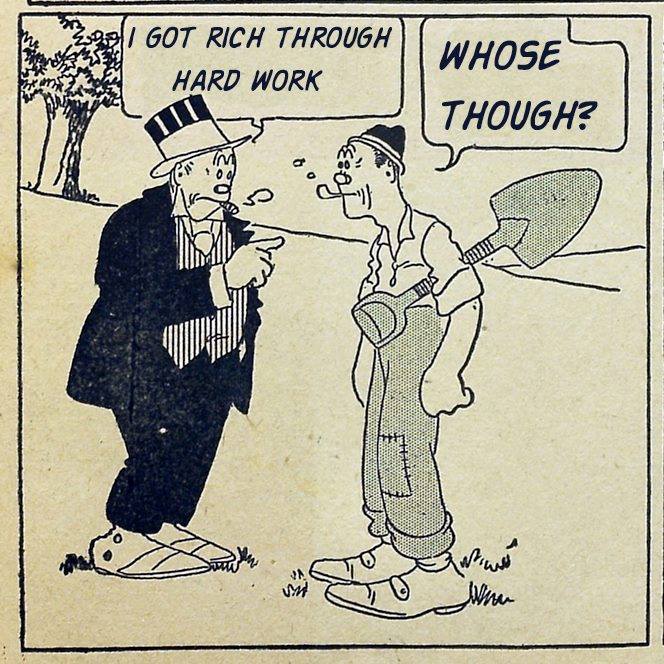
Given the well-established history in the United States of institutional racism, social exclusion, and problems associated with the difficulty of overcoming intergenerational poverty, can you see how someone confronting this might  see violence, rioting, and burning down their neighborhood as the last remaining rational response to oppression caused by the overwhelming power of these interlocking social forces?

In the wake of the Baltimore riots, city officials are considering new measures to help curb the kind of violence the city experienced in the wake of Freddie Gray’s murder by police officers. They are considering a policy that would prevent individuals caught rioting, looting, destroying property, or acting in a violent and unlawful manner from collecting government benefits (they would be permanently revoked). The punishment also applied to minors, so that parents of underage individuals who are captured while engaging in criminal activities related to the rioting would be held accountable and risk losing state benefits  (and potentially custody of their child).  Do you think this is an appropriate response to public protest?

baltimore-time-cover-20467986238_b892b21d49_b

Course: Policing, Race, Crime & Justice

We are the 53%

19 Comments

53percent_guy

The different responses to the “We are the 99 percent” movement are somewhat funny, though they are also a little bit heartbreaking and tragic for the level of cognitive dissonance they imply.

Recalling former Presidential candidate Mitt Romney’s famous gaffe that “47% of Americans were takers” (in the sense they were not paying taxes – not true), the self-declared “Mr. 53%” depicted here aimed to declare how he, by way of contrast, was not a taker (aka slacker/not “entitled”). He says he doesn’t blame Wall Street for the fact that, despite his being a veteran, he has had to struggle to work and pay for school. For him, these struggles are something akin to a badge of honor that he wears with pride.

For a different point of view, consider what this blogger has to say:

“I bet the Wall Street elite are thankful that they have some idiot kid with no sense of history willing to act as one of their brown-shirts if things start getting ugly in this new class war. There aren’t too many of the top 1% who are ex-military and a lot of liberals are afraid to death of former soldiers. I served too, and I’d like to tell this kid something. I didn’t serve in the military to protect a country that seems only out to make life better for the richest few.

If the conservative hero Ronald Reagan hadn’t slashed the living shit out of the GI Bill this kid would have had a lot easier time making it through college. He could have done it in four years while only working part-time. But Saint Ronnie said that government spending sucks so he made a complete mockery of educational benefits for veterans (while drastically increasing overall military spending). If you don’t believe me you can look it up. I was actually serving during the Reagan administration and luckily for me I had completed most of my degree before I enlisted.

And f*^ck you for calling people whiners who are fighting for the rights of the working class. I’d be the first to say that many of the Occupy Wall Street folks have their heads up their asses and don’t have much of an idea of what to do, but at least they are doing something. They are actually protesting so people like you don’t have to work like a 16th century peasant.  I suppose that you think the early union organizers in America were whiners for trying to protect workers from the worst abuses of the industrial era. You should be ashamed of yourself instead of being so smug and high and mighty.

It was a huge government “bail-out” of returning WWII veterans that turned America into a country which actually created the idea of the middle class. Veterans were able to go to college and then buy home with VA loans. These men were mostly lower middle class deadbeats who would have never been able to afford a college education, much less buy a house. My father was one of those vets.

This was the United States government that did this, so be careful when you spew out shit from Rush Limbaugh criticizing the government. And perhaps you skipped the class on civics, but in a democracy we are the government. This means that if we don’t like something we can work to change it. If our elected officials aren’t carrying out our wishes, then we can protest our government. It’s legal and it’s in the constitution.  Try reading it sometime instead of having some right-wing moron spoon-feed you their bizarre interpretation of our founding document.

53alex

Discusion Questions

Based on our diverse readings about the plight of the white working class, what do you think might explain why the people pictured here, who are proud to claim they are “making it” without government handouts? Why do you think they don’t question the fact that they are forced to work so hard for so little?

Why are poor and working class people content to see their children sent to fight in wars of choice in exchange for free education? Why don’t they demand that education without a service obligation? Why do they let their children expose themselves to physical harm and even death, without fighting for other service/policy options?

Do you think policy makers are hesitant to make education “free” in the United States, because they might lose out on “volunteers” for military service?  

u3ogmyp

ccbui-tukaanozm

2e1e412405c0ac8134a65b3a07e2d96bb1e10b2112493003b66acc317f8c1e20

u7d2o

Course: Classical Social Theory, Policing

Should We “Fix” Poverty?

76 Comments

8-SMITH-Wanda

Poverty in the Land of the Free

Why is there so much poverty in wealthy country like the United States? And we might also ask: why do so many Americans dislike anti-poverty programs? This is the question posed by Martin Gilens in his (2019) book Why Do Americans Hate Welfare?

Dramatic cuts in welfare have been called for from politicians who represent both major political parties in the U.S. In this case, they are capitalizing on distorted public opinions and “feelings,” rather than data, to further erode crucial aspects of a social safety net that is already full of holes. So again, we must ask – why?

Gilens research aims to answer this question (more on that later). For now, lets take a look at some facts and information contained in official government statistics, which are put together by the US Census Bureau.

In order to talk about “poverty” we should first agree on a working definition.

To define poverty in America, the Census Bureau uses what are called ‘poverty thresholds’ or Official Poverty Measures (OPM), updated each year. Note that there are two different versions of the federal poverty measure. The differences may be slight but they are important:

  • The poverty thresholds, and
  • The poverty guidelines

Poverty thresholds are the original version of the federal poverty measure. They are updated each year by the Census Bureau. The thresholds are used mainly for statistical purpose — for instance, they are used to prepare estimates of the number of Americans in poverty each year. To be clear, all U.S. government official poverty population figures are calculated using the poverty thresholds, not the guidelines. These thresholds are applied to a family’s income to determine their poverty status. Official poverty thresholds do not vary geographically, but they are updated for inflation using Consumer Price Index.

Note that the official poverty definition uses money income before taxes and does not include capital gains or non-cash benefits (such as public housing, Medicaid, and food stamps). To put it simply, in 2020, a family of  4 is considered to be living in poverty if their family income falls below $26,200.

The poverty guidelines are another federal poverty measure. They are issued each year in the Federal Register by the Department of Health and Human Services (HHS). The guidelines are a simplification of the poverty thresholds, which are used to determine financial eligibility for certain federal programs.

Poverty as of 2019

In 2019, the overall poverty rate in the U.S. is: 10.5%  or 34.0 million people. Almost half of those (15.5 million) were living in deep poverty, with reported family income below one-half of the poverty threshold.

To put this is terms of income, the percentage of people who fell below the poverty line — $25,926 for a family of four — in 2019

Child Poverty Rate: 14.4% (10.5 million people)

Percentage of children under age 18 who fell below the poverty line in 2019

Women’s Poverty Rate: 11.5% (19.0 million people)

Percentage of females who fell below the poverty line in 2019

African American Poverty Rate: 18.8% (8.1 million people)

Percentage of African Americans who fell below the poverty line in 2019

Hispanic Poverty Rate: 15.7% (9.5 million people)

Percentage of Hispanics who fell below the poverty line in 2019

White Poverty Rate: 7.3% (14.2 million people)

Percentage of non-Hispanic whites who fell below the poverty line in 2019

Native American Poverty Rate: 23.0% (600,000 people)

Percentage of Native Americans who fell below the poverty line in 2019

People with Disabilities Poverty Rate: 22.5% (3.3 million people)

Percentage of people with disabilities ages 18 to 64 who fell below the poverty line in 2019

To summarize, these rates tell us that Whites by far constitute the largest number of people who are living in poverty; African Americans are disproportionately represented as a group (18.8% vs. 7.3% of whites). This out-sized representation contributes significantly to the perception that African Americans are taking advantage of the system, even though more whites receive benefits. Children are also represented in high numbers as are the elderly, who are not distinguished in this table.


United Nations Report on Extreme Poverty

Not long ago (December 2017), the United Nations Special Rapporteur on extreme poverty and human rights, Professor Philip Alston, issued a formal statement which provided an assessment of poverty in the United States. His report details findings from a 15-day fact-finding mission that took him into some of the poorest neighborhoods in the U.S., in states that included  California, Alabama, Georgia, Puerto Rico, West Virginia, and Washington DC.

Alston began his statement with a nod to the passing of sweeping new tax reforms, as he said “my visit coincides with a dramatic change of direction in US policies relating to inequality and extreme poverty. The proposed tax reform package stakes out America’s bid to become the most unequal society in the world, and will greatly increase the already high levels of wealth and income inequality between the richest 1% and the poorest 50% of Americans.”

Alston goes on to acknowledge that “the United States is one of the world’s richest, most powerful and technologically innovative countries; but neither its wealth nor its power nor its technology is being harnessed to address the situation in which 40 million people continue to live in poverty.”

“American exceptionalism,” he points out, “was a constant theme in my conversations.  But instead of realizing its founders’ admirable commitments, today’s United States has proved itself to be exceptional in far more problematic ways that are shockingly at odds with its immense wealth and its founding commitment to human rights.  As a result, contrasts between private wealth and public squalor abound.”

He further notes that “in practice, the United States is alone among developed countries in insisting that while human rights are of fundamental importance, they do not include rights that guard against dying of hunger, dying from a lack of access to affordable healthcare, or growing up in a context of total deprivation. . . at the end of the day, particularly in a rich country like the USA, the persistence of extreme poverty is a political choice made by those in power. With political will, it could readily be eliminated.”

[Note: Alston is also a professor of law at New York University].

The Deserving and the Undeserving Poor

Back to Gilens. His research calls upon a wide range of empirical sources to argue that the problem is more complex; that Americans don’t simply all hate welfare.

According to his findings:

Americans support government aid to people they believe are “deserving” recipients; in other words, the worthy poor.

Americans are grossly misinformed about who is actually getting formal  assistance, mainly because the media misrepresents welfare recipients.

Media representations, which are mostly visual, disproportionately over-represent African-Americans as aid recipients – especially single mothers.

Media executives, especially editors and journalists, are as misinformed as the public. Their life experiences are traditionally far removed from first-hand experiences of poverty/knowing poor people. This makes it difficult to them to understand and appropriately relate to those experiences, which in turn distorts media narratives and results in misreporting.

Distorted understandings of race are deeply embedded in the making of  welfare policy, resulting in welfare being understood as “black” serving program. As such, people judge it as not deserving of support (Gilens, 2019).

Contradictions

What is interesting about Gilens research is that he is able to analyze public opinion polling data to show that there is, in fact, widespread support for the idea of a social safety net in general and for welfare to the poor in particular. But there are some inconsistencies that emerge, as these sentiments did not carryover and translate as support for African Americans. What and how did this happen?

According to Gilens, media representations of people living in poverty changed over time. He studied book reviews and stories about poverty and noted that these started to increase in the time period of the 1960s. At this time, the number of welfare recipients started to grow in connection with the racial turmoil and civil unrest that occurred during that time. This was true for black as well as white recipients. Whites especially, due to their larger overall numbers, constituted the largest number of welfare recipients. Despite this, the public came to see welfare as a program that mainly benefited African-Americans. Gilens attributes this to distorted media narratives about poverty and welfare, many of which still have currency in our present time.

The important takeaway here is not that the media simply act as an amplifier of public opinion; they are in many respects responsible for manufacturing public opinion. Ultimately, this exerts an major influence on our public policy, which instead of being based on facts ends up cynically indulging people’s feelings about who should get public help and who should be written off as unworthy.

This is why we see in the United States that there is unwavering support for what are essentially draconian welfare reforms that have the effect of hurting the most needy in the interest of hurting those that the public believes should be punished. Americans, according to Gilens, support these cuts for reasons that they mistake who is on welfare, attributing many among them to be undeserving.

These views link up to other narratives and ideas that run deep in American culture. For example, the idea that everyone who works hard will be able to achieve their dreams, the idea that everyone must assert “personal responsibility” as this pertains to work and taking care of their family, and the idea that relying on the government help for any reason is indicative of personal failing.

A Perfect Problem In An Imperfect World

(The following article is re-blogged: “The myth destroying America: Why social mobility is beyond ordinary people’s control,” by Sean McElwee)

Many cultures have viewed poverty as an inescapable part of an imperfect world. Throughout history, societies have suffered from two kinds of poverty: social poverty, which withholds from some people the opportunities available to others; and biological poverty, which puts the very lives of individuals at risk due to lack of food and shelter. Perhaps social poverty can never be eradicated, but in many countries around the world, biological poverty is a thing of the past.

Until recently, most people hovered very close to the biological poverty line, below which a person lacks enough calories to sustain life for long. Even small miscalculations or misfortunes could easily push people below that line, into starvation. Natural disasters and man-made calamities often plunged entire populations over the abyss, causing the death of millions.

Today most of the world’s people have a safety net stretched below them [note: the very idea of a “safety net” is under attack in the United States for political reasons and ideologies born out of “free market” fundamentalism; some politicians have referred to the net as a “hammock”]. Individuals are protected from personal misfortune by insurance, state-sponsored social security and a plethora of local and international NGOs. When calamity strikes an entire region, worldwide relief efforts are usually successful in preventing the worst. People still suffer from numerous degradations, humiliations and poverty-related illnesses, but in most countries, nobody is starving to death. In fact, in many societies, more people are in danger of dying from obesity than from starvation.

As science began to solve one unsolvable problem after another, many became convinced that humankind could overcome any and every problem by acquiring and applying new knowledge. Poverty, sickness, wars, famines, old age and death itself were not the inevitable fate of humankind. They were simply the fruits of our ignorance.

We are living in a technical age. Many are convinced that science and technology hold the answers to all our problems. We should just let the scientists and technicians go on with their work, and they will create heaven here on earth. But science is not an enterprise that takes place on some superior moral or spiritual plane above the rest of human activity. Like all other parts of our culture, it is shaped by economic, political and religious interests.

Poverty, consequently, rather than being seen as a “technical” problem that might be fixed is often seen as a moral failing: it is the poor themselves that are to be blamed.

Research on Poverty

According to a new report from the Pew Research Center, Americans are almost evenly split over who is responsible for poverty and whether the poor have it easy or hard. Here are some factoids from the data:

44% think that the government should do more for the needy, even if it means more debt
51% think the government can’t afford to do more for the needy and shouldn’t
45% think that poor people today have it easy
47% think that poor people have it hard

pew

What is interesting here is how survey responses correlate with whether the respondents themselves are rich or poor. Not surprisingly, a proportionately larger number of the least economically secure (2/3rds) think government benefits don’t go far enough; the proportion of people who share this view diminishes among economically secure people (only 1/3rd). The pattern repeats again when people are asked whether the government should and can do more – 60% of the least economically secure say “yes,” while 62% of the most secure say “no.”

The Myth of the American Dream

In the United States, there is a strongly held conviction that with hard work, anyone can make it into the middle class. Pew finds, however, that Americans are far more likely than people in other countries to believe that work determines success, as opposed to other factors beyond an individual’s control. Unfortunately, this positivity comes with a negative side — a tendency to pathologize those living in poverty.

In other words, Americans are more inclined to blame individuals for structural problems. Thus we find that 60 percent of Americans (compared with 26 percent of Europeans) say that the poor are “lazy.” Only 29 percent of Americans say those living in poverty are trapped in poverty by “factors beyond their control” (compared with 60 percent of Europeans).

Again, it is important to distinguish here how the survey responses provided by people reflect their “beliefs” – and this differs from the data and evidence. While a majority of Americans might think that hard work determines success and that it should be relatively simple business to climb and remain out of poverty, the empirical reality is that the United States has a relatively entrenched upper class, but very precarious, ever-shifting lower and middle classes.

As for welfare, while many Americans hate welfare, the data suggest they are fairly likely to fall into it at one point or another. In their recent book, “Chasing the American Dream,” sociologists Mark Robert Rank, Thomas Hirschl and Kirk Foster argue that the American experience is more fluid than both liberals and conservatives believe. Using Panel Survey of Income Dynamics (PSID) data — a survey that tracked 5,000 households (18,000 individuals) from 1968 and 2010 — they show that many Americans have temporary bouts of affluence (defined as eight times the poverty line), but also temporary bouts of poverty, unemployment and welfare use.

Keep in mind that “welfare” is not just food stamps. This study tracked use of Medicaid, Temporary Assistance to Needy Families/Aid to Families with Dependent Children (food stamps), Supplemental Security Income, and any other cash/in-kind programs that rely on income level to qualify. The chart below illustrates different measures of economic insecurity experienced by people relative to time spent claiming benefits.

inc

Researchers found that a large number of Americans eventually fall into one of the “welfare” categories, but few stay “welfare dependent” for long. Instead, the social safety net does as it is intended – it catches them – and allows them to get back on their feet.

The same authors also found that the risk of poverty is higher for people of color. (Since the PSID began in 1968, most non-white people in the survey have been black.) And while most Americans will at some time experience affluence, again, this experience is segregated by race.

inc2

Social Mobility

In a study published earlier this year, Rank and Hirschl examine the top 1 percent of wage earners and find that entry into it is more fluid than previously thought. They find that 11 percent of Americans will enter the 1 percent at some point in their lives. But here again, access is deeply segregated. Whites are nearly seven times more likely to enter the 1 percent than non-whites. Further, those without physical disability and those who are married are far more likely to enter the 1 percent. The researchers, however, didn’t measure how being born into wealth effects an individual’s chances, but there are other ways to estimate this effect.

For instance, a 2007 Treasury Department study of inequality allows us to examine mobility at the most elite level. On the horizontal axis (see below) is an individual’s position on the income spectrum in 1996. On the vertical level is where they were in 2005. To examine the myth of mobility, I focused on the chances of making it into the top 10, 5 or 1 percent. We see that these chances are abysmal. Only .2 percent of those who began in the bottom quintile made it into the top 1 percent. In contrast, 82.7 percent of those who began in the top 1 percent remained in the top 10 percent a decade later.

mob

One recent summary of twin studies suggests that “economic outcomes and preferences, once corrected for measurement error, appear to be about as heritable as many medical conditions and personality traits.” Another finds that wages are more heritable than height. Economists estimate that the intergenerational elasticity of income, or how much income parents pass onto their children, is approximately 0.5 in the U.S. This means that parents in the U.S. pass on 50 percent of their incomes to their children. In Canada, parents pass on only 19 percent of their incomes, and in the Nordic countries, where mobility is high, the rate ranges from 15 percent (in Denmark) to 27 percent (in Sweden).

There is reason to believe that wealth, which is far more unequally distributed than income, is also more heritable. In his recent book, “The Son Also Rises,” Gregory Clark explores social mobility in societies spanning centuries. According to Clark, “current studies… overestimate overall mobility.” He argues as follows:

“Groups that seem to persist in low or high status, such as the black and the Jewish populations in the United States, are not exceptions to a general rule of higher intergenerational mobility. They are experiencing the same universal rates of slow intergenerational mobility as the rest of the population. Their visibility, combined with a mistaken impression of rapid social mobility in the majority population, makes them seem like an exception to a rule. The are in instead the exemplary of the rule of low rates of social mobility.”

Clark finds that the residual effects of wealth remain for 10 to 15 generations. As one reviewer writes, “in the long run, intergenerational mobility is far slower than conventional estimates suggest. If your ancestors made it to the top of society… the probability is that you have high social status too.” While parents pass on about half of their income (at least in the United States), Clark estimates that they pass on about 75 percent of their wealth.

Thus, what Rank and Hirschl identify, an often-changing 1 percent, is primarily a shuffling between the almost affluent and the rich, rather than what we would consider true social mobility.

The American story, then, is different than normally imagined. For one, many Americans are living increasingly precarious existences. In another paper, Hirschl and Rank find that younger Americans in their sample are more likely to be asset poor at some point in their lives. But more importantly, a majority of Americans will at some point come to rely on the safety net. Rather than being a society of “makers” and “takers,” we are a society of “makers” who invest in a safety net we will all likely come in contact with at one point or another.

The Gini Coefficient measures how equally distributed resources are, on a scale from 0 to 1. In the case of 0, everyone shares all resources equally, and in a society with a coefficient of 1, a single person would own everything. While income in the U.S. is distributed unequally, with a .574 gini, wealth is distributed far more unequally, with a gini of .834 — and financial assets are distributed with a gini of .908, with the richest 10 percent own a whopping 83 percent.

Wealth and financial assets are the ticket to long-term financial stability; those who inherit wealth need never fear relying on the safety net. And it is these few individuals, shielded from the need to sell their labor on the market, who have created the divisive “makers” and “takers” narrative in our contemporary politics.

Using race as a wedge, they have tried to gut programs that nearly all Americans will rely on. They have created the myth of the self-made individual, when in fact, most Americans will eventually need to rely on the safety net. They treat the safety net as a benefit exclusively for non-whites, when in reality, whites depend upon it too (even if people of color are disproportionately affected).

mob2

As many scholars have noted before, the way the welfare state works (where inefficient tax credits are given to the middle class) is a big part of why this delusion has been sustained.

It is therefore not that Americans believe themselves to be “temporarily embarrassed millionaires,” but rather “self-made men” (with a dose of racism and sexism), that drives opposition to the welfare state.

And by this, I mean that while most people understand they are not likely to become millionaires, few among them realize how much government programs have benefited them throughout their lives.

Sources

The source for this article, including the charts referenced in it is Sean McElwee. His original article, published by Salon, is entitled “The myth destroying America: Why social mobility is beyond ordinary people’s control.” Link no longer available.

Poverty Data Sources

The Census Bureau reports poverty data from several major household surveys and programs.

The Annual Social and Economic Supplement (ASEC) to the Current Population Survey (CPS) is the source of official national poverty estimates. The American Community Survey (ACS) provides single and multi-year estimates for smaller areas.

The Survey of Income and Program Participation (SIPP) provides longitudinal estimates.

The Small Area Income and Poverty Estimates (SAIPE) program provides model-based poverty estimates for school districts, counties, and states.

Discussion Questions

How should an affluent society like the United States respond to poverty?

Millions of Americans lack access to sufficient food and shelter. What should we do with them?

Why do you think so many Americans hate the idea of welfare even as they also support helping the poor?

Do you think the United States should provide for a social safety net? (setting a minimum threshold for subsistence…or not?)

When you close your eyes an imagine a picture of someone who fits the description of “deserving poor” what do they look like? Do the same for “undeserving poor.” What do they look like? (think in terms of age, gender, race).

What do you think about programs like Medicaid and Medicare? Do you know what they are and how they work? (one is an anti-poverty program and the other is a benefit for people over the age of 65 that is funded through payroll deductions over the course of one’s working lifetime). Should we maintain these programs, make them more or less available, or get rid of them?

How might “personal responsibility,” “personal freedom,” and “small government” narratives make it difficult to deal with social problems at the policy level?

How do you think we might address the problem of persistent inter-generational poverty and social inequality (think about places like Appalachia, WVA and Kentucky in particular, and even rural and deindustrialized parts of Pennsylvania)?

Do you think that the government providing things like job training and food stamps are enough to fix the problem? Is it too much help or not enough?

What do you think about the sentiment “No one deserves to be poor?” Or do some people deserve it and, likewise, deserve to be punished?

How might our economy be systematically organized, even “rigged,” to condemn many people, including a disproportionate number of African Americans, to live lives of poverty and desperation?

Look at your own neighborhoods and towns. Do you think the poverty that you see is a product of economic structural failure (widespread job loss and the re-ordering of the local economy to provide only low wage jobs) or do you think it is the result of people simply not working hard enough?

Course: Classical Social Theory, Current Social Theory, Policing, Race, Crime & Justice

White Pride: Disrobing the KKK

85 Comments

Members of the Ku Klux Klan turn their backs to the cameras or hide their faces during a rally held in New York City

Back to the Future

Although some might take comfort in the fact that decades have passed since the Ku Klux Klan lynched African-Americans, the hate group nonetheless remains active in its advocacy for the white power agenda. According to the Southern Poverty Law Center (SPLC), there are 41 states in the U.S. that have documented member chapters. Estimates suggest more than 5,000 active Klan members may be affiliated with local and national organizations. Local groups include the Fraternal White Knights of the Ku Klux Klan in Tennessee and Missouri,  as well as the national Knights of the Ku Klux Klan [more information about local chapters can be found on the SPLC website listed below].

The Ku Klux Klan, with its long history of violence, is the most infamous – and oldest – of American hate groups. Although African Americans have typically been the Klan’s primary target, it also has attacked Jews, immigrants, gays and lesbians and, until recently, Catholics. Over the years since it was formed in December 1865, the Klan has typically seen itself as a Christian organization, although in modern times Klan groups are motivated by a variety of theological and political ideologies. Started during Reconstruction at the end of the Civil War, the Klan quickly mobilized as a vigilante group to intimidate Southern blacks – and any whites who would help them – and to prevent them from enjoying basic civil rights. Outlandish titles (like imperial wizard and exalted cyclops), hooded costumes, violent “night rides,” and the notion that the group comprised an “invisible empire” conferred a mystique that only added to the Klan’s popularity. Lynchings, tar-and-featherings, rapes and other violent attacks on those challenging white supremacy became a hallmark of the Klan (Jacobs, 2014).

kkk

After a short but violent period, the “first era” Klan disbanded after Jim Crow laws secured the domination of Southern whites. But the Klan enjoyed a huge revival in the 1920s when it opposed (mainly Catholic and Jewish) immigration. By 1925, when its followers staged a huge Washington, D.C., march, the Klan had as many as 4 million members and, in some states, considerable political power. But a series of sex scandals, internal battles over power and newspaper exposés quickly reduced its influence (Jacobs, 2014).

The Klan arose a third time during the 1960s to oppose the civil rights movement and to preserve segregation in the face of unfavorable court rulings. The Klan’s bombings, murders and other attacks took a great many lives, including, among others, four young girls killed while preparing for Sunday services at the 16th Street Baptist Church in Birmingham, Ala. Since the 1970s the Klan has been greatly weakened by internal conflicts, court cases, a seemingly endless series of splits and government infiltration. While some factions have preserved an openly racist and militant approach, others have tried to enter the mainstream, cloaking their racism as mere “civil rights for whites.” Today, the SPLC estimates between 5,000 and 8,000 Klan members are split among dozens of different – and often warring – organizations that use the Klan name (Jacobs, 2014).

If-I-Were-Grand-Dragon-of-the-Ku-Klux-Klan

Photojournalist Anthony S. Karen spent the greater part of the last eight years documenting Klan organizations in 14 states across the country. Some of his photos appear below [more photos are published in his eBook, entitled “White Pride.”]

akarenkkk-4 Anthony Karen's photos of the Klan

Photo Credit: Anthony Karen

akarenkkk-10

Photo Credit: Anthony Karen

akarenkkk-2

Photo Credit: Anthony Karen

Discussion Questions

Why do you think some people engage in inter-group social violence, whereas others who might hold similar beliefs do not?

What is a hate crime and how is it different from ordinary crime?

Why is some violence sanctioned (or at least treated as a ordinary crime) but other violence that follows a similar pattern is defined as terrorism? Why is it that if a criminal has dark skin and/or is a Muslim then they are terrorists, but if they have white skin they are often simply understood to be criminals?

What is the difference between a “terrorist” and someone who affiliates with/engages in violence as a member of the KKK?

Sources:

Anthony Karen, 2009. The Invisible Empire: Ku Klux Klan. Powerhouse Books.

“What the KU KLUX Klan Looks Like Today,” by Harrison Jacobs. Business Insider, April 4, 2014.

Southern Poverty Law Center provides a listing of active KKK groups that you can access here.

Course: Policing, Race Ethnicity

#Ferguson – Hands Up! Don’t Shoot!

137 Comments

APTOPIX Police Shooting Missouri
Photo credit – Jeff Roberson, AP

The Battle of Ferguson

People across the United States and around the world were transfixed by the events that unfolded in Ferguson, Missouri during the month of August 2014. The uprising originated when an unarmed black teenager, Michael Brown, was shot and killed by a white police officer, Darren Wilson. While the event remains noteworthy, it is important to note that police accountability critics and activists have pointed out that Brown’s killing was not an isolated incident. They claim that abusive behavior among police in Ferguson pre-dated the shooting of Brown. Conflict in Ferguson, they say, had been smoldering in the community for a long time, fueled by racial animosity and a history of repression directed against Ferguson’s majority African American residents.

ferguson-missouri-michael-brown-protests-police

To say that the events there have been polarizing is a radical understatement. Community polling in the wake of the conflict documented extreme differences of opinion among residents. Interviews with residents and others outside the immediate vicinity of Ferguson demonstrate there is a complete lack of agreement reality about nearly everything pertaining to Michael Brown’s shooting. Basic facts are disputed regarding how the events unfolded that day – and they continue to be disputed (i.e. how many shots were fired? was the officer attacked?).

Differences of opinion between residents, it turns out, were found to be strongly correlated with demographic indicators of social identity (i.e. race, class, gender, socio-economic status, region/residence, and political party affiliation). That is to say, the understanding of basic facts as they pertain to the case were found to be contingent upon social identity factors, which played (and continue to play)  a powerful role in determining how people interpret what happened. And although there is no current research to document this, potentially the same might also be said about how people across the nation at large interpreted these events. And by this, I mean that a given individual’s understanding of the events there might be found to vary on the basis of the very same social identity factors.

01798a77422328c6fd1599aceb93bad7b7a0d5b3e8

Social identities (as opposed to facts) potentially explain why some people see Michael Brown as a criminally deviant teenager; one whose failure to comply with a law enforcement officer’s reasonable requests resulted in him being shot by a police officer. Alternatively, others see his shooting as the outcome of a more complex array of social forces: state-sanctioned murder resulting from a toxic combination of institutionalized racism, police militarization, implicit racial bias, and the hyper-criminalization of black youth – all reflecting what some critical theorists have variously termed the institutionalization of “white racial supremacist capitalism.”

violence-erupts-ferguson-missouri

American Apartheid

Amnesty International published a report filed by the delegation they sent to monitor police activity in Ferguson and report human rights violations. Observers called attention to what academics in the United States have been writing about for years: social inequality in the U.S., as indicated by widespread, nationally persistent, patterns of racialized social segregation, is made worse by racially discriminatory police practices. Some of those practices are the result of the discretionary powers granted to individual police officers, though it is also the case that those practices are shaped in significant ways by the systematic and formal enactment of institutional policies and directives.

The Amnesty report findings were issued along with demands that the U.S. government do more to address “systemic racial discrimination.” Navi Pillay, formerly the United Nations High Commissioner for Human Rights said:

“Privately I was thinking that there are many parts of the United States where apartheid is flourishing.” Another observer commented: “I saw a police force, armed to the teeth, with military-grade weapons. I saw a crowd that included the elderly and young children fighting the effects of tear gas. There must be accountability and systemic change that follows this excessive force.”

Bear in mind now how ground-breaking/precedent setting it is to have human rights organizations, whose debates about human rights abuses are typically directed at countries outside the United States, to now focus their attention on U.S. soil. According to Steven Hawkins, Executive Director of Amnesty International USA, “What Amnesty International witnessed in Missouri on the ground this summer underscored that human rights abuses do not just happen across borders and oceans.” Yet the question remains: How will the world act when the abuser is the United States taking action against their own people?

3

410508_1280x720

police-shooting-missouri-1

Police Militarization

One issue that continues to generate attention has to do with the increased militarization of local police forces. In light of this, it is important to take into consideration how community policing has changed over the years. There is much to discover by taking stock of the different national and local policy initiatives scholars, journalists, and civil rights activists argue are having a lasting damaging impact on our residential communities.

The aggressive posture taken by local, state, and county law enforcement in Ferguson Missouri has drawn attention to these issues in a way that abstract arguments about militarization and equipment transfers never did. Numerous photos and videos circulating in both traditional, as well as social media, dramatically illustrate what critics have alleged is a warrior mentality shared among the police, or to put it another way, an “us vs. them” mentality. The problem with this, of course, is that when police act this way, they are essentially telling the public: “You are our enemy and you will obey us. And you will obey us regardless of whether or not our behavior is lawful. Because if you don’t obey us, bad things might happen to you.”

Protestors and local residents in Ferguson were treated by the police there in a manner that is not much different than the way an Army treats hostile enemy combatants. Military hardware and military-style weapons, including flash-bang grenade devices, were used as a standing operating practice in Ferguson. Noteworthy here is that despite being marketed as “non-lethal,” flash-bangs have been documented on many occasions to cause serious injury and even death.

Police-in-Ferguson.Charlie Riedel, AP

Photo Credit – Charlie Riedel, AP

Do BlackLivesMatter to the Police?

The issue of race and policing and the movement politics that have developed in the wake of high profile police shootings is an obvious issue that Ferguson calls attention to. According to a report published by ProPublica, data confirm that black youth in the United States aged 15 to 19 were killed at a rate of 31.17 per million, compared to 1.47 per million for their white counterparts. The disparity, in this instance, reflects blacks are 21 times more likely to be shot by police than whites (statistics derived from data reported to the FBI between 2010 and 2012). The report went on to say, furthermore, that it’s mostly white officers who are responsible for the killings.

On Twitter, the hashtag #BlackLivesMatter served as a vehicle to mobilize critique against the grand jury decisions not to indict police officers Darrell Wilson and Daniel Pantaleo. Social media, in this respect, rallied around the deaths of Michael Brown, Eric Garner, and so many others, in order to ingite a conversation about institutionalized racism that many believe to be endemic to police power, the state, and the criminal justice system in the United States; a system that many people feel sanctifies the actions of white police officers with impunity at the same time as it affirms disposability of  black lives.

0173923b59f9f7aa98f36d929707190714f5cb45e0

Reporting Police Involved Deaths of Civilians

The report further noted that reporting the killing of civilians is optional. Consequently, the actual numbers and the corresponding rate is likely to be much higher.

An old episode of the Daily Show used humor to point out the absurdity of voluntary reporting. You can watch the interview, which features a discussion with criminologist and author David Klinger, by pasting this link into your browser: http://www.cc.com/video-clips/v4l2pe/the-daily-show-with-jon-stewart-a-shot-in-the-dark

Not only does the FBI not mandate reporting as part of its UCR reporting requirement, the DOJ/Bureau of Justice Statistics confirmed that other government efforts to construct data on what are termed police-involved deaths have been off for more than a decade — by more than 100 percent!

Alternatively, DOJ report estimates document “an average of 928 law-enforcement homicides per year” from 2003-2009 and 2011 — this means that previous yearly tallies by the BJS and the FBI included fewer than half of all such deaths. The FBI reported an average of only 383 “justifiable homicides by law enforcement” per year over the same period. Comparatively speaking then, the BJS numbers were slightly closer to reality, averaging 454.

These numbers, by the way, do not include the deaths of bystanders, deaths during vehicular pursuit, or deaths at the hands of federal agents.

pic

There Are Many Fergusons

Long-simmering community resentment over issues of race and class-based social inequality boiled over in Ferguson, particularly as this relates to law enforcement and police practice. Whereas the residential population in Ferguson is approximately 65% black, the police force is 98% white.

In light of this, scholars and other critics like Marc Lamont Hill have pointed out that the problems of Ferguson are, in fact, problems that many communities throughout the United States struggle with; there are essentially many Fergusons. Consequently, there is evidence mounting that the exploding racial tension here portends more wide-spread social disruption.

The situation in Ferguson was made worse when St. Louis supporters of Darren Wilson (the police officer who shot Michael Brown) sold t-shirts to baseball fans to wear as a show of support at a St. Louis Cardinals playoff game. “Go Cards’ was hand-painted on the front and “Darren Wilson 6″ on the back. The significance of the “6,” which was also emblazoned on wristbands as “We got your 6,″ is military parlance that means “I got your back.” The number 6, coincidentally, is also the precise number of gunshot wounds Brown suffered in the shooting.

666

Digital Surveillance

One last word on digital surveillance, its increasing prevalence, and how we all might encounter it differently, as it is deployed by law enforcement against citizens and vice versa. We have arrived at a point in time where despite the fact that court systems in the United States have repeatedly ruled it is legal for citizens to film police officers, the police continue to harass, beat up, and arrest citizens and journalists who exercise their constitutional rights to do so. Some of this new technology has scholars and activists expressing deep concern, as they warn that anyone and everyone is potentially at risk and can be deemed a threat.

Stingrays, also known as “IMSI catchers” and “cell site simulators,” are particularly invasive surveillance devices that mimic cell phone towers. So, what does this technology do precisely? It effectively puts up a wall between the user’s phone and their cell service provider, forcing phones in a targeted area to send data to the police instead of the nearest cell towers. The phones, in other words, are “tricked” into passing data to the government/police, who are connecting to users personal devices without their knowledge or consent. This raises serious privacy concerns, as many people rightly question how they (and the data) are being used.

The effective range of the technology is considerable: devices can gather records of every cellphone call, text message and data transfer up to a half a mile away. Potentially, non-criminal, non-protesting bystanders are easily caught up in the sweep. This means you don’t have to be a criminal, suspect, or protestor to have your information intercepted- you merely need to be within range of an event and have an operating cell phone in your possession.

Stingrays were first systematically deployed in the U.S. during the Occupy Wallstreet demonstrations to track people who were determined to be “agitators,” though they are now widely deployed whenever there is planned large-scale political protest activity taking place – protests that ostensibly represent protected “free speech.”

Police Shooting Missouri

Outrage In Missouri Town After Police Shooting Of 18-Yr-Old Man


Ferg

Discussion Questions

Do you think it’s okay for a police officer to shoot an unarmed individual if they run away and/or don’t stop running when commanded to do so?

What do you think about police tactics like “Stop and Frisk?” and tactics that target political protestors? Do you think these policing tactics are being practiced in ways that violate people’s basic civil rights? Does this concern you?

When you see police, do they make you feel safe or threatened?

Do you think the police unfairly profile some groups of people more than others? Or are they merely focusing limited police resources on high crime areas?

How do you think your own social identity (relative to dominant power structures) potentially influences your views of law enforcement in general and police officers in particular?

When you reflect on your own personal experiences with law enforcement, what do you think? Do you think your experiences representative of what other people experience or might your experience be different?

Do you find it hard to think about police encounters in a structural way (not just in terms of your own subjective experiences)?

What do you think about the proliferation of cameras and other forms of video technology? How might it be impacting police practice? Do you think the technology (i.e. filming) is good or bad?

Does it bother you to know that you personal privacy is not secure and that your individual movements are being tracked through public and cyberspace?

Sources

Read more about Amnesty International’s “Free Thought Project” as it pertains to Ferguson.

article-2726755-2093252800000578-299_634x455


934877_1518457188421036_5441618563714449232_n

Police Shooting Missouri

Course: Policing, Race, Crime & Justice

Policing the Black Body

56 Comments

sdsdf
photo credit Tim McDonagh, The Atlantic

Recent events haunt black communities like ghosts from the past; a past that people like to think of as a violent era long gone— yet we have the tragic deaths of people like George Floyd, Breonna Taylor, Antwon Rose, Trayvon Martin, Eric Garner, Michael Brown, and countless others. Their forebearers are people like Emmett Till. Whatever you might think of it all, one thing is certain: these recent deaths are not “accidents” — they hark back to the history of the founding of the country and the collective memory of enslavement.

Local History and Biography

Many of you have grown up with fixed ideas about race one way or another; you’ve developed racialized understandings that operate like  intellectual short cuts about social problems based on your social location (residence/neighborhood, family, friends, school) with clear-cut understandings of who is poor, who is dangerous, and who is a good person. Terms like “welfare,” “affirmative action” and “food stamps were your bêtes noirs (meaning: things people dislike). Other concepts like institutional racism, structural poverty, neighborhood redlining, and the “poverty tax” were not nearly as familiar.

Life experiences are also different. You’ve grown up in different neighborhoods, many of which have been racially & spatially segregated, which means opportunities for social contact have been  limited. This, in turn, creates a situation where people rely on media depictions and imagery to tell them stories about people that they don’t know.

Consequently, you might find yourself wondering: how it is that someone might be confined for months in jail for only misdemeanor offenses? Why don’t people simply follow the police officers’ instructions (to prevent them from being executed)? You might also find it also strange that someone who is innocent might get pulled over for “looking like the suspect” or for “race out of place” – both of these situations arise out of the condition of being a black body in a white neighborhood and/or “driving while black.”

Discussions about voter rules continue to be a hot topic. You’ve probably wondered: “How are there adults in the U.S. who have no ID? And no bank accounts? Who are these people? How do they vote? How do they live? What planet are they on?

It may strike you as hyperbole to say that the United States uses deadly violence, domestically as well as abroad, to discipline, control, and kill black bodies – but it’s not.

Blackness and Physical Power

Narratives that describe the athletic prowess of tennis’s Williams sisters tends to focus on them “overwhelming'” and “destroying” their female opponents. In doing so, they call upon enduring stereotypes of the ‘dangerous’ black body and the ‘strong black woman,'” Serena, in particular, has been described as “pummeling,” “overwhelming,” and “overpowering” vis a vis her (apparently frail and powerless) white female opponents.”

Venus-williams

It’s true that sports metaphors include reverences to violence – “crushed,” “killed,” and “destroyed” aren’t unusual words to hear when describing wins. But descriptions of Serena’s power and the strength behind her victories have taken this type of hyperbole to another level — one that suggests she’s absolutely unparalleled in her strength and capacity for violence, especially as compared with her white opponents.

Writing for Rolling Stone in 2013, Stephen Roderick observed, “Sharapova is tall, white and blond, and, because of that, makes more money in endorsements than Serena, who is black, beautiful and built like one of those monster trucks that crushes Volkswagens at sports arenas.”

Black male athletes, like LeBron James, are also often depicted as possessing a problematic excess of physicality.

Uncovered: Possible Inspiration For Controversial LeBron James Vogue Cover  | HuffPost

These depictions of physical excess are not trivial matters; they find their roots in slavery. That they continue to circulate as fact in our contemporary society has enormous social repercussions.

Rewind to Ferguson, Missouri, and the officer who shot Michael Brown, Darren Wilson. When testifying in court, officer Wilson characterized him as being really “big” (Brown was actually only one inch shorter than Wilson, who is 6 feet four inches tall). Here are some excerpts from his testimony, where he justified using deadly force on Brown because his perceived physicality made him fear for his life:

“I see [Brown and Dorian Johnson] walking down the middle of the street. And the first thing that struck me was, they’re walking down the middle of the street … And the next thing I noticed was the size of the individuals, because either the first one was really small or the second one was really big.”

“I tried to hold his right arm and use my left hand to get out to have some type of control and not be trapped in my car any more,” Wilson said. “And when I grabbed him, the only way I can describe it is I felt like a five-year-old holding on to Hulk Hogan.”

“He (Brown) looked up at me, and had the most intense, aggressive face. The only way I can describe it – it looks like a demon. That’s how angry he looked.”

“At this point it looked like he was almost bulking up to run through the shots, like it was making him mad that I’m shooting at him … And the face that he had was looking straight through me, like I wasn’t even there, I wasn’t even anything in his way.”

Links Between Slavery and Law Enforcement

John Matteson, Distinguished Professor of English at John Jay College of Criminal Justice in New York City, believes that the violence exhibited today is contextually linked to slavery and has become part of the culture over time.

In an interview with The Root magazine, Matteson explained “Slavery was a form of privatized law enforcement.” “What it did was take a number of the powers that are typically reserved to the government—the power to discipline … the power over another person’s life—and it conferred those powers on private individuals. And there’s this continuing undercurrent in particularly Southern culture where there’s a reluctance to get the government involved if you can avoid it, because there’s just a sort of general distrust of centralized authority” (Edwards, 2014).

According to Matteson “What we have here is a legacy from slavery that the assumption was, a black person is controlled through violence, not through the application of law or reason” (Edwards, 2014).

The sort of argument that runs in people’s minds between violence and the maintenance of order is ingrained not only on a societal level but also on a family level,” Matteson explained. Children often become acculturated to violence through beatings during their upbringing; on some level then, children may learn “to associate discipline with violence and order and the proper order of things, with the application of violence from a stronger person to a weaker” (Edwards, 2014)

To this end, Matteson continues, “I would suspect also that when you find a violent cop, or somebody who’s excited about the prospect of vigilante justice, I would guess … that you’re going to find that those abusive cops and the gun-toting nuts are very often people who themselves have experienced abuse” (Edwards, 2014).

“Because abuse, as we know, is something that replicates itself from generation to generation,” he continued, “and if people start their lives by viewing everything through a lens of violence, it’s going to turn up in racial violence, but it’s also going to turn up in domestic violence. It’s going to turn up in the dysfunction of the individual human being in a myriad of ways.” (Edwards, 2014).

Visual Iconography

Visual depictions of black bodies being brutalized have become de rigueur. Telling stories through the depictions of bodies can, however, be positive as well as negative.

More recently, with the advent of social media, people have used images of bodies as a way to reclaim their power, where the body is shown to be  a site of empowerment.

If you were to tell a story about your body or any body, how might you use visual imagery to do so? What are some examples of visual imagery that make a statement about body power?

Here’s an example:

tumblr_n4jlmfpNN01rwazoko4_r1_1280

Queen of the Court: Serena Williams – Singles Tennis Number 1 Ranked Woman in the World,  2002; doubles, 2010.

Matters of the Intimate/Matters of State

The female body and the raced body are, more than others, the targets of organized state-sanctioned violence. The question is why? 

For Discussion & Reflection

How are the violent structures/institutions of the state implicated in regulating the domains of body as well as the intimate (including sexuality)?

How are the prison and the barracks similarly involved in the enterprise of regulating intimate body relations through violence?

Why/how do states find is it productive to regulate bodies using different practices, many of which involve state-sanctioned violence? How is race, class, and gender used as a means to determine which bodies should be regulated? Why is so much effort put into doing this?

Sources & Additional Reading

Coates, Ta Nehesi Coates, excerpt from “Between The World and Me: Letter to My Son.” The Atlantic, July 4, 2015.

Du Rocher, Kristina. Raising Racists: The Socialization of White Children in the Jim Crow South. Lexington, Kentucky: The University Press of Kentucky, 2011. 248 pp.

Edwards, Breanna. From Slavery to Ferguson: America’s History of Violence Towards Blacks. The Root, September 27, 2014.

Gordon, Lewis R. Bad Faith and Antiblack Racism. Atlantic Highlands, New Jersey: Humanities Press, 1995. 222 pp.

Reger Zach and Lauren Steele. Politics of the Black Body Series Explores Questions About Media and Visual Representation, 2014.


Course: Policing

Policing and the Family

19 Comments

smiling-teachers1

The Significance of Others

In the summer of 2014, after a string of violent incidents involving police officers killing unarmed civilians, a number of different counter-demonstrations supporting police officers were circulated in social media. For example, consider the photo above published by the New York Post, which shows Teachers from Staten Island wearing their NYPD t-shirts as a show of support for police officers shortly after Eric Garner’s death [he died when a police officer applied a chokehold to subdue him for selling loose cigarettes]. While a number of teachers cited the reason for wearing the shirts was to protest their union’s support for an Eric Garner rally, there were others who criticized their peers for the public display and the timing of it, which they felt was potentially disrespectful of many of their student’s feelings.

Not surpisingly, given that the overwhelming number of police officers working in the United States are white men, their most passionate defenders are correspondingly more often than not white women – wives, sisters, girlfriends, mothers, and daughters. They are all in a word – family.  The overwhelming whiteness of the group photo is doubtless the most powerful message it conveys (even if it is unintentional). Among the arguments typically offered by family members rallying to the defense of police officers are claims such as “you don’t know them like we do,” “police should always be respected because they are honest, hard-working people with difficult and dangerous jobs,” and “it’s only a few bad apples that get all the attention.”

This particualr photograph demonstrates how the politics of race, class, and gender are deployed in what I call the “post-traumatic economy of militarized law enforcement.” Economy here is suggestive of a relational ontology between people, images, objects, and things; it is post-traumatic in the sense that the visual imagery demands we see, recognize, respect, and honor police officers and at the same time not “see” social divisions based on race, class, and gender. Militarized policing, in this respect, inscribes itself as a trauma on the bodies of both those who police and those who are policed, even when the traumatized don’t register recognition of their trauma.Compulsory forgetting, witnessing without seeing, and testifying without speech are all symptomatic of how militarized law enforcement manifests itself through a psycho-social process that relies on shock ,dispersal, and repression to elude understanding.

In what amounts to nothing less than a stunning reversal of the more traditional defense of “white womanhood,” the above photo suggests that a defense of “white manhood” concomitant with the defense of white womanhood might be asserting itself as a social bulwark against encroaching “otherness” represented by poor and minority ethnic communities.

Daddy’s Little Girl

Pictured below is Kathryn Knott, the daughter of a Philadelphia area police chief, Karl Knott. Her behavior was cited recently in the media, if only because in this particular case she served as her own documentarian. As noted above, Knox to some extent embodies the increasingly prevalent trend among police family members to engage in the defense of “white heterosexual manhood.” Not surprisingly, we find her described by her lawyer among others as “a young woman who’s never been in trouble” and as a girl who “comes from a wonderful family” with a law enforcement background.

Pol fam

As it turns out, Knott was arraigned alongside two male companions for “aggravated assault, criminal conspiracy, simple assault and recklessly endangering another person” when a group she was traveling with was caught on video beating two gay men in Philadelphia earlier this month. Knott’s Twitter feed only added to the social media outrage when it revealed a different side of her character than the one portrayed by her lawyer.

knott tweet

tweet2

Taken altogether, it might be productive to reflect on how the post-traumatic economy of militarized law enforcement reflects the history of racial segregation, economic inequality in the United States. Think about the historic role played by law enforcement in policing race, class, and gender boundaries; boundaries that continue to be challenged, as evidenced by the ongoing conflict that unfolds daily across the social landscapes of our city streets and towns. As the photo and tweets remind us, it is simply not possible to fail to notice the overwhelming white power structure that predominates in police departments like those in Ferguson, Missouri as well as in places like Philadelphia and Bucks County, Pennsylvania.


IMG_6740

Discussion Questions

What are we to make of social patterns as they relate to issues of race, class, gender, and sexuality when it comes to  local practices that involve community policing?

How do you account for the disparities that you see or hear about when it comes to issues that involve the police? Do you think there is a problem with police behavior, or do you think the reporting of these incidents is exgaggerated by people who are simply “playing the race card?”

Do you count among your own friends and family members of the law enforcement community? And if so, how might that impact as well as infomr how you see and interpret conflicts like those taking place in Ferguson, MO, Cleveland, OH, Baltimore, MD, and  New York City?

Do you find it difficult to reltate to people and protesters in places like Ferguson, where the lived experience of individuals might contradict and/ or reside far outside your own lived experience?

019eaa171062dae47d7660cc644e54c76b26112adb


Course: Policing

From Mayberry to Martial Law

29 Comments

mb1

Funding Police Militarization

What do local law enforcement have to do with the United States Military? As it turns out, apparently a lot.

In 1997, Congress passed the National Defense Authorization Act. Burried deep inside this legislation was the 1033 Program. What does this program do precisely? The 1033 Program allows the Law Enforcement Support Office to transfer excess Department of Defense property to law enforcement agencies across the United States and its territories. The Law Enforcement Support Office (LESO) serves as a bridge between the U.S. military and local law enforcement agencies with oversight conducted by the Pentagon. The LESO has two slogans: “Transferring Property from the Warfighter to the Crimefighter” and “Get with the Program.”

Mb2

The 1033 Program’s original mission was to provide additional support for the War on Drugs, which commenced back in the 1970s. Increased funding for law enforcement was at this time triggered during the Nixon administration. It was given addtional support from President George W. Bush’s War on Terror, declared in aftermath of 9/11, which provided a massive boost to the militarization of American police forces. Congress decided at this time that if law enforcement personnel were waging a drug war, they needed to be outfitted like warriors.

jnhvgvg

Serve and Protect or Search and Destroy?

So how many surplus weapons are we talking about? By the end of 2014, the 1033 Program will have transferred over $5 billion worth of military property to local police forces.

During the first six months of 2014, the 1033 Program had transferred almost $750 million (¾ of a billion dollars) worth of equipment–a figure that represents nearly double 2013’s entire yearly total of $450 million. It’s about the same amount transferred through the program from 2000 until 2007.

If we continue at the current rate in 2014, the total dollar value of equipment promises to approximate 1.5 billion dollars. In other words, one third (30%) of the entire 17 years worth of equipment transfers will have been accomplished in 2014 alone.

mb3

mb5

This is what an MRAP looks like…a nice pretty blue one!

CPDtank
Columbia South Carolina Police Department

army.mil-30907-2009-02-27-100244
U.S. Army unit posing with their MRAP in Iraq

The progressive arming of police departments with military grade hardware is troubling for obvious reasons. Even more troubling is how all of this has occured in spite of the following contradicitions:

  • Crime has been trending downward in many parts of the United States for years, falling an estimated 19% between 1987 and 2011.
  • The job of being a police officer has become safer, as the number of police killed by gunfire plummeted to 33 in 2013 — a rate that indicates a 50% decrease from 2012. Incidents of police officers being killed on the job are  documented to be at their lowest level since the year 1887, a time when the U.S. population was 75% lower than it is today.
  • A report by the Justice Policy Institute, a not-for-profit justice reform group, shows that state and local spending on police has soared from $40 billion in 1982 to more than $100 billion in 2012. When you add federal level spending on law enforcement (including FBI, Alcohol, Tobacco and Firearms, the Drug Enforcement Agency, and much of the Homeland Security Department budget, in addition to federal grants to state and local law enforcement) this more than doubles that total.
  • The federal Bureau of Justice Statistics reports that the ranks of state and local law enforcement personnel swelled from 603,000 to 794,000 between 1992 and 2010. This number represents almost two-thirds as many men and women as are presently serving in the entire active-duty US military.

Privatizing Prison Profits

The following short clip offers a critical perspective on these developments and considers them in light of increasing profits that are being made as a result of states outsourcing prision services to private corporations:

What this means is that the large scale deployment of law enforcement personnel armed with military equipment is occuring precisely at a moment in time when crime is trending downward. In short: police activity in America is ramping up at the same time as the crime rate is falling.

Social science research cites a variety of reasons are likely to be driving decreasing crime rates. Experts agree, first of all, that crime rates started falling far in advance of police militarization activity. So it’s not a simple case of increased investment in law enforcement causing crime to fall. The story is a good deal more complex. Some researchers cite increased immigration as a factor which influences the trends down, because of those families’ emphasis on strong family ties. Others point to an aging population—older people commit fewer violent crimes.

But what about terrorism? Isn’t it the case that if we’re fighting them “over there” it’s only a matter of time before we are fighting them “over here?” The nation recieved over 34 billion dollars in federal funding from Homeland Security grants to help local police fight terrorism (some of this money was paid on top of funds for the 1033 program).

MB6

MB7

All of the equipment transferred under the 1033 Program is considered military surplus. This is provided at no added cost to taxpayers, because it’s already been paid for once with federal income taxes. The only additional funds required are funds for shipping and maintenance. The Pentagon confirmed, however, that more than 1/3 of everything transferred through the 1033 Program is brand new. By creating what is essentially a new “market” for military hardware, defense contractors and the Pentagon have cleared the way to spend more taxpayer dollars on the purchase of newer toys and hardware.

MB9

Again, it is important to remember that the 1033 Program was started to combat the War on Drugs. Local police departments thus stand a much greater chance of getting equipment if their jurisdiction falls within one of the designated 28 High Intensity Drug Trafficking Areas determined by the DEA— this drug surveillance zone covers territory that includes 2 out of 3 (60%) people in the contiguous U.S. Stop now and think about that. Because if you are having any thoughts as you sit here reading this that it’s not likely to impact you and the neighborhood that you live in….that YOU are not a target. You might want to think about that again.

MB10

Course: Policing

Angry White Men

186 Comments

9ufxJ (1)

Why Is It Always a White Guy?

The socialization of males in American society, which varies considerably based on one’s race and social class, relies in no small measure upon the encouragement of men to achieve self-definition, independence, strength, and a sense of purpose through violence. In other words, the masculine attribute of wielding violence effectively is celebrated far more so than other masculine virtues like being a good protector and family man.

Military service represents the paragon of this ideal, however, we see how this dynamic is similarly prevalent in sports and fitness activities. Interlocking fields of male endeavor, in ways that are both overt and covert, participate in the social reproduction of what is essentially a socially sanctioned cult of violence; one that confers honor and status upon men that can establish dominant status over weaker men and women as well as those who are members of defined racial/ethnic groups. Real men bring the pain. Women are pain.

But let’s not just pick on the men here – women participate in this too. When women join institutions that have been created by men for men, who often merely tolerate women (i.e. police, military, prisons), they are forced to adopt the prevailing values of the organization in order to “fit” the culture and achieve recognition and success. Rejecting presentations of self that evoke a “feminine” persona, they will sometimes favor gender-neutral presentations, and participate with like enthusiasm in a culture that is violent and abusive toward women and other non-white male groups (they do so to be perceived as one of the “cool girls”). This involves a dynamic psychological process of self-negation that can be deeply harmful. In other words, adopting/mirroring some of the worst of what has historically been male-gendered behavior is not the way to achieve equality; it’s the behavior of a weak person who is trying to pretend they are a strong person (but everyone smells the fear).

Sociologists have gone to considerable lengths to study issues like domestic violence and gang violence. But very little work looks at violence specifically in connection with white men as a social group. In his book “Angry White Men,” Michael Kimmel, a sociologist at Stony Brook University in New York, takes up the issue of American anger within the context of male entitlement (what he calls “aggrieved entitlement” and criminologist Mike King calls “aggrieved whiteness.” He explores an idea that has achieved quite a bit of recent currency: the idea that white Americans are the real victims of racism/reverse racism; that they have become oppressed victims of politically correct “woke” multiculturalism.

Pointing to what he calls “masculinity at the end of an era,” Kimmel addresses his critique to straight-identified white men, whom he argues are unhappy with changes that occurred in American society over the past 30 years. According to Kimmel “meritocracy sucks when you are suddenly one of the losers.”

southern_pickup-1280x960

At a gun show in Shippensburg, Pa., Kimmel passed time with a guy he calls “Rick,” who manages the K.K.K. table. Men like Rick, he points out, “feel like they’ve been screwed.” They suffered financial losses as a result of a series of recessions and other economic changes, which left them feeling emasculated and humiliated. The outsourcing of most traditional manufacturing jobs and the rise of the service economy, says Kimmel, produced nothing short of a radical cultural shift. “Betrayed by the country they love,” he writes, they are “discarded like trash on the side of the information superhighway.” These particular men are “downwardly mobile…and they’re mad as hell.” They are among the new group of super fans that want to restore America to the good old days – to make America great again.

Their sin, according to Kimmel, is a failure to adjust. Yet what many find difficult to admit is that for years they benefited from a birth privilege that put white men on top.

White men, he writes, “have been running with the wind at our backs all these years,” and “what we think of as ‘fairness’ to us has been built on the backs of others.”

This new  “fairness” that they are being forced to confront now feels like oppression.

Yet what’s really happening here, Kimmel argues, is that their economic role has changed and they don’t know who to hold to account or what to do about it.

knuckle 3

So instead of adjusting to social change, Kimmel says, some men have chosen to feed their rage. But they don’t get mad at the corporate overlords who shipped their jobs overseas or the banks that took their houses. No. Instead, they rage at ball-busting feminists (“feminazis”) for stealing their American manhood; they hate immigrants for stealing their jobs; and they seethe with resentment over the idea that poor people on welfare are picking their pockets and living off their tax dollars.

Man holding Confederate flag during US Captiol riot arrested | Donald Trump News | Al Jazeera

To pass the time, America’s angry white men listen to other angry white men like Rush Limbaugh, Mike Savage, and Tucker Carlson on the radio and on podcasts; their kids stay busy playing violent video games and, in the worst case scenario, open fire on their classmates at school.

Oddly enough, all of this is occurring at a moment in time when white men still maintain almost all the power in the United States.

There is, I should add, a growing movement among men to claim that white men are the real victims[for more on this see MRM/Men’s rights movement].

Working Class Social Identity: Joe Lunchbucket vs. The Welfare Queen

White working-class men comprise a large demographic in the American social landscape. Andrew Levinson writes in his book The White Working Class Today that nearly half of white men and 35-40% of white women in the labor force identify as “working class.” Their occupations span skilled and unskilled as well as young and old workers. With that, if we were to locate the moment in time when this group became disaffected, we would have to go back to the time period of the race riots in the U.S., which occurred in the late ’60s and ’70s.

Joe Lunchbucket

Photo by Rebecca Cook/Reuters

At this time, black social identity became identified with urban decay, social disorder, and most especially “welfare.” President Ronald Reagan captivated would-be voters (especially white male working class democrats) as he learned to capitalize on these populist sentiments when he invoked his now famous “Welfare Queen” script.

From a campaign strategy perspective, this diversion helped to effectively redirect whites’ attention away from the economic dislocation and other disruption caused by his administration’s “trickle down” economic policies of the late 70s and 80s.

The “great communicator,” as he was known, effectively channeled white anger and outrage and helped redirect it toward blacks. Working class whites, who would otherwise vigorously defend social welfare programs like Medicare and Social Security, ultimately associated “welfare as we know it” with blacks, whom they felt were not deserving of benefits for lack of having contributed to the system through paid work like whites.

Adding fuel to the fire was the fact that black incomes rose during this time period while many white incomes stagnated. Major economic changes, combined with desegregation politics and school busing programs (all of which were perceived negatively by whites), occurred within social context that saw increases in anti-poverty (War on Poverty) New Deal successor programs aimed at blacks. This created deep social cleavages that remain intact in our present day.

The “War on Poverty” turned out to ultimately be a war that working-class whites would not support; it is a war that continues  to rampage across our contemporary social and political landscape.

So where do we go from here?

The trick is perhaps to not demonize these groups (working class white men) but to engage in dialogue to understand them. Questions for policymakers and members of political parties who desire engagement with these men could include changes in social policy could help ease some of their perceived sufferings.

Bear in mind that despite their historic structural advantage, working class groups across the race and gender divide have endured economic hardships that cannot be addressed through continued “hard work.”  Almost all working class people are suffering economically, though it appears that its only the white working class men who are taking up arms.

Here is the puzzle box: How do we call attention to social problems that are demographically associated with “whiteness” and patriarchal social structures (which are shown to foster problematic, even violent behavior) without alienating white men?

Interview with Michael Kimmel:

https://www.youtube.com/watch?v=eo6oR73FCXA

Sources:

For a more in-depth look at these issues, consult the article written in Slate.com by Jamelle Bouie, entitled “Why Democrats Can’t Win Over White Working Class Voters.”

Michael Kimmel, Angry White Men: American Masculinity at the End of an Era, Nation Books, 2015.

The 3 white men who killed Ahmaud Arbery are found guilty of murder : NPR

The 3 white men found guilty of the murder of Ahmaud Arbery

school

Shooters Gallery of Angry White Boys

Discussion Questions:

What do you think about Kimmel’s main argument? Do you think there might be a relationship between “entitled” male anger and high-profile incidents of violence? What other explanations might you offer?

What does Kimmel mean by his term “aggrieved entitlement”?

What do you think about Kimmel’s theoretical framework? His theory draws from a model that identifies the following social variables to make an argument about what kinds of places might be more at risk for school shootings: 1) local gun culture; 2)local gender culture; 3)local school culture; 4) political ID; 5) race; 6) religion; 7) and region. Do you think this model could help identify schools at risk (though perhaps not outright predict) mass shootings and school violence?

How does Kimmel’s framework explain the “God, Guns, and Gays” concerns of working-class white voters? Why do cultural issues like this appear to trump the economic concerns of this group?

Do you have a relative or friend that listens regularly to what some refer to as “hate media” and “outrage media?” Do they gravitate towards conspiracy theories? Have you noticed changes in their behavior and general level of happiness over time?

Course: Policing, Race Ethnicity

Soldier or Police Officer?

110 Comments

military_1920x1080_3981

There is perhaps no other topic that generates public controversy and divisive opinion than that which pertains to the question: What is the proper role of police?

Doubtless, the criminal justice system has undergone massive change over the course of the last 20 years in the wake of the 9-11 tragedy in New York. World events have caused many Americans to question what they want their policemen and women to do on a daily basis. Should they, for example, be public servants, who “Serve & Protect?” Or should they be soldiers, policing the homeland to fight the war on terror? Do we want them to be exclusively focused on drug crimes, leaving violent crime, white collar crime, and other offenses to languish without resources and attention? Or perhaps we want them to be social workers, who just so happen to carry a gun to work every day?

Policing Evolution or Revolution? The New Military Urbanism

Authors Stephen Graham and Radley Balko both argue in their respective books, “Rise of the Warrior Cop:The Militarization of America’s Police Forces” (Balko) and “Cities Under Siege:The New Military Urbanism,” (Graham) that a shift is underway, where military doctrine, battlefield tactics, and methods of population control are increasingly being integrated into urban police forces. These developments, according to Graham, “dramatically blur the juridical and operational separation between policing, intelligence, and the military; distinctions between war and peace; and those between local, national, and global operations.” The end result of this process is what he calls the “new military urbanism.”

Aggressive police practice, while not new, is getting increased attention due to the proliferation of social media and organizations dedicated to calling attention to high profile incidents of police crime and violence.

Normalizing Police Violence: Order Maintenance Policing

As we have discussed in class, the military equipment associated with SWAT operations and the military mentality that the use of such equipment apparently breeds is not confined to those special operations units. Increasingly, they’re permeating all forms of policing.

In the recent time period, since the turn to the 21st century, the two dominant models of policing have been the Community Policing Model and the Order Maintenance Policing Model. In terms of what we see put into practice (despite a lot of “happy talk” to the contrary) the Order Maintenance Model has apparently won out. This has occurred despite overwhelming research and evidence that demonstrates community policing models are more effective – Order Maintenance models potentially create more problems than may have existed in the first place. The Order Maintenance Model is a model that appears to be built for police militarization, with its emphasis on harsh counterinsurgency tactics.

Community Policing – officers wear traditional uniforms on foot patrol in Philadelphia

Karl Bickel, a senior policy analyst with the Justice Department’s Community Policing Services office, observes that police across America are being trained in ways that emphasize force and aggression. The dominant model in police training today is a stress-based regimen that aspires to mimic military boot camp. This model has replaced the more relaxed academic setting that a minority of police departments still employ. The result, in his view, is that young officers become acculturated to an idea of policing that privileges “kicking ass” rather than working with the community to make neighborhoods safe. Likewise, we increasingly see police departments adopting different versions of the military battle-dress uniforms (BDUs) for patrol officers. These militaristic, typically black or olive-drab jumpsuits, according to Bickel, make them less approachable and possibly also more aggressive in their interactions with the citizens they’re supposed to protect.

Oddly enough, the authoritarian approach stands in opposition to the dominant philosophy that distinguished twenty-first-century American police thinking: community policing. This model of policing was intended to emphasize “keeping the peace” by creating and maintaining partnerships of trust in the communities served. The community policing model, which also happens to be the official policing philosophy of the U.S. government, sees officers as protectors that are also problem solvers; they’re supposed to care who lives in their community and about how their community see them. According to this model, officers don’t command respect, so much as they earn it. Rather than aiming to instill fear, officers are supposed to work to foster trust.

Police Recruiting

Police recruiting videos (like those from California’s Newport Beach Police Department and New Mexico’s Hobbs Police Department) don’t play up the community policing angle, but rather emphasize military adventurism and aim to attract young men with the promise of Army-style high-tech toys. Policing, as depicted in videos like the one shown here, isn’t about calmly solving problems; it’s about the boys “getting their war on” and breaking down doors in the middle of the night.

Now compare this video to a recruitment video produced by a New Zealand police department. Can you see a difference? Compare and contrast the two approaches. What themes do you see being are emphasized in American and New Zealand videos and how are they different? How do you think the two approaches might result in different types of people being recruited and hired for police work? In which of the two examples do you see future officers being taught to operate as a domestic occupying army, where citizens are potentially viewed as enemy combatants? Which police force would you rather work for?

A small research project at Johns Hopkins University appears to back up Bickel’s claims. People were shown pictures of police officers in their traditional uniforms and in BDUs. Respondents in the survey indicated they would much rather have a police officer show up in traditional dress blues. Perhaps like this?

cops

Summarizing the survey findings, Bickel writes, “The more militaristic look of the BDUs, much like what is seen in news stories of our military in war zones, gives rise to the notion of our police being an occupying force in some inner-city neighborhoods, instead of trusted community protectors.”

This is consistent with other research undertaken by researchers in criminology, who have concluded that the order policing model is deeply implicated in the rise of the new military urbanism. This model stands at odds with the community policing model – the “serve and protect” model – that many assume to be the dominant policing model.

5-POLICE_SWAT

Militarizing Childhood

Research on the interaction between police departments and children is presently lacking. Judging from the photos below, efforts to instill a military mindset appear to start early.

Drill Instructor for the Asbury Park New Jersey Youth Police Academy

Drill Instructor, Asbury Park NJ Youth Police Academy

1800272_970201369663526_8535877970908473014_n

Summer camp for kids run by the Cumberland, MD police department.

Police Militarization Doesn’t Affect Me

Unfortunately, despite the torrent of photo/video evidence that has become commonplace in today’s fluid media environment, this is not enough to foster meaningful change in the way we deploy police officers in our communities. Absent action at the policy level or the grassroots level, where individual citizens organize and agitate for change, we are left to continue to speculate how long it will take to remove what we are told are simply “a few bad apples.” The images have become almost an entertaining source of “outrage” consumption, but again it’s not bringing about changes in practice.

For many of us (perhaps college students in particular), the brutality depicted in the video clips is not likely to touch our lives (or so we think). Police violence is quickly becoming normalized in U.S. culture and this is a problem. The vast majority of citizens don’t have regular police encounters, given that the focus of policing tends to be in poor minority communities, where the residents are poor, assumed to be violent, and are judged as deserving of the added police attention.

In light of all this, if you are still not disturbed by any of this, if you are not concerned about socializing children into a culture of violence (not simply firearms used for hunting) but more, and/or you simply don’t think police militarization is a problem for society, then it’s unlikely additional evidence or research will convince you otherwise. Perhaps at some point in the future, if you are subject to an accidental no-knock raid on your home that kills your dog or maims your child (it’s okay, it was an innocent mistake), you might arrive at a different understanding. But until then, you’re good.

Okay. Let’s take a different approach, since caring about the physical, emotional, and inhumane trauma inflicted upon your fellow citizens is not a priority; let’s look at how this hits you in your wallet. Consider the following statistics as a taxpaying citizen:

    • San Diego paid $5.9 million to compensate for sexual assault against multiple women by one officer.
    • A city southwest of Tucson AZ spent $3.4 million to pay for one deadly SWAT raid.
    • Boston settled a single case of police brutality for $1.4 million that left a man with permanent brain injury.
    • Scottsdale AZ paid $4.25 million for the fatal shooting of an unarmed man.
    • Baltimore paid $5.7 million in private settlements plus an additional $5.8 million in legal fees for police brutality.
    • Minneapolis paid close to $21 million since 2003
    • Oakland CA paid $74 million from 1990 to present
    • Los Angeles paid $54 million in 2011 alone; recently they paid $1.5 million on a single case of a California Highway Patrol officer beating a homeless woman senseless at a traffic stop.
    • Chicago paid $521 million over the past decade; $84.6 million in 2013 (includes court and legal fees).
  • pepper-spray-cop-goes-to-kent-state-30768-1321902129-34

    Pepper spraying cop goes to Kent State

And the King of them all ……

The New York City Police Department spent nearly 1 billion dollars on settlements in connection with police brutality; 964 million from 2000 – 2010; $765 million in 2012. The New York figure is expected to reach $815 million by 2016.

Keep in mind, most of these city-wide figures do not always take into account the legal costs of cases that are processed through the “justice” system, where violent police officers are excused and victims are left with nothing. It doesn’t count the money individuals who are not compensated must spend to take care of medical expenses (like the parents of the baby hit by the flash-bang grenade, who were recently told by their local municipality that there was no evidence of wrongdoing and that no damages would be awarded).

Discussion Questions:

What do you think about concerns as this pertains to the militarization of police? Do you think this is a problem?

Do you think police forces should patrol their neighborhoods like soldiers or should they interact with the public in a different way?

What if lawsuits and settlements were taken directly out of police budgets (instead of taxpayer funds)? Do you think that would have an impact decreasing police violence and brutality?

What if individual police officers were required to obtain the equivalent of malpractice insurance? [this is a standard practice for attorneys, medical doctors, and other professionals]

When you reflect on your own encounters with police, do you think of them as civil servants who “serve and protect,” or do you see them as agents of repression and/or “revenue generators” whom you regard as potentially hostile?

Do you think there may be links between socio-cultural factors, where people raised in a culture that glorifies gun ownership and violence may be prone to see police violence as a natural and just response to crime?

Do you think violence is “normal” within police culture (not a simple matter of a few bad apples) or do you think we can easily weed out the bad actors through disciplinary action?

How do you think police training might contribute to the problem of police brutality and violence?

When you see videos like the ones depicted here, do you think incidents of police violence are increasing, or are we finding that social media combined with aggressive reporting has simply increased visibility of a problem that has always existed?

Italian Police. Not bad.

Sources

Some of the content for this post appears in an article written by Matthew Harwood, entitled “To Terrify and Occupy: How the Excessive Militarization of the Police Is Turning Cops Into Counterinsurgents.” You can find the full content of the article posted here.

cartoon

jsfbd

Course: Criminal Justice, Criminology, Policing, War & Society

Censoring Disorder

53 Comments

censoring disorder

Freedom of Speech. Freedom of Press. Freedom to Peaceably Assemble. Citizens in the United States have the right to engage in peaceful protest activity, as guaranteed by the 1st amendment, regardless of whether they are doing so in public parks or on public sidewalks and streets.

Recent events, particularly those that occurred in connection with Ferguson Missouri and the different Occupy and Black Lives Matter (#BLM) Movements, suggest that these rights are being challenged by federal, state, and local authorities. Even members of the public have come out to criticize public protest when they find it is inconvenient or feel the cause is not one that affects them.

Student activists are increasingly coming under fire on college campuses around the country. For instance, U.C Davis students protesting campus governance and CUNY students protesting everything from tuition increases to the adjunct appointment of the former General and CIA Chief David Petraeus, who many accuse of complicity with war crimes, have all been variously pepper sprayed, beaten, and jailed by campus security and local police for engaging in constitutionally guaranteed free-speech activity.

Two of our authors, Stephen Graham and Radley Balko, look at the trend of criminalizing student protest activity; a development that they situate within a general critique of the militarization of society and police forces in particular. Instead of merely looking at the “small picture” of whether or not the students were polite/impolite or whether the protesters did/did not have permits, the authors help us to situate the activity within a larger social spectrum of developments taking place in the United States [note: you can find a concise rendering of information on what constitutes lawful protected protest activity on the New York Civil Liberties Union website http://www.occupyyourrights.org/].

Untitled

The UC Davis pepper-spray incident  occurred on November 18, 2011, in connection with an Occupy Movement demonstration. Students seated on a paved path on the campus quad were, after failing to respond to an order to vacate the premises, sprayed by UC Davis police officer Lt. John Pike. This photo and a video of the incident went viral and became an Internet meme. Later, in October 2013, a judge ruled the officer would be paid $38,000 to compensate for pain and suffering he claimed he was forced to endure as a result of his own actions.

CCNY Students Protest

In September of 2013, 6 CUNY students were arrested during a protest that took place on the street outside Macauley Honors College (see video below). Students and alumnae were similarly arrested together at City College, a major hub for student organizing activity in the CUNY system, when the Morales/Shakur Student and Community Center was closed without warning by the CCNY administration. Two CCNY students were “banned” from CUNY campuses without due process (one student was as forcibly removed from class by campus security). To make matters worse, the university’s proposed (and recently voted to change) policy on “expressive activity,” which essentially codifies/legitimizes this kind of violence against students in what can only be seen as an action intended to put a lid on student dissent at CUNY [a draft of the policy can be found here: http://www.cunyufs.org/EXPRESSIVEACTIVITIES.pdf].

Untitled

Link to the full article: http://blogs.villagevoice.com/runninscared/2013/11/tafadar_sourov_khalil_vasquez_ccny_

morales-shakur_criminal_charges.php

Free CUNY

OWS

Discussion Questions

What do you think about the student protesters and the police interaction in the video clip? Have you ever participated in a student-led protest?

What is the purpose behind maintaining a campus police force separate from the local community’s police department? [there are actually clear and good reasons for this]. Nonetheless, why does it increasingly appear that the tactics applied to deal with students are no longer different from that which we might expect not only from a civilian police force, but from an occupying army?

What explains the recent uptick in violent encounters between students and police officers? Are students becoming more violent, compared to students in the past, or are the police? How does this make you feel as a student? Do you feel comfortable engaging in protest activity on important issues (i.e. tuition increases), or do you feel afraid?

Based on the current anti-protest climate that is being cultivated by institutions AGAINST students, what does this say about the values of higher education? Do you think universities perhaps now care more about money than students?

Why are peaceful protests that are completely lawful continuing to be criminalized?

Why are universities, who are charged with the educational development and care of students, forming league with law enforcement to monitor student organizing activity and in many cases physically hurt them?

To what extent do you think these aggressive policies might potentially threaten and undermine the democratic promise of higher education?

What institutional structural comparisons might you make between prisons and universities? Do you see any similarities in terms of how the “clients” of these institutions are treated?

Occupy UC Davis Protests Police Pepper Spray Incident

Course: Policing, War & Society

Tweets by @SandraTrappen