

Gimmee a Smile
It’s safe to say that just about every woman and maybe even a few men have had some experience with the street phenomenon known as “cat-calling.” And now, due to the overwhelming power of social media, it is highly likely that a lot of you saw the viral video produced by the marketing company “Hollaback,” where a woman records her experience walking up and down the streets of New York City. While the video was powerful in terms of its marketing outreach and for shining a light on the problem of street harassment; it was nevertheless problematic in terms of the way it represented men. Most of the men that appeared in the video were poor and/or working class men, identified as black or latino. The production company, it turned out, edited out the white men, whose incidents of harassment were deemed to be not as sensational or camera worthy.
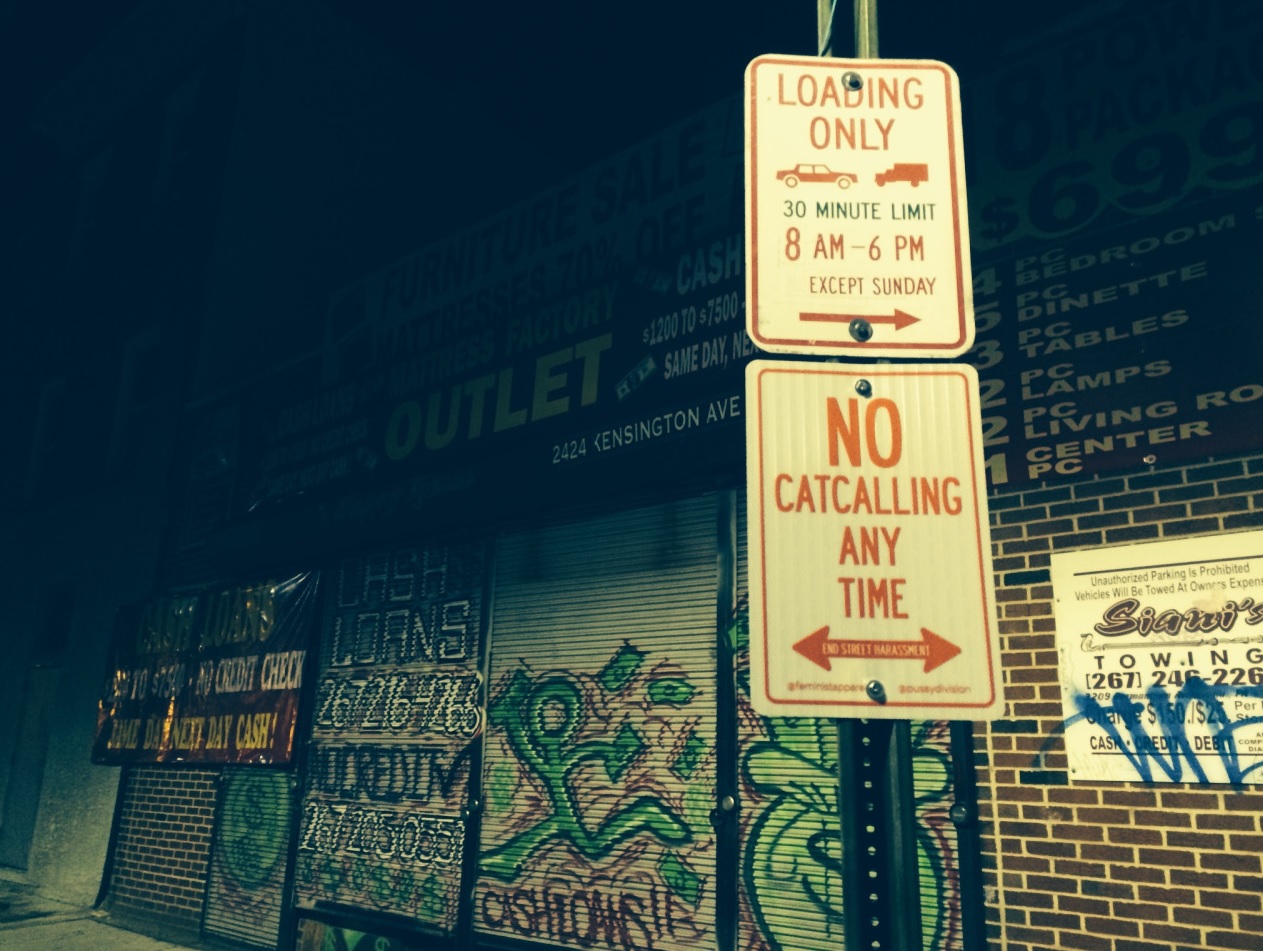
What Men Are Really Saying When They Catcall Women
Here again, we might use intersectional theory to help us make sense of the different experiences that people have in regards to street harassment, taking into account how this activity plays out in different ways (intersectional theory examines social dynamics on the basis of race, class, and gender).
The first video demonstrated how poor and working class men engage in street harassment. Now think about how not poor professional men, many who are often white, might engage in similar activity, even if it is not always on the street.
What if Dudes Catcalled Dudes?
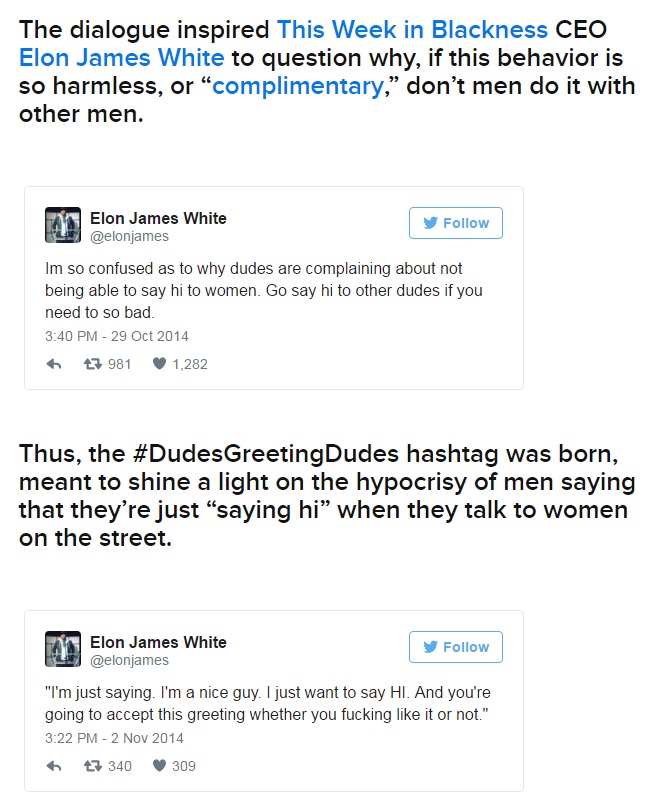
Elon Jame White, the CEO of This Week in Blackness, isn’t buying the “guys just want to say Hello” argument. He started the hashtag #DudesGreetingDudes to illustrate the absurdity of the idea.
The Comedians at Funny or Die are in on the joke too, as they take the absurdity to another level, acting out what it would look like if men said the kind of things to each other that they say to other women.
Benevolent Patriarchy
Why are women so sensitive about catcalling? Don’t they understand that men who are socially awkward are simply trying to say “hi?”
Not really. There’s actually a lot more going on here than meets the eye. These so-called greetings are a great example of what we might call “benevolent patriarchy.”
Let’s break this down a bit. What do we mean by “patriarchy?” Patriarchy refers to an ideology or belief system rooted in unique gender differences; it upholds the idea of a “natural” social order, where men are in charge and women are submissive. Patriarchy is the legitimating ideology that underlies the belief that it is just, right, and proper for men to control political, economic, corporate, legal, social, and marital spheres.
“Benevolent” patriarchy, on the other hand, represents a more insideous form of this type of thinking: it’s the same idea with nicer packaging. For example, the idealization of motherhood, the idea that women should look to men and expect protection, recognition, and leadership, from them. All rely, more or less, on tacit acceptance of the idea that female self-esteem should be grounded in male approval; and that female self-actualization takes place through men.
So what’s really going on with this greeting behavior?
First, the men are exercising their gendered prerogative to both control social space and women’s bodies. Women are supposed to “accept” the “compliment, which is really not a compliment at all, but an example of men exercising power over women.
Second, when women fail to respond or appreciate their greeting, they generally take advantage of the opportunity/opening to remind women of their place: to be an object (not a person) of male desire. Women who resist the greeting, don’t respond, etc. are written off as “bitches” and ingrates, who should be thankful they are getting male attention. See how that works?
In these instances, the men commit what sociologist Erving Goffman might call an act of “interactional vandalism.” When men call out to women subsequently indicate they are not interested in having a conversation with them, the men force women to technically “break the rules” of polite social interaction (refusing to acknowledge them). In light of this, catcalls are not greetings at all; they are examples of harassment pure and simple.
To illustrate the absurdity of benevolent patriarchy, comedian and This Week In Blackness CEO, Elon James White created the hashtag #dudesgreetingdudes. He serves up the following critique on Twitter:
Gender-based Street Harassment – “Prettiness is not a rent you pay for occupying a space marked ‘female.’”
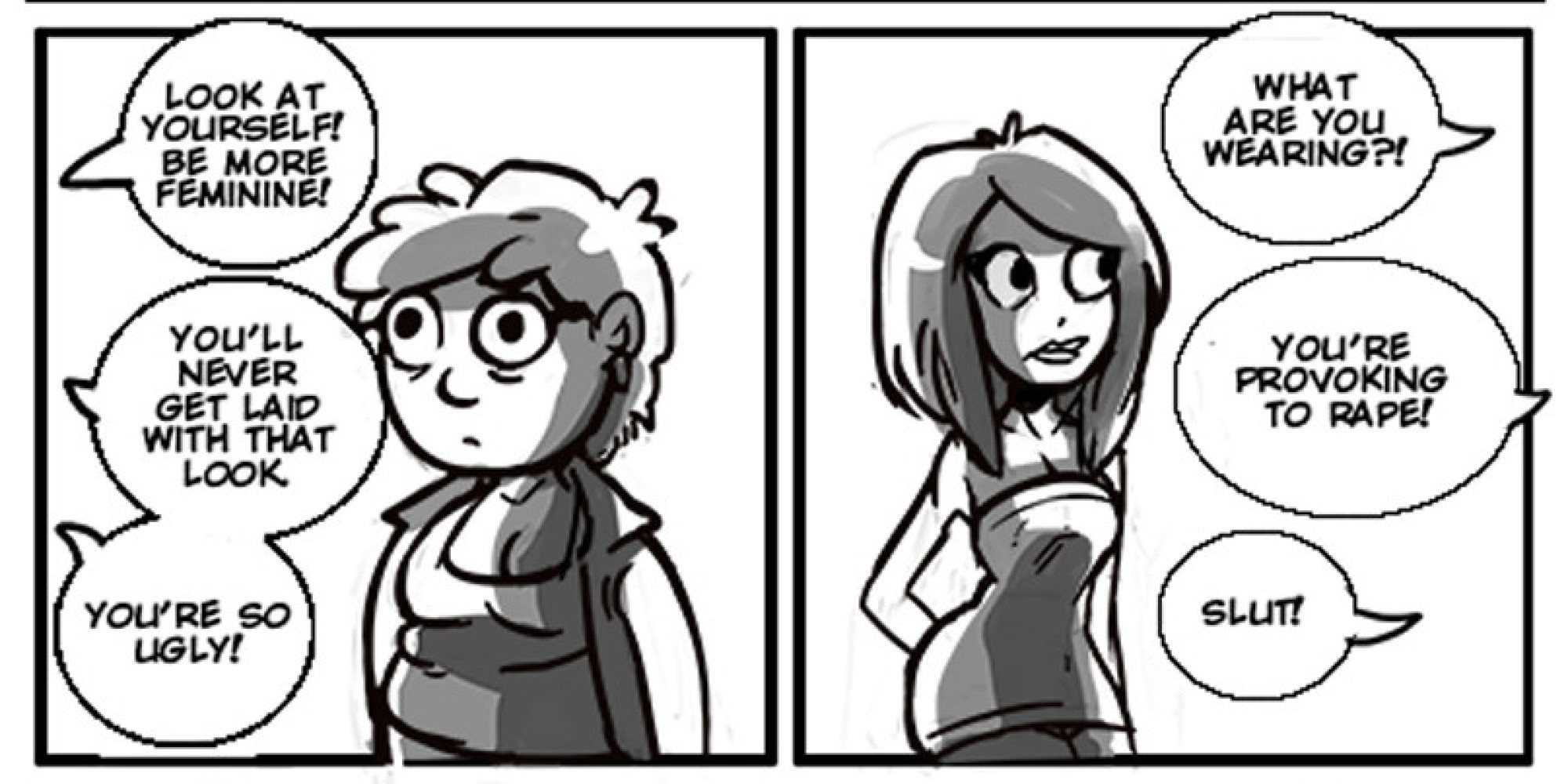
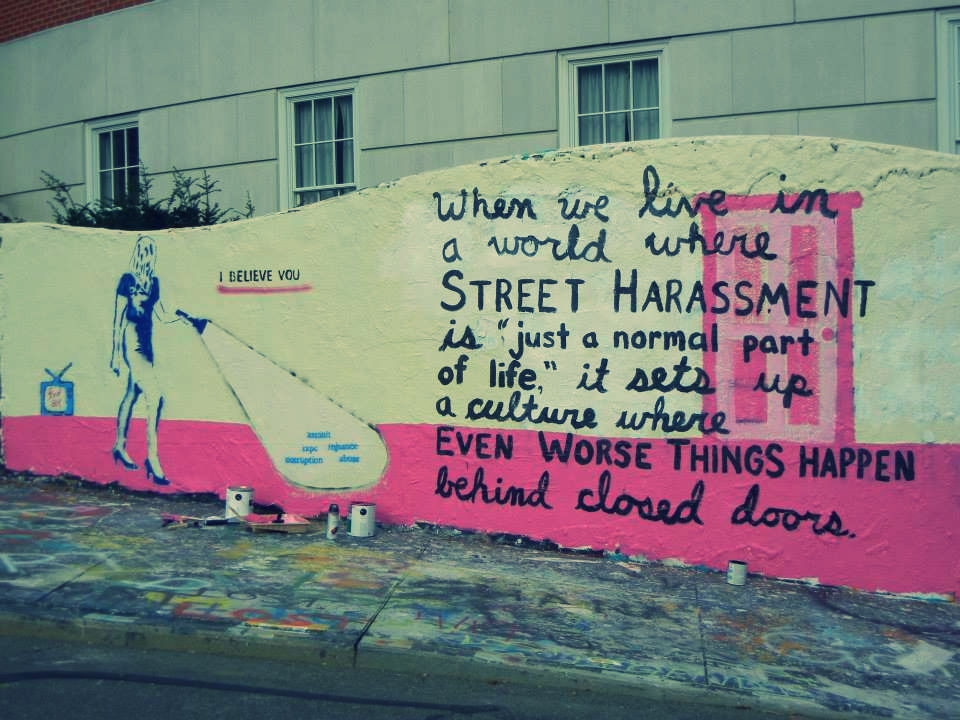
Gender-based Street harassment, which can effect men as well as women (though incidents reported by women are far more frequent and are to some extent normalized) , is part of a larger system opression, where men feel entitled to comment upon women’s bodies based on their appearance and mannerisms. This kind of harassment is based on the problematic idea that public spaces are actually “men’s spaces” and that women passing through them are subject to the desires, needs, and opinions of the men that own this space.
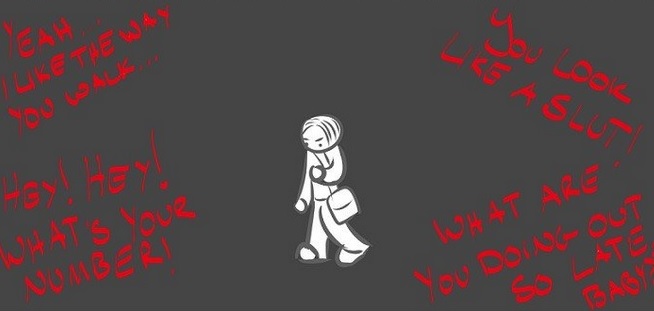
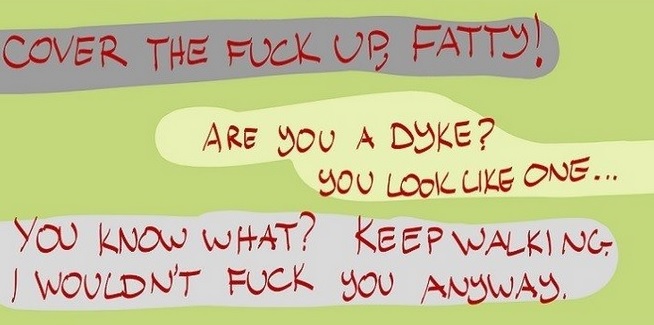
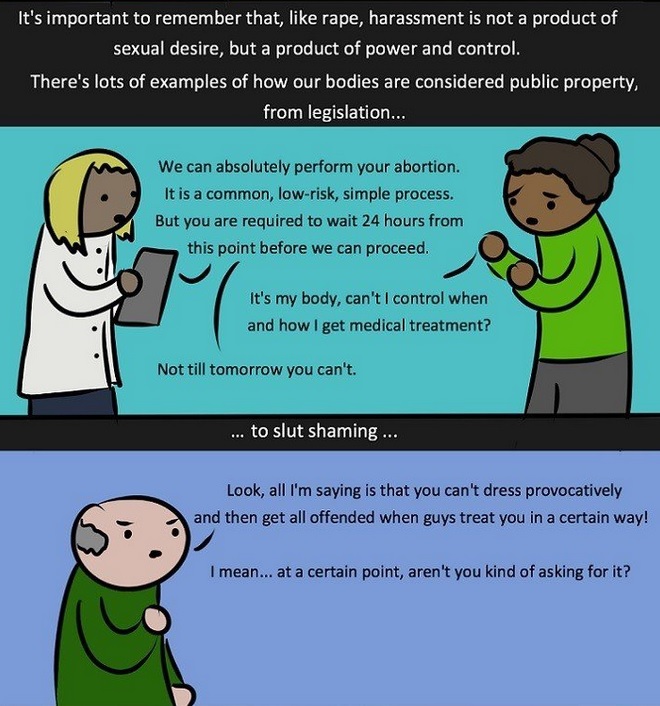
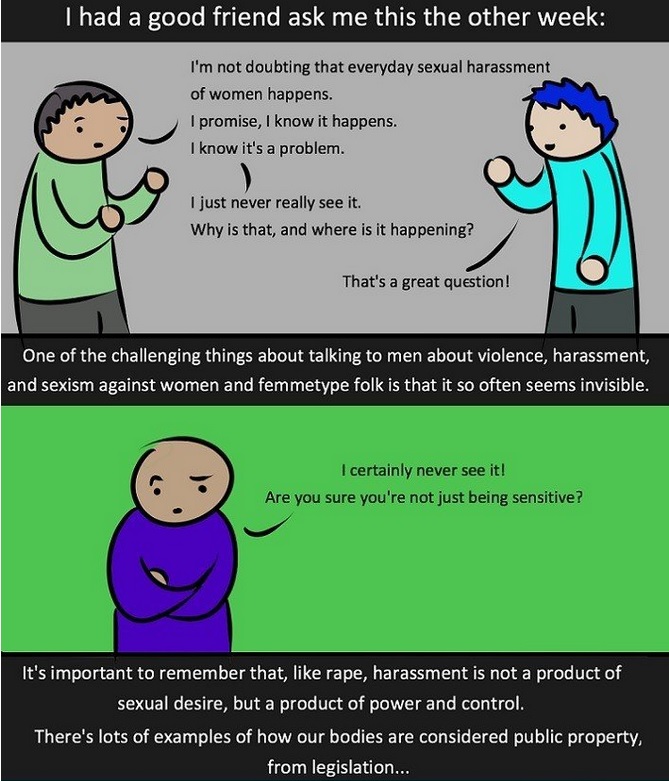
Sexual harassment is not about desireability. Nor as was stated earlier is it a simple matter of men simply wanting to offer a greeting or share a compliment; this behavior is about men feeling empowered to tell women who dare to encroach upon their social space that they are not sexy to them; that their appearance is not pleaseing; and that by resisting the terms of desirability that are implicit in this system of opressive objectification, they are subject to challenge, insult, and outright dismissal of their personhood.
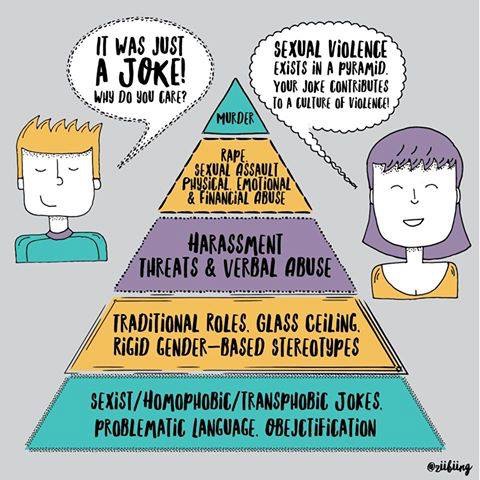
Behavior that many want to dismiss on grounds that someone is merely “joking” or offering a “compliment” is, in fact, sexually objectifying. Women are not being treated as women, who are worthy of respect; they are being treated as objects. This type of behavior, moreover, lays a foundation for progressively worse behavior that can lead to sexual violence.
Sources
For more on what does it mean to be pretty, check out his blog post by Erin McKean.
Discussion Questions:
Can you recall a time that you experienced street harassment? What was the social context and how did it make you feel?
How was your race/ethnicity potentially a factor in how you were treated? (or how you treated others?).
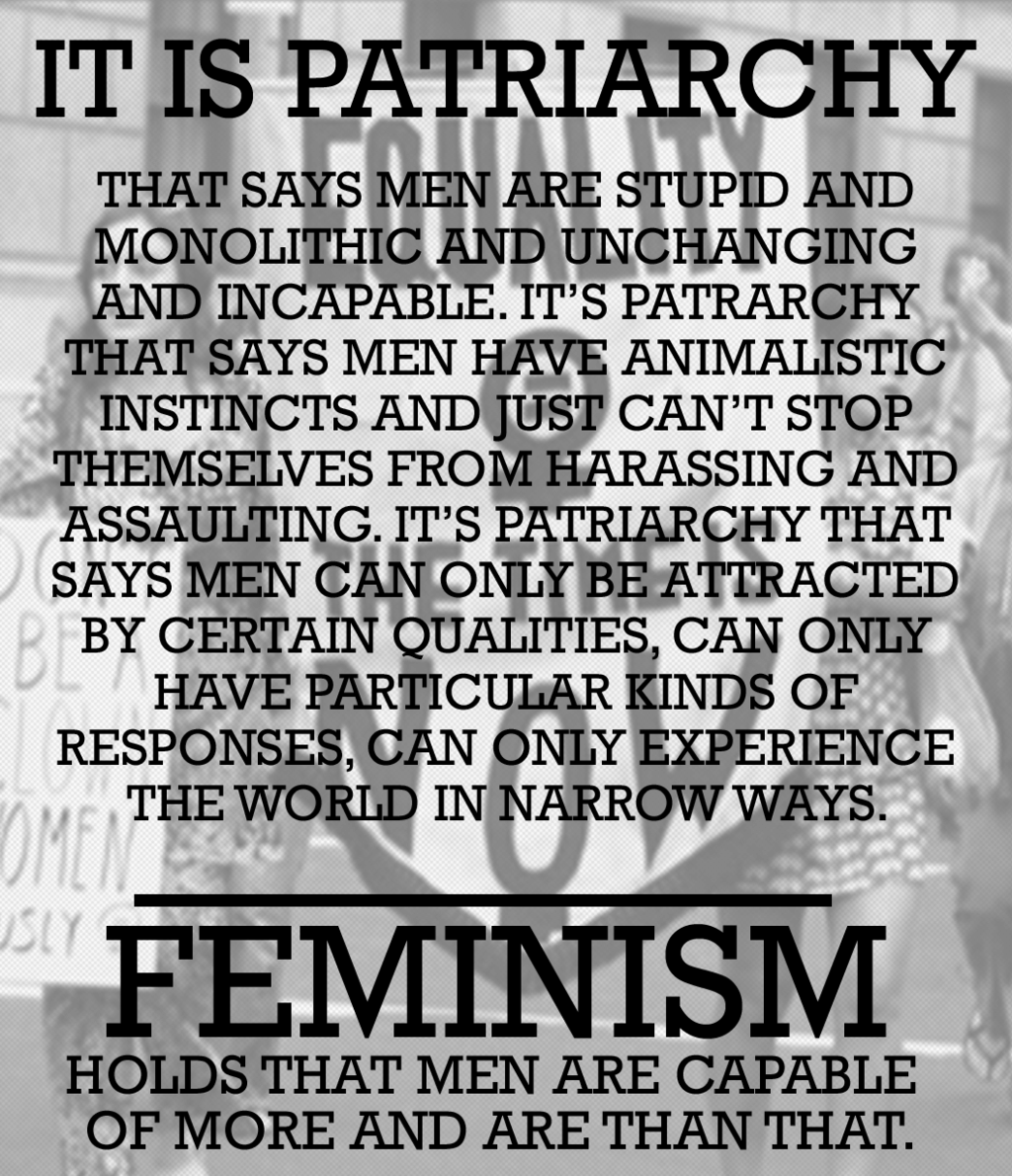
Traditional “wisdom” holds that “men can’t control their urges” or “boys will be boys.” Rather than agreeing with this logic, why don’t more men take issue with thinking that puts them on a level with animals that can’t control themselves?
Why does our culture seem to only ever address the problem of harassment and sexual violence as a “woman’s problem” instead of putting the emphasis on the corrective with men? Men: don’t harass women- don’t rape.
Fortunately, I have grown up in New York City, but this means that I have been exposed to street harassment. I have been exposed more times than I can count, and at a point and time in my life I was being harassed every single day, anytime I left my house. There is no specific social context to any of the times I have been harassed. It could be winter, summer, I could be fully covered head-to-toe, wearing fitted clothes, wearing clothes that are completely baggy, and I would still be harassed. After a certain point you learn to not let the words bother you, although from time-to-time I will snap back at some of them. Race and ethnicity is not necessarily a factor in how I was treated. I have received comments from all types of races/ethnicities. Nor has race affected how I treated others. Rather than agreeing with this logic, I think more men do take issue with thinking that puts them on a level with animals that can’t control themselves because it is an easy excuse. This is something that was recited and believed at some point in time, and remains an easy excuse for men to act however they please without taking accountability for their actions.
The idea that “men can’t control their urges” is not only deeply insulting to men but it also functions as an excuse for harmful behavior. It paints men as lacking agency or moral responsibility, as if they are biologically destined to harm, which is both dehumanizing and untrue. Unfortunately, many men don’t challenge this narrative because doing so requires confronting uncomfortable truths about gender, power, and privilege. Some may also feel defensive or fear being lumped in with those who commit violence, rather than seeing the opportunity to be part of the solution. Culturally, we’ve long framed harassment and sexual violence as a “woman’s problem” because women are more often the victims, but that framing misses the root cause: the perpetrators, who are overwhelmingly men. By focusing only on how women can protect themselves, we avoid talking about how to change male behavior and the systems that enable it. This reinforces the status quo and lets men off the hook.
Truly I would say..sexism isn’t going anywhere, not as long as some men feel the need to constantly have power over women, and some women have been conditioned to believe they’re somehow less. But the truth is, no woman should ever be harassed no matter what she’s wearing, how she carries herself, or what she says.
As a woman living in Philly, I’ve had more than a few uncomfortable run-ins with men who thought it was okay to invade my space. One day, I was just walking down the street when a group of guys started calling out to me. I ignored them, hoping they’d stop. Instead, when they realized I wasn’t responding, they started screaming at me…literally screaming. It was dehumanizing. I was just trying to go about my day, and somehow that invited disrespect.
It really hit me then. We all deserve to be treated like people, like equals regardless of gender. But that won’t happen until we start addressing where this mindset begins. A lot of it starts with the media & how women are portrayed, talked about, and valued. That’s where the change has to begin.
This article demonstrates that street harassment is a visible expression of benevolent patriarchy that polices a woman’s right to exist freely in public spaces. Rather than being harmless, such behavior functions to regulate and constrain women’s autonomy. The article employs an intersectional lens, highlighting how race and class shape the nature of harassment. For example, white, Black, and Asian-American women all encounter street harassment, but the comments and threats they face differ in tone and intent, reflecting broader societal biases. The “Hollaback” movement calls out these distinctions and refuses to normalize them. The viral video that featured Shoshana B. Roberts walking through New York framed the harassment she experienced as compliments. However, the article clarifies how these unsolicited remarks function as demands for attention and submission rather than as benign social interaction. Ultimately, the article critiques the normalization of this behavior and emphasizes women’s right to public space without fear.
I’ve seen how white women are often harassed in ways that reflect traditional ideas of beauty and passiveness. They might be sexualized, but they are also more likely to be protected or believed when they speak up. Black women, on the other hand, face harassment that is more aggressive and rooted in racist stereotypes. I’ve learned that they’re often seen as loud or overly sexual, which adds another layer of harm and makes it harder for them to be taken seriously. Asian women also deal with unique struggles. I didn’t always realize how much they’re fetishized and treated as exotic or submissive which is a dehumanizing experience. Street harassment isn’t just about being a woman. I now see how gender, race, and ethnicity all shape different experiences. Intersectionality helped me understand that we don’t all face the same danger, even if we’re all women.
As a man, I’ve never experienced street harassment, and I’ve never catcalled anyone either. But reading about this topic really made me think about how normalized and one-sided the conversation around harassment is. Society tends to frame it as a “women’s issue,” but rarely does it push men to be part of the solution. I’ve always found it strange how some guys defend catcalling as “just saying hi,” when it’s clearly about control or objectification, not starting a respectful conversation. It’s frustrating that many men don’t speak out more against this behavior especially when it makes men seem like they are animals that cannot control themselves. That’s insulting to both men and women. Harassment should be addressed as a men’s responsibility to change, not just something women have to navigate.
As a man, I’ve been catcalled a few times, especially at the beach. Since I’m a big guy and work out a lot, when I take my shirt off and show my physique, I naturally get a lot of attention. I remember one time in Miami with a group of friends at South Beach I took my shirt off, and a middle-aged woman and her friends started whistling. I laughed a little because I didn’t expect that kind of attention; I thought it would just be a normal day hanging out with friends. When it comes to women in society, catcalling men can be complicated. Sometimes guys take it too far, especially when a woman clearly shows she’s not interested. Also, there are stereotypes about women of different races. Black women are often seen as loud, independent, and overly confident; white women are stereotyped as dependent; and Asian women are often thought of as submissive.
I have never really been cat called before and I believe this is because I am a woman who has always been big, tall, and white; I do not appear to be someone who is an easy target so most men actually refuse to acknowledge my existence. Well, now that I think about it I have been one time after my brother’s wedding where I was walking alone in my dress in downtown Pittsburgh, a man from his car said I looked very nice all dressed up. It caught me off guard but I have never felt unsafe because of my stature and my race, and most of my friends who are much smaller than me feel safer around me because of that. Tangentially, when I was 17 and a cashier at Goodwill, this man with his teenage son told me to smile. He said “see son, this is how you talk to women” and I replied that I am 17 years old, and that did not bother him in the slightest. It is frankly disgusting and disappointing that he would pass that filth down to his son.
I think men find solace in being labelled as animalistic because it excuses their demented behavior and they do not feel the need to look inward; it is simply easier to be animalistic than it is to be humanistic. That is also why sexual harassment and violence is labelled as a woman’s problem, women are deemed emotional beings while men are deemed as uncontrollable animals that lack the ability to self-reflect, when we all know that is not really the case. Women are made to carry the scars of what has happened to them while men who have harmed women get to carry on like nothing has happened because it does not seem to effect them.
Sandra Trappen’s article “Sexism: Does It Exist? Many Men Say ‘No’” highlights the gap between how women and men understand sexism, with many men denying it’s existence. Women face the negative effects of sexism, so Trappen explains that some men do not understand sexism as it does not hinder them. This makes it easy for them to ignore or downplay the issue.
An important point that is made is that even though women have made progress in areas like education or leadership, that doesn’t mean sexism is gone. Small acts of sexism can still be very destructive, whether it be a simple comment, workplace behavior, or media reflecting unequal stereotypes. Progress is slowed in mitigating sexism when men ignore the fact that it exists.
The article encourages readers, especially men, to listen and be open to seeing how sexism still shapes our society. Even though it may be in different ways than in the past, sexism is still present today. Acknowledging it is the first step toward change.
A time that I experienced street harassment was at the boardwalk at the beach. In middle school, it was common to walk around there. A few nights in a row, there was a guy and his group of friends who would come up to my group and me and try to talk to us. This seems like innocent adolescent flirting, but in reality, the constant pestering after we said we were not interested became scary, and we avoided the boardwalk the rest of the trip. I think our culture seems to only ever address the problem of harassment and sexual violence as a “woman’s problem” instead of emphasizing the corrective action with men, because our culture also believes it is the women’s fault for the harassment or violence occurring.
I can’t recall the time I experienced street harassment. I also can’t recall a time where I harassed a woman in the street. When I was an Army recruiter, I used to get catcalls from women a lot. I recall two sisters walking up to me in Market Square. They asked me if I’ve ever been intimately involved with two women at the same time. I was shocked at the boldness but not offended. I think men handle situations like this different for a couple of reasons. One, I think we feel we have control of the situation. Its real hard for a woman to rape a man if he is not sexually into it. Its sort of a waste of time and felony. Secondly, men are looked at as softies if we complain about a woman harassing us. It happens a lot to men, but it’s rarely reported.
My race or ethnicity was not a factor in the events that happened to me. I think we live in a time where women are bolder. If they like what they see, they will say something or give gestures. I feel that if I was accused of harassing a white woman, it would be a lot harder for me to defend, than other white men.
I think that catcalling and unwanted gestures are either accepted or denied with offensiveness if that woman is not attracted. If a woman is into you and you say the exact thing an unattractive man says, it’s taken different by woman. I have seen this personally a lot.
As I said above I think that harassment and sexual violence is considered a woman’s problem because 9 times out of 10, men won’t report it. With that being said, women know they can say bold things to men, and it will just be brushed off. I treat women the same whether I like you or not, attractive or not. I’m just not calling the law or reporting a woman when I have total power of shutting it down.
I have been cat called and harassed multiple times. One time as I was standing in a parking lot with my sister I had my back turned towards a car next to us. My sister looked over and seen this man staring at me from the back and he was doing inappropriate things towards me. I have never felt so uncomfortable in my life. And I was being blamed because I was wearing shorts and was told “men will just be men”.
Another time like 8 men followed my sister and I around a shopping center and kept trying to talk to us. They left the store before we did and surrounded my car with their vans and trucks.They also put something on my windshield trying to get us to grab it. We had to call the cops as we could not leave or go anywhere else.
“Gender Trouble,” looks at how street harassment isn’t just about gender. It explains that white, Black, and Asian women often face different types of harassment because of stereotypes tied to their identities. For example, Black women may be seen as overly sexual, Asian women as submissive, and white women as needing protection. The article urges us to think about how all these factors combine to form each woman’s experience.
me personally walking around the streets with my female cousins has experienced a older male following us around and “catcalling” my cousin into loring her to him. this was a very emotional event for my cousin because it made her scared to go walk around alone wothout someone being with her that she trusts. still til this day she is insecure on going out without someone because she is afraid of someone catcalling her or even kidnapping etc.. i think it is very wrong for anyone to even consider doing this to a female or even a male it is plan out inhumane and wrong.
I have experienced street harassment and cat calling and the one that I recall the most was when I was 14/15 in Giant Eagle and this gentlemen started to make gestures at me, attempting to get touch me and even started literally meowing at me. He didn’t stop until he realized I was with my dad. I just remember feeling so uncomfortable and just not doing anything because there wasn’t much I could do about it. I didn’t even mention it to my dad because I didn’t know how I could put it into terms that would make sense because it wasn’t an interaction I’ve ever encountered before or wanted to encounter. It was extremely uncomfortable for numerous amounts of reasons and it just made me want to stay home all day. I still will not understand why people do things like this. Even if it was meant to be “Flattering” or a “compliment”, it can entirely do the opposite of that. It was hard for me to go to the store or even outside for a while until I saw his face on the news. He was arrested for attempting to solicit a minor! I knew there were more and worse people than him out there, but after watching that, it did help me regain the courage to not be afraid when I go to the store anymore. Personally, I think men should just be respectful towards women and not make comments or remarks just because they think it’s funny because those comments can really have an impact on people.
That sounds terrible! So sorry that happened to you.
Personally, I have experienced catcalling from the street before. Whether it was by an old man or a group of kids, which are both disgusting, yet it’s viewed as almost normal in today’s world. When men or boys do these type of things it’s often brushed off and considered “men being men” or “boys being boys,” which realistically is just an excuse for being raised poorly. Our culture would rather look at sexual harassment as the women’s problem or try and tell themselves they were “asking for it” simply by an outfit. So ultimately, women have to deal with the consequences of men and boys not being mature or raised poorly.
Intersectional theory helps us understand that experiences like street harassment aren’t just about gender. Gender norms and expectations are enforced in everyday life, including through street harassment. It shows how these moments are not only expressions of power but also tools that reinforce larger social hierarchies. White women often experience street harassment that is gendered and sexualized, but also with assumptions about purity, beauty standards, or desirability. They may also be seen as more worthy of protection, which can lead to different reactions from bystanders or authorities. Asian women often deal with harassment that sexualizes them through racialize stereotypes. This can lead to a unique kind of harassment that combines both sexism and racism and can feel particularly dehumanizing. Black women may encounter street harassment that is not only sexist but also informed by stereotypes. Their experiences are often minimized because of racist assumptions that they are tough or can handle more abuse.
The purpose of this assignment is for you to share your personal views, experiences, opinions….it’s not for you to Google or us AI to generate some text for you. Academic integrity violation. Don’t do it again.
I have never been catcalled or faced any other form of street harassment before. However, I do remember my sister getting catcalled once when we were out walking down the strip in Pittsburgh, and that made me feel pretty angry and made her feel uncomfortable. I don’t remember much now, but he was definitely an older dude, and it all felt really creepy. There was only one time I dealt with any issue because of my ethnicity, and that’s when my last name was constantly spelled MacCarelli and not Maccarelli on my college documents. Though that’s more of an inconvenience, and unfortunately, I hear about much more impactful situations than mine, I am always disappointed that we still have people this dense out there.
I can recall many times that I experienced street harassment/catcalling. It has always been when I was walking on a sidewalk next to or near a road. The way it made me feel was uncomfortable and confused. Sometimes I would laugh because they just looked dumb. But there were some people that just had a strange vibe that I couldn’t laugh at. The traditional wisdom of “boys will be boys” or “men can’t control their urges” is just an excuse for their behavior, and also an excuse for bad parenting. “Boys will be boys” is something I hear so many parents say about their sons that misbehave, which is why when these boys grow older they do not know how to act. They do not care that they act like an animal because their parents were lazy and made excuses for their behavior, and women have to deal with the consequences. Our culture views the problem of sexual harassment and sexual violence as a “woman’s” problem because our culture is based all around patriarchy, so once again, women are forced to deal with the consequences, instead of parents/culture teaching men the proper ways to act.
Personally, I’ve never experienced catcalling firsthand. However, I do know multiple friends who have been catcalled and have shared their experiences with it. By what I’ve been told, it’s happened the most when they’ve been on runs around downtown and when they’re out with friends. I think the majority of cat calling is by men who don’t get enough attention, and are just looking to satisfy themselves by saying whatever they want. Sexism is definitely a thing that I’ve seen firsthand multiple times. I believe that most Men who are sexist towards women, with the standard of cooking and cleaning, for example, being women’s jobs, are the same people who believe that men should be doing hard work and labor. Which I could see the general public being able to agree that it for the most part. I think it depends where you’re at, but I think that’s the most common form of sexism I see.
Yes unfortunately I have been catcalled before, this was when I was in Manhattan with my sister, we were walking down the street to get coffee and out of nowhere this man comes up behind us as we are walking and starts saying stuff like “hey there beautiful” “come on talk to me, I’m just saying hi to you, let me appreciate you”, he would not stop following us. My sister and I just ignored him and instead we talked in a different language as if we did not understand what this man was trying to say to us. He then gave in and said, “okay you could have just said no in English, too bad I do not know what language you were speaking, I would have tried speaking to you still”. It was a thing I do if a person catcalls me, I just speak in a different language to confuse or make them give up easily. I felt so disrespected in my opinion because he would not just understand that I clearly do not want to talk to him, I am doing everything to get away from this man and he still would not understand. I did feel a little scared as well since I did not have my pepper spray with me and I was worried if he might have a weapon with him.
In a different time, when I was helping someone in my job, an older person told me that they did not appreciate how they let “communists” like me in the US just because of my accent. I was so shocked that someone would even say something like that to me, I was being so nice and helpful and they gave me this rude comment instead.
Men will think they cannot control their urges because no one has told them to never think like that, they have been enabled and possibly even encouraged to think and act like that.
Our culture has deep roots of patriarchy and many people from older generations will not change their mindset easily, they would rather just go with what they were taught that women will always be in the wrong instead of the man taking responsibility for their own actions.
Our culture tends to frame harassment and sexual violence as primarily a “woman’s problem” because it has long been ingrained in societal norms that women are more vulnerable or need protecting, while men are often seen as the perpetrators. This framing shifts the responsibility away from men and places the burden of addressing the issue on women, assuming they must defend themselves or avoid dangerous situations. Instead of focusing on changing the behaviors of men, there’s a tendency to encourage women to protect themselves, as if the problem lies in their actions or vulnerability
The focus should be on holding men accountable. Men should be taught from a young age that harassment, assault, and violence are never acceptable. Society needs to emphasize that men should not harass women, not rape, and not treat others with disrespect. By shifting the conversation to the perpetrators and addressing the root causes of these harmful behaviors, we can begin to make meaningful progress in reducing harassment and sexual violence. It’s not just a woman’s issue; it’s a societal issue that requires men to take responsibility for their actions and contribute to a culture of respect and equality.
As a young-woman I’ve personally never experienced cat-calling or street harassment, but it breaks my heart how often society treats sexual harassment as a “woman’s problem.” Imagine a woman out at a club, just trying to have fun, wearing a short skirt because she felt confident and beautiful in it. Then a man comes up and starts groping her—crossing a line, violating her space—because he assumes her outfit means she’s asking for attention. And instead of blaming him for his actions, society turns around and blames her. They say she was “asking for it,” as if her clothing, her confidence, or her presence somehow invited assault. It’s infuriating and deeply unfair. This way of thinking doesn’t just excuse predatory behavior—it protects it. Women deserve to exist, to express themselves, and to feel safe without being blamed for someone else’s choice to harm them.
Society has consistently mistreated women and blamed them simply for existing, so it’s sadly no surprise that “woman-blaming” remains such a widespread issue. This mindset is deeply ingrained and incredibly harmful. It needs to change. A woman wearing tight clothes is not an open invitation for touch, comments, or unwanted attention. She’s expressing herself, not asking for permission to be disrespected. Her body is not public property, and her choices don’t justify someone else’s bad behavior. The problem isn’t what she’s wearing—it’s the way society keeps excusing those who cross the line.
It was a viral video made by the ad company Hollaback to draw attention to the issue of street harassment, an all-too-common experience for a lot of women and some men too. It involved a woman walking through the busy streets of New York City as she encountered every type of catcall and unwanted remark. The video was hugely popular and acclaimed for drawing attention to a genuine issue that usually goes unremarked upon in the public sphere. Nevertheless, despite as much as it tried to be philanthropic, the video was criticized for its representation of the harassers. The majority of the men shown perpetuating the act of catcalling were Black or Latino and seemed to be working-class, which gave rise to accusations of racial and class bias. It was eventually disclosed that the production team had made the choice to edit out white men who had also harassed the woman, implying a conscious choice to feature minority men and make the harassment more aggressive or unexpected. This choice caused many to claim that the video perpetuated negative stereotypes and overlooked the broader, more complicated reality of street harassment, which can be demonstrated by individuals of any race. Consequently, even as the video effectively brought under the spotlight a pertinent issue, it also generated controversy about representation, media accountability, and the intersection of race, class, and gender in the public sphere. The controversy accentuates the necessity of more inclusivity and precision in representation while tackling social issues, particularly when using media platforms that wield broad influence.
I ask for you to simply share your own views. Easy stuff. You cut and pasted text from Google. Not cool and no credit.
As a woman, I do not think that I get “catcalled” often. You hear from time to time the classic “a construction worker catcalled me.” When reading through some of the other comments I see that a lot of people find it quite disgusting and gross that men do this to women. As I do have the same mindset as the rest of these comments I do not think I look as much into it as other people do. I realize that it is disgusting that a man thinks it is okay to do this to anyone. However, I do not let it ruin my day. This may be because I have never had a “bad experience” with catcalling other than someone just saying something to me. I just let it slide off my back and let it go. The last experience I have with catcalling that I can recall was two summers ago. I was with my boyfriend and one of his friends. We were heading to Picklesburgh walking through the city. A man looked at me and said “You look like a bi*** that I want to take home” he then did the classic catcalling whistle afterward. Instead of reacting after we passed him a few blocks after I looked at the people I was with and just laughed. Personally, I find it more funny than anything that people think that women are okay with being told those things.
Our way of life regularly considers harassment and sexual violence to be a “Women problem”, which prepares women for protection, unlike the solution of the main reason: the behavior of Men. This shows the widespread history of blaming victims, patriarchal standards and social pain with the protection of responsible guys. Media insurance, educational systems and equipment regularly support this by specializing in what women have to do to live safe, rather than Men coaching, so that they now do not bother or attack. Real alternative challenges to transfer the narrative – prematurely to store boys about consent, admire and empathy, protect the perpetrators of responsible and inspiring people to behave in harmful behavior within themselves and other tasks. Sexual violence is not “women’s problems”. It is a social failure and Men should be part of the answer, not only history.
this post needs some massive editing…not even sure what you are saying in some places here.
I can not remember a time that I have experienced sexual harassment or catcalling. I think that our culture has normalized this sort of situation to occur more for women than for men because women are told to speak out about it, as for men it’s not as common but it does still occur, but it is more demoralizing for men. One reason this happens is because of gender norms that have long shaped expectations of men and women. Men, particularly in patriarchal societies, are often socialized to be dominant, assertive, and entitled to control or access to women’s bodies, while women are often socialized to be passive, nurturing, and submissive. When sexual harassment or violence occurs, the focus has often been on what women can do to avoid being attacked, rather than addressing the behavior of the perpetrators. The solution needs to be more about challenging harmful behaviors and attitudes in men and encouraging respect and equality.
Speaking for myself when the phrase “boys will be boys” is said to me as a rationale for acting a certain way it just comes across as childish and immature. When I think of that phrase I think of prepubescent middle schoolers pulling off “jackass” level stunts in order to impress their friends. Eventually just as a person I feel as though you should reach a certain age where that desire for validation and constant attention from your peers fade, but instead of maturing what some men choose to do is double down on those traits and replace the reckless behavior with arrogant behavior and a superiority complex. You see it everywhere where men soak in red pill content that validates these egotistical beliefs that they are the “alpha males” and that everyone around them is inferior, leading to people (mostly women) to be treated as such. Men like this will use the attempt of humiliation of a women to feed into their own self centered ego.
Sexism and sexual harassment are real problems that impact a lot of people, and it’s essential for us to talk about them with care and empathy. Many women have endured awful treatment from men throughout the years, and this is something we really need to acknowledge and confront. Sexism shows up in different ways, both at work and out in public.
When it comes to compliments, context is key. Saying someone is “beautiful” can be a heartfelt compliment, but it can also come across as inappropriate depending on where you are and how you say it. The most important thing is to make sure that compliments are given with respect and don’t cross any boundaries.
Touching someone without their permission is absolutely not okay. Work should be a place where everyone feels safe and respected. Men need to think of how they act and steer clear of being creepy or inappropriate. It’s embarrassing to realize how often catcalling and harassment occur, and we all need to strive for a safer environment for everyone.
This article adds a lot of significant detail of lived experiences that have sexism affected them. I certainly believe that sexism affects women much more than men. But there does exist a lot of stigma for men as it relates to be emotional, vulnerable, etc. For a prolonged period of time and including in today’s reality, women are pushed far behind, everything from falsifying sexual assault, to gender pay rate gaps, and more. My personal experience I have witnessed gender discrimination, I do not stand for it and I believe we as a society need to be focused on eliminating this while also destroying stigmas for both genders. As a men, I am often not attacked about my gender. But as someone who is Hispanic, I have encountered racist situations but never really because of my gender. I share frustation with these old-time practices that continue to haunt women.
As a woman, I think this is disrespectful. I get “catcalled” here and there. It makes me feel worse about myself. In 2023, I worked at a hardware store and almost every day, older guys would stare at me, “compliment” me, and I even had one stalk me! I felt the need to go along with all of these things because I was born in a society with guys who feel they should do whatever to a female. When I learned these things are wrong, I started to gain self-respect. My personal opinion with this website post is guys should treat women with more respect.
I think our culture seems to only ever address the problem of harassment and sexual violence as a “woman’s problem”, because we tend to view women as more vulnerable than men. Even in television shows, women are almost always being rescued by a man from another bad man. Instead of viewing men as the problem, we just assume that the woman is weak and vulnerable and can’t help herself when in reality that is not the case at all. Society needs to take a good look at the men in the world and what can be done to prevent them from harassing others in the world. Now obviously there are also women who harass men at some point as well. The difference with this is the man is not as likely to point out that something is harassment, because many men do not understand how they can be sexually assaulted by a woman.
As I can relate in a work environment it is very common, I actually work in a restaurant and sometimes I have customers who make me uncomfortable sometimes and also even not even only at work in stores, and other places. I also had a coworker at my old job make me feel uncomfortable and reported it. Honestly, when cat called it kind of scares you now because it is not the same as back then I feel. In Pittsburgh men often try to cat call and women often say they feel unsafe to reject a man and just walking away without a smile and no because the men hate rejection here, they call you bad names all sorts of things. As I feel it is very common some men do not like rejection it makes them feel insecure and hurts their ego. I feel some men do not respect women and those are the ones with little respect for themselves. I have also noticed men go for the innocent look and looks like you have your life in order. Men seem to also look for a really attractive person and how they are dressed, walking alone or their chance to strike.
How I feel some men are just embarrassing and need some manners and training on how to treat women.
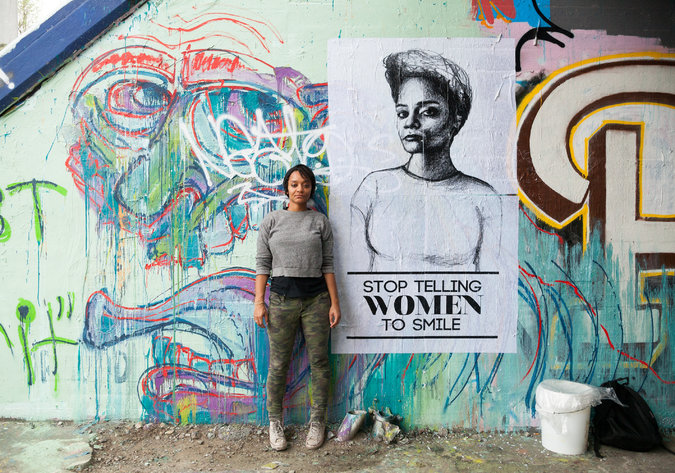
In the workplace, I feel it is especially common to get catcalled. Historically, the workplace has been male dominated and when women started moving into the workforce in order to support their families, men began to feel intimidated. The saw work outside of the house as being their job and household chores as a woman’s job. Sexual harassment of women in their place of work originally acted as a coping mechanism for men who felt threatened by women’s presence. As a hostess in a local chain restaurant, I have experienced harassment from my co-workers and boss. I have been kissed on the cheek multiple times by a waiter nicknamed by the women at work as “creepy Carlos.” I have also been told by my boss that “I should smile more because it makes me look prettier.” These things make me, and I think most women, extremely uncomfortable. It makes going to work a stressful experience which is not something men typically have to go through.
For some if not most women, I believe the question ought to be ‘When have you not experienced sexual harassment?’ From the posts above and in the video in the blog, it is evident that women have had more encounters with men who can’t keep their mouths shut than fingers and toes. Two weeks ago I was at my favorite halal cart in the city, the one I’d been going to since I was a sophomore in high school. The two men running the cart were always polite and smiled, which I took as good service. Yet, as I was handing my money to them and taking my food, one of them said “Have a nice day,” while his eyes drifted to an area below my chin, where my eyes obviously were not. I frowned while walking away, comforting myself with the idea that maybe he’d been looking at my necklace and that perhaps collarbones were in this season and I’d missed the memo. Earlier this week, even with the presence of a guy taller than he beside me, the server grinned and asked “What can I get you, baby?” which he’d never ever asked before. I didn’t answer him. The whole “This is just what men do” argument is garbage. Why any man would want to be viewed as an inconsiderate, uncontrollable animal is beyond me. The ones who can approach women respectfully and can refrain from getting attention by shrieking like howler monkeys are the real men, if not just regular human beings.
ok lets keep it real as we all know, everybody is born with a assigned gender that has its role.and for men being the dominan gender with all the privileges bring in them the most demeaning characteristics that a human being can have. now a days we see woman going to college, being in power positions, but in the other hand we see man, specially in the minority groups that can not afford to support their family, have very demeaning jobs that do not pay enough. all those circumstances bring in them the question of how manly they are, and the power that they do not have breaks their masculinity, and they can not afford to be seen as feminine, weak or less by their own sex. as a result, their “power” is shown by being violent against women or simply by calling names/frases/ even following any women that walks by them.
Furthermore, the “power” gained by calling names on the females that they see makes them feel like men, but sadly it works, because we ( females) restrict ourselves of walking let say by a construction and taking the longest way because we do not want to be seen as a piece of meat, we feel uncomfortable, and the fact that if we answered or NOT to what they say, brings in the them the sense that they are in powered, so what should we do against them ? should we walk and just ignored them ? should we continue to show them in an indirect way ( by taking the longest path to avoid a crow of men) that because of them we have to continue to change ?
why the F. do females have to be the ones to change or give up somethings in order to ” survive” in this society ?
and i do not care if we live in a society dominated by men, i do not care about that, what i do care about is why one of the two have to control the other ?
The most recent street harassment I have experienced was about three weeks ago, I was walking towards the subway station and had to stop at a crossing, I heard a man calling me, he told me I was beautiful and wanted to get my number, I felt really embarrassed and annoyed, I didn’t say anything, and I made the mistake of looking in his direction. When I didn’t reply to his proposition, he got angry and screamed “You can’t even say Thank you?” I did not feel he required a thank you from me because his approach was aggressive and unwanted. At the end I felt people staring at me and I felt really ashamed of myself. Even though I knew I shouldn’t be.
I believe it’s difficult for men to think that this puts them on a same level as animals because society makes it easy for them. They rarely get scolded or punished for their daily wrongful treatment of women. Society is in a way enabling them and they won’t see it this way until we take a stand and defend ourselves, and show them the ugly truth. Their eyes need to be open.
Addressing it is as “woman’s problem” is very sexist from our part. I think it’s because our culture doesn’t give women as much respect as they need. We women have come a long way to where we are (voting rights), but we still are being treated like second best. Our culture is ruled by men mostly and it makes it hard to put a stop to sexual violence or harassment because most men don’t have to deal with it and/or don’t think it’s a problem. That’s why our culture doesn’t just say “Don’t harass women or don’t rape”.
Being a woman in New York City and I would imagine in most cities, the opportunities for sexual harassment be it subtle or overt are innumerable. Honestly, there is not a day goes by where someone doesn’t or do something that makes you feel like there is something you should be apologetic over. As if by simply being in the same social space as some gives them permission–nay, right–to comment on your appearance or existence.
There are different types of harassment. But, the idea that men are just trying to be “nice” and cat-calling is in our head, is absurd. Even the nicest of encounters I’ve had with male strangers, the situations inherently oozes of some power dynamic. I’ll recount a couple:
The Subway Rider:
For background I will tell you that I often work late into the night, sometimes 2-3am as a cocktail waitress. I take the subway home most nights, and for added background I will say I’ve never been one of these girls that’s afraid to take trains late or walk in dangerous neighborhoods, one of which I live in: Coney Island.
So I live in Coney Island, which for reference is the second to last stop on both the F and the Q lines in Brooklyn. Being just off a shift I fell asleep on the train which happens pretty often. If i miss my stop, its only one stop until the train turns around again–the risk is low. When this happens though, people will often wake me up, usually out of concern that I’ll miss my stop.
The guy woke me up at 2am to hit on me. I mean really, he didn’t wake me out of concern for missing my stop he actually felt so entitled to attention and being heard that he woke me up to ask me a bunch of superficial questions about what I study in school and if I like my job. I felt like he woke me up to be a dancing monkey. Uncool, but honestly the nicer of my accounts on the subway. Read on.
The Subway Groper
This is the guy, and I should say guys, that will stand a little too close during rush hour for a cheap feel. Flat out harassment, and I don’t know why some women stand for it. Ladies, I know I’m not alone because I’ve seen it happen to you and just shuffle 2 or 3 inches or move your bag in front of the part of your body that some random guy feels entitled to touch.
The Patron
Sexual harassment in the workplace, unfortunately is something most women will deal with in their lives. Usually from a boss, but there is not just one type. As I’ve mentioned, I’m a waitress, and there is an inherent power relationship between server and patron, denoted by titles alone. In class we spoke about a sociologist, I think it was Kimmel but I could be misremembering, who asked a cat-calling male, “why do you do the things you do? to what end? what are you seeking to get out of it” and his response was something to the effect of, “she’s gotta take it”.
This is the same conception I think the patron at a restaurant or bar takes in hitting on a waitress. I watch guys sit and drink all night, too afraid to approach women–no really, I hear them talking about it, they have no intention on hitting on women– But for a 20% tip on their credit card they feel it their right to say whatever they want to me. And the sad part is, I do have to take.
We’re not even appalled by it anymore, I cannot remember the last time a friend of mine called me to say, “you know what this scumbag on the train said to me today?” or “this creep on the street told me good morning”.
I think I have the same mentality as most women do on cat-calling and subtle harassment. And I call it subtle not to demean, but just to say the harassment that comes from passer-bys that you never see again. We’re numb to it now. It’s everyday, it’s whether we’re dolled up or bumming it out, day and night. We see it happen to other women, and just regard it as a circumstance of being a woman. It is definitely only ever about power.
After last weeks discussion in class about calling I went straight to Union Square to meet a friend. Within a span of 2 minutes, I was catcalled twice. I’ve been catcalled in the past but I was already angered and worked up about the class discussion and how women have to walk a certain way, make sure they look a certain way so they don’t get cat called. The first man was walking towards me and looked at me and said “daaaaaaamn ma”. After that I said to myself, you have to be kidding me. I walked down one more street and a guy riding his bike screamed out at me “you lookin’ good today beautiful”. The worst part of all of that was the fact that I could not say something back. Despite all my anger and frustration from class and then having it all actually happen to me, all I wanted to do was say something back to them, but for my own personal safety, I did not.
It is so sad and frustrating that in a sense women do have to take it because they never know what the man could do to them for talking back. Cat calling gives these men a sense of power over women. They know that women have to accept it and move on with their day, despite being harassed.
It is not just everyday people walking the streets in a t shirt and jeans, but it is also those “prestigious” and “honorable” white men in suits. My friends and I describe these men and as the creepy 40 year old guys, who tell their wives they’re working late, go to the bar and flirt with other women and possibly even cheat on them, but at the end of the night will go home to their wives with flowers in hand and act like nothing is wrong. I’ve seen these men also harass women on the street, asking for their numbers, or a “i’d like to get to know someone like you better”. It happens on the subway where they will go out of their way to eye down a woman and possibly brush past her and touch her on the train. Anyone can be a victim of cat calling and anyone can be the cat caller.
The last time I experience street harassment was yesterday. I was getting off the train and a group of boys were standing near the escalators. I usually don’t take certain exist, when I get off the train because around certain time there are group of men just hanging out at a certain exist. That day I had to exist there because I had to go to the bank, and that was only exist closer to the bank. As soon as I got closer to them, I could already sense them starring at me. While walking pass them, one of the men grabbed my arms and says ” You look so beautiful”. I continue walking towards the next block, and notice that one of them where following me. I started walking faster, and he caught up, and tried to have a conversation with me. I pretended I was listening to music, and ignored him. He noticed I was ignoring him, and put his arms around my shoulders and took my headphones out my ear. ” You didnt hear me talking to you”. I replied by telling him if he touch me again I will call the cops.
I find it really annoying that women are not safe in the streets. There are times where my brother will have to walk behind me at certain places, or have someone tag along with me. In the video of the women walking around NYC, it portray men of color are the ones doing cat calling or some sort of harassment. I had many white men who will drive up to me while I’m walking, and ask me for a ride, or even follow me around. No matter what color you are ,every men does it !
The last time I experienced street harassment was just yesterday. I was walking to Penn. Station on a semi-crowded street and an older man said ‘wow’ and the one second of eye contact that prompted me to make apparently encourage him to lean towards me and shout out ‘so sexy!’ This was the most extreme street harassment I’ve ever encountered and it made me feel frightened that he might get physical and also dirty because I’m not used to being leered at. I’ve been lucky enough not to have men get frustrated and yell abuse at me when I ignore them but getting harassed at all leaves me angry and frustrated because I’m too scared to ask them to stop.
I think our culture sees harassment and rape as women’s problems because women are still expected to cater to what men want and to seek their acceptance because men are seen as more important. If a woman is cat-called ‘she should be happy to have been noticed’ is an example of the belief that woman are seeking men’s approval at all times. In the case of rape people may think that women should anticipate men wanting to have sex with them if they present themselves a certain way and should therefore dress more modestly to accommodate this or they will be ‘asking for it.’ This ‘asking for it’ mentality can also be applied to street harassment if a girl is dressed a ‘certain way.’
I recall walking past a group of young men in my neighborhood, one of them called out to me but I kept walking and because I ignored him, they got upset and started cussing at me, telling me “you ain’t all that”. It made me feel uncomfortable but at the same time I thought it was funny, since he “complimented” me but just because I didn’t respond the way he wanted I’m no longer worthy as if I was interested to begin with. However, not every man who calls at a woman in the street has behaved or acted towards her in a negative way; because on numerous occasions all that was said to me was a respectful “good morning” or they wanted to ask a simple question.
There are, of course, many factors that go into catcalling and other forms of sexual harassment against women, but I think one of the most important factors is the miseducation of both young boys and girls and the constant blaming of women in their own harassment. It is truly so backwards when you think about it; there is no other crime I can think of where the victim is so heavily blamed and it seems ridiculous to ever do that, yet it is constantly done in this context.
I’ve never really noticed it, either, how infrequently boys are taught to not rape, or even about what constitutes rape. I was in 10th grade when in my co-ed gym class, only the girls were taken into a separate room during the basketball unit to take a self defense class. When I got my license my mom told me that, if I had to walk alone at night, to make sure I had 911 dialed and to hold my key between my fingers. When I went away to college for my freshman year, I was repeatedly told to never walk alone at night, even though I saw boy after boy by himself on the street. It was so easy for me to see this as normal behavior, because my sister was told the same things, and so were all of my female friends. However, when boys are not taught these things, and are not even taught about their potential preventive measures or what they could do if they see a girl getting sexually harassed by another boy, it is clear to see where a lot of the problem stems from. It also makes it easier to understand why there is so much victim blaming.
I remember I was at a sexual harassment seminar once and the majority of the boys (aged 18, 19) had no idea that women were taking these measures or were taught to take them. Most of the men there even had a vastly different definition of rape than the women. One boy in particular said that he couldn’t, by definition, rape his girlfriend. I’m definitely aware of the class and race factors that go into this as well, but I am just continually shocked to see how it can happen anywhere and how the “rape culture” is promoted and reinforced, even in my white, middle-class suburb.
I feel as if I experience street harassment almost every time I walk out my door. Whether it is meant to be innocent or not, it always gives me an uncomfortable feeling. If you ask the men that are cat calling or simply saying hi, they would tell you a woman should be flattered by such advances. I think they truly believe that. I often get “oh, so you’re too good to talk to me?” or even ” you arrogant bitch!” If I’m not “polite” enough to respond to their greetings and advances. What I don’t understand is that just because they say something that I should automatically respond like a good girl. This speaks volumes on ” Benevolent Patriarchy.” To that, I mean, we as women in general are treated like we’re lucky to have any man talk to us at all. We are so lucky that this male has decided that we are attractive enough to approach and therefore we should always be grateful and responsive. This goes for those that might be considered super attractive men as well because one’s arrogance often supersedes their physical appearance.
OFCOURSE IT DOES. i swear if i wasn’t a female i wouldn’t get away with most of the things i get away with half the time. like speeding tickets (except when there’s a speed camera or when the police is trying to get their quota up by the end of the month). when a male gets pulled over hes definitely getting a ticket if its another male cop pulling him over, most of the time that’s why my male friends wants me to drive. sometimes guys go through harassment to but we don’t see it on a daily basis. I hate when I’m walking alone and there’s a group of guys standing at the corner or in front of the store i have to go into. i just want to cross the street or find the next closest store even if its miles away where there aren’t so many guys just standing there, its intimidating and i don’t feel comfortable, they might not even want to say anything to me i could just be conditioned but its happened too often. it seems like there waiting for you to walk past them for them to say anything. and if you ignore them they have the nerve to call you a B**** or shout any insults. why must any female that don’t want to be bothered be harassed if she refuses to speak when she is approached in an inappropriate manner?
While I think that Walking 10 Minutes in New York reinforced negative stereotypes about men of color, I think that we shouldn’t pretend as though men of color do not partake in these things. I think a criticism should be rendered for the editing of the video, but I also think that criticism shouldn’t invalidate the point being made that street harassment is real for many women. If we take a closer look at street harassment, it could be noted that it occurs more frequently when when are traveling streets alone. The idea that since she is unaccompanied by others “she must be up for grabs”. Maybe the “cat-caller” feels is if an unaccompanied women is vulnerable and therefore more susceptible to the harassment. Also, we should consider the age and peer influence of young men that engage in street harassment. I’m not implying that older men don’t act in this way but it wouldn’t surprise me to find out that a majority of “cat-callers” are young men acting in concert with other young men to assert their masculinity socially.
I guess there are a whole host of factors to consider when observing the details that go into street harassment. I guess the socio-economical status, race, other demographics etc.
Yes, you are correct. Good catch! The criticism that you raise about the video was actually raised by many others soon after it was released, as the video producers were asked about why they appeared to focus on men of color. One critic, a sociologist, pointed out that this behavior says as much about social class as race. Poor and working class men, by virtue of their structural position in society, are more likely to engage in sexist behavior on the streets. White men, on ther other hand, because of their historical social structural advantages, engage in sexist behavior at a different level – in their companies, in the boardroom, through employment practices, etc. They are doing the same thing at a different level, but the way they do it can’t be rendered so dramatically on camera. Age, as you point out, also has a lot to do with it.
I remember at a young age feeling compelled to walk behind my mother and prevent men from staring at her ass. She was catcalled frequently whether my younger sister and I were present or not. She actually notices the decline in catcalling as she has gotten older. I cannot recall the first time that I was catcalled, but I remember my most recent encounter being today. A man walking in the opposite direction of me on the sidewalk said “You look beautiful.” Even though I was noticeably on the phone, I said thank you and continued my conversation.
Most women would, without a shadow of a doubt, call this harassment. Since I didn’t feel personally threatened or imposed upon by him, I don’t call this harassment. All of the examples provided are, without argument, forms of sexual harassment. However, I wonder where that line is drawn or if anyone wants to admit that one exists. Is it based on the person on the receiving end of the catcalling? If the person welcomes the catcalling, are they still being harassed? For men, it can definitely be seen as a claim to their supposed inherent power as men to catcall women in their social space. For women, can’t it also be seen as a self esteem booster? Even for women who speak about how they don’t welcome the behavior, they notice when it stops.
Granted, being catcalled makes you feel like your under a microscope and like you’re undergoing a full body scan. Personally, I’ve learned not to think much of it after a series of women have been physically assaulted or killed for being “ungrateful.” It is in no way fair that I should fear my life if I don’t acknowledge a stranger that makes me uncomfortable, but it also isn’t worth my life if I don’t spare these men two seconds of acknowledgement. However, if I was being pursued and taunted the way the woman in the first clip was, I’d take my chances.
The fact that men feel it’s necessary for females to even reply to cat-calling is proof that we live in a sexist society. Living in NYC, cat calling is something almost every female has experienced but I find the term rather euphemistic. When a man finds it appropriate to comment on a female’s body as a way of “getting her attention”, that should be considered “verbal rape”. Not only do these kind of comments cause a female to feel violated but it also allows a man to exercise physical privilege because generally if a female is to respond by defending herself, she is subject to an argument in which the man’s physicality will triumph.
During adolescence, I had a tendency to always “talk back” anytime a guy tried to “holler” at me. Once when I was at some sit-in bodega with my friend Cassie, a group of guys began to say the typical “What’s good ma’s” and “Can I get your numbers”. Cassie and I simply ignored them until our rejections of their supposed patriarchal dominance got them angry. One of the guys approached me and asked “Why are you ignoring me?”, I tried to keep it courteous and simply do the typical “Sorry, I gotta boyfriend” routine but that only provoked more benevolent patriarchy in him and the rest of his male group.
They began to comment on both me and my friend’s physical appearance with a diction that solely related to sex and spoke loudly as if their conservation was some way to allure us. Both me and my friend felt disgusted so I told them as any typical teenager would to “shut up” and keep their comments to themselves, but of course that only resulted in them exhibiting even more patriarchal behavior. They all began strengthening their voices and threatening us with phrases like “I don’t care if you’re a girl, don’t disrespect me” and “Tell me to shut up one more time”.
This kind of reaction is common with men once they feel as though their entitlement has been devalued. The only resolution to reinforce entitlement is by trying to physically intimidate the female which leaves us as females in very vulnerable positions.Luckily all was resolved by a male employee instructing them to leave the bodega. What I find fascinating to this very day is that their notion of respect was based on my friend and I submitting to their sexual comments without defense. Once I revolted, they got angry..as though females are supposed to accept this kind of “verbal rape”.
I have experienced street harassment many times. It’s rude, disgusting and puts me in a situation either to be friendly or ignore the situation. In New York City, you have to say acknowledge them, be courteous, make small talk to satisfy hunger. I feel that you have to put on a performance in order for them to get the “doer” off your back or you will be subjected to worse things. People are crazy and vicious and will do anything to make the victim feel less then they are already are. Hence, that is why I must simply make small talk for my own safety. You simply can’t say “I do not want to be bothered.”
I think that men always can take on self-control. It is social construction that tells them that they have to act a certain way in order to get by in society. Men do not see themselves as individuals. Rather, they see themselves as a group that is tightly woven together. Because if one dropped stitch, the bond of masculinity is broken.
I feel that this topic isn’t addressed as a “woman’s problem” because women do not want to be put in that situation. It is also that women feel “helpless” or to do not want to bring more problems to the situation. It is also a tough situation because women want to remain and protect their innocence.
Sexism would never go away. Because men would always feel overpowering then women, and weak minded women would believe it too. No woman no matter what she says, how she walks, and what she wears, she should never be harassed. As a woman and having many encounters myself with harassment by men it has made me so uncomfortable.
One day I was walking by a group of men who were calling me but i paid no mind. They continued until they noticed that I wasn’t going to pay attention. And that’s when they started barking at me. I felt so offended and I knew that I didn’t deserve that because at the end of the day we are all human men and women and we deserve respect.
At the end of the day sexism should end and it should start with the media, and that’s where it all starts.
It’s funny because I have to go through this everyday, whether I look like crap or not. Its just disgusting. It just happen to become pretty normal to me which is scary now that I think of it. All I do is just stay quiet and move along to where I have to go.
For many years when I used to live in Jamaica, the same old drug dealers always in the corner always trying to hit on me and I would always just ignore it or cross the street to avoid them. After so many years, I realized they stopped when they saw me in my medical assistant scrubs. I guess that probably intimidated them and they just eventually got tired of trying that now they leave me alone. Here and there I hear “That’s wifey” come out their mouths. I just feel like telling all of them to shut up but I’m sure that will trigger to something worse than just words. The world (or should I just say New York) is full of disgusting men (not only old men) but most men are just disgustingly always checking younger girls and saying something inappropriate. It disgusts me so much on the train as well that even when I see someone making inappropriate eye contact I make a disgusted look and get up and change my seat.
There was one time when I was walking to the train station to go home. There was couple of guys hanging out around the train station and I immediately put my head down and just kept walking. As I was walking past them, there was this one guy, who was Spanish and looked like he was around his forty’s. He said something in Spanish, which was ” Ay Mami! Why don’t you come over here and sit on my lap? You know you want to.” I ignored him and continue walking and then he was said, “Come on girl, don’t be like that.” I suddenly felt scared because I was in a city where I am not familiar with and with a situation like this happens, I felt very unsafe and went inside the train station and sat next a family just in case something were to happen. It is just creepy and gross that an old man hits on a young female and doesn’t feel like what they are doing is wrong. I’m surprise that men don’t know how creepy and stupid they look when they hit on girls.
I spend a lot of time in Philadelphia and when you are walking through the streets alone or with other women it is very common for men to harass you. One time I was walking alone in the middle of the day to the train station and the whole time I had to listen to many men call out at me and try to stop me on the street. I usually just keep my head down and try my best not to make eye contact but in reality I feel very uncomfortable. It makes me feel really unsafe as well. Especially when they walk behind you, one time I could hear this guy talking about me with his friend as they walked behind me for three blocks. They spoke loud enough that I could hear them and every couple minutes they’d tell me to “wait up”. The entire time I kept trying to speed up and walk quicker to get away from them. Being a smaller sized girl walking alone in the city, not knowing anyone around you can be really scary. When you add the factor of larger men yelling at you and following closely behind you, it can be very terrifying. I’ve gotten to the point where I feel that I can’t walk around in the city without a male friend or some kind of protection. It’s not fair that because I am a woman I have to be afraid to walk alone in the city.
As a male, I must say that I have actually been cat called. I would have never thought this would happen to guys but sure enough it does. For me, I was walking to meet my girlfriend at the movies when I was first cat called. Two girls were standing pretty distant from me yelling things like “Hey there lightskin. My friend thinks you look good as fuck. Why don’t you come over here so she can talk to you?” I honestly just chuckled and paid it no mind. However, i did feel slightly uncomfortable. That only happened to me once. Women must undergo a lot of stress from cat calling due to the fact they experience it more frequently.
I have actually experienced both sides of “Cat Calling”. Every now and then when my friends and I would be bored hanging out and saw a cute girl, sometimes one of us would make a comment to her and laugh about it thinking it was funny. It wasn’t until recently when I was spending some time with my sister in Freehold town and a man yelled to my sister, “hey baby you are looking hot today”. When I heard this come out of his mouth and saw my sisters reaction to it I realized how immature it sounded and also noticed that women do not find it funny or attractive at all. Now seeing first hand how my sister reacted to it, made me think of how dumb men sound when they “holla” at random girls on the street.
Matt, thank you for your very honest answer. It’s always good to hear about different perspectives. And good to know your sister is having a positive influence!
I recall at the young age of fourteen I was with my mother down in North Carolina in a Walmart. This man, who looked at least nineteen, followed us around the store for about five minutes. He finally went away, or so we thought. As we were leaving the store I heard someone shout “Ay yo ma ! Shorty in the jean shorts ! ” Without even turning to look I realized it was that same guy, I was so upset. My immediate response was ” Ay yo ma?! That’s not even proper grammar ! I bet your mother raised you better than that. I was so upset I continued and screamed out that I’m underage and that it was sexual harassment. The situation left me feeling very embarrassed, me ! I couldn’t believe that he had the audacity to hit on a young child. My mother was so proud that I stood up for myself, that’s just the woman she raised me to be. However, I know many women probably would have kept walking just to get away from the person harassing them because the situation is uncomfortable.