
Privilege Politics
There are lots of ways that we discuss privilege in politics. Sometimes the focus is on social class, whereas at other times race may be emphasized. To be sure, things are a good deal more complicated than this, as sociologists will argue that race and class are deeply intertwined.
For example, there are sections of the working class who are doubtless more oppressed/less privileged than others. The term itself – “social class” is also hotly contested, as people find it hard to agree on criteria that defines inclusion in the working class (i.e. does it mean simply not having a college education? is there a wage threshold?).
Turning to the question of race privilege dials up the heat even further. To bring up the idea of “White privilege” is a guaranteed surefire way to set off fireworks for many people. The term is culturally charged. Or some might say people get “triggered.” For the purpose of discussion and entering into a dialog, let’s slow down a bit and unpack the term.
What are we talking about when we say something like “White Privilege?” As a social scientist and researcher that works on social justice issues, colleagues and I understand the term “White Privilege” as both a concept and a lived experience. The term is used to provoke critical reflection (it asks us consider race within a framework of power); it suggests whites as a social group (though perhaps not you personally) have enjoyed and continue to enjoy distinct social advantages because of skin color.
The advantages of this “skin privilege” do not accrue simply at the micro-level of day-to-day interpersonal encounters; rather, they are most powerfully felt at the macro-level, where race-related privileges are understood to be bound up within a systemic structural system of policies and governance that is based on a history of white supremacy.
This system that operates today is no less powerful now than the one that operated in the United States during the Civil War era. To be sure, the system has without a doubt evolved and changed over time. One might argue it has become more sophisticated and may be more powerful because the operations are hidden. Yet there can be no mistake, the residual effects continue to persist and are found all around us, visible to those who care enough to look.
To be “white” is to claim a place in an imagined social hierarchy, where whiteness confers membership in the dominant social group.
That is why I emphasize that we can’t engage a complete analysis of the problem as such if we rely solely on the extremely limited perspective of “individual personal experience.” When we limit discussion to this narrow perspective – subjective experience – it becomes far too easy for people to dismiss the problem at hand on the basis of “I have never personally benefited from nor have I personally observed white privilege. And because I have not personally experienced this, I cannot accept your argument attesting that white privilege is a ‘thing.’ ” Yeah, no. Anecdotal/subjective/individual-level experiential encounters, real as they may be, cannot be used to refute mountains of research, data, and evidence.
The point is here is that to get beyond this common impasse people must be willing to concede a little intellectual space and make an effort to bridge the gap. To be sure, we want to recognize and take into account the subjective experiences of individuals. Yet as we do so, we want to also examine how those individual personal encounters are situated within a long history of laws, beliefs, and social practices that have evolved over time to define the social relationships between whites, blacks, and other racial and ethnic groups in the United States.
Contrary to what many might argue (often pointing to what are known as “model minorities” like Asian groups) the residual impacts of the U.S. slavery caste system has had a disturbingly long-lived impact on blacks in particular as well as members of other ethnic minority groups who are identified with blacks (i.e. Puerto Ricans, Dominicans).
Research on White Privilege (re-blogged from Philly Magazine)
The research on the “value of whiteness” transcends a focus on any one “magic variable.” The study by Demos and the Institute for Assets and Social Policy (IASP) at Brandeis University, The Asset Value of Whiteness: Understanding the Racial Wealth Gap, looks at the impact of education on wealth. It finds that college attendance doesn’t close the wealth gap — the median white adult college attendee has “7.2 times more wealth than the median black adult college attendee.”
The notion that a two-parent household would improve matters also falls away: a “median white single parent has 2.2. times more wealth than the median black two-parent household.” Working full-time doesn’t move the needle either: “the median white household that includes a full-time worker has 7.6 times more wealth than the median black household with a full-time worker.” And just when you thought spending less could help reduce the problem: “the average white household spends 1.3 times more than the average black household of the same income group.”
Long story short: No matter how well educated, socially respectable, or fiscally responsible one might be, white people in this country will always be better off, because they benefit from long-standing systemic (structural) advantage and yes “privilege.”
Despite what some would have us believe, our social system of institutions is not “colorblind.” They do not, as many imagine, furnish everyone with “equal opportunities” differentiated only by “hard work” that political conservatives and liberals alike want us to believe explains differences in outcomes.
To put it more bluntly, if you don’t have the time or inclination to make an effort to study and truly contemplate the contradictions of how this reality might exist in our contemporary society – IF NONE OF THIS TROUBLES YOU. Then BOOM! There you have it. This is evidence of privilege in action. Because if none of this angers you, you’re probably benefiting from the current system as it is constructed now. Why would you want to change it? By ignoring all of this, you sadly prove you are interested in maintaining privileges for yourself.
An Economy Built on Exploitation
The entire American economy has been built on the labor of exploited people of color. That’s a historical fact. In a time where politicians are trying to leave identity politics behind even as they pretend there is such a thing as a singular “working class” demographic, it’s clear they remain tone-deaf to the real issue, which is race.
White privilege in this country grew through Native American genocide, abusive black slavery, exploited Hispanic immigrant labor, and Asian concentration camps. The consequences of these past practices were so profound that they continue to produce present-day housing, education, and employment disparities across racial and ethnic lines.
To put this another way, if you are living in a gentrified neighborhood, putting your children in private schools to avoid the “bad public ones,” and are barely interacting with co-workers of color, you’re complicit in compounding the racial wealth gap and perpetuating systemic racism overall.
The cure for these deep-seated institutional wounds won’t be found in our lifetime. But what we can do is stop denying the role race places in every aspect of our society. The denial will not make it go away, no matter how personally guilty you feel or how helpless it seems. Let the guilt compel you to stop ignoring the very visible and active racial injustice that is reproduced in your social circle, employment space, and neighborhoods. If you are white and are already aware that things are messed up, it’s time to talk to those around you who don’t. And when the talking feels pointless and the conversations become frustrating, it’s time to get back up and do more with what you have.
The myth has finally be exposed: being poor and white doesn’t exempt you from enjoying white privilege. Now it’s time to recognize that any action that helps to address the racial disparity gap in our country is a moral obligation, not a matter of opinion.
Now is not the time “to agree to disagree” while people of color are being disenfranchised regardless of how hard they strive to achieve. You can no longer consider yourself a true American if you choose to turn a blind eye against those who are oppressed and dwelling in a land of the “free” that they, too, call home. If you agree to disagree about this, then you can consider yourself a part of the problem.
But I Didn’t Own Any Slaves (an no one in my family owned slaves)! So I Don’t Owe You Shit. Can’t We All Just Get Over This?
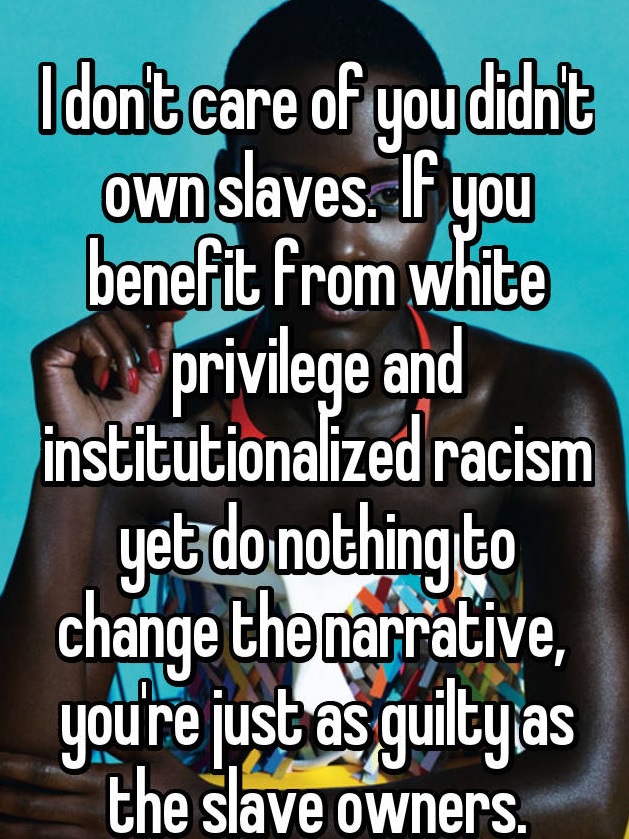
Even though all the white people living today did not own slaves when the United States operated a legalized system of slavery, they continue to benefit from structural systems of power that find their roots in that era as well as the era of Jim Crow that followed it, which elevated white people in the status hierarchy and gave them a legal basis to discriminate against black people. Failing to recognize (or being unwilling to recognize) how this legacy shapes out current social structures and institutions (i.e. education, police, labor markets) makes you complicit.
Boot Straps & Hard Work: “If You Work Hard and Get an Education You Can Have Success Too”
The idea that success derives from “hard work” alone is one that I will often talk about in class. Closely related to the concept of “The American Dream,” the idea that all that anyone has to do is work hard to get ahead makes people feel good and is a hard one to “give up” regardless of who we are talking about. In my experience, I have found that college students of all races and ethnicities who are of different social class backgrounds are particularly invested in the idea that all they have to do is work hard, study hard, and “success” is the guaranteed result. And why wouldn’t they be? What’s the purpose of spending tens of thousands of dollars on a degree if it’s not going to buy you some guarantees and a little status along the way, right?
Sorry to say this, but there are no guarantees as such. That is not to say that you shouldn’t work and study hard – far from it. It simply means that the story is a bit more complicated and that you might want to start paying closer attention to how opportunity structures work.
This thinking is seductive for reasons that it implies that we all exist in the United States on a completely level playing field; that where we all end up is a reflection of one simple thing – the magic variable “work ethic.”
So goes the thinking: Work hard, get ahead. Are you poor? Obviously you didn’t work hard. Stuck going to a crappy school? Well, you need to work harder to get out our your crap neighborhood and move to better one with a better school.”
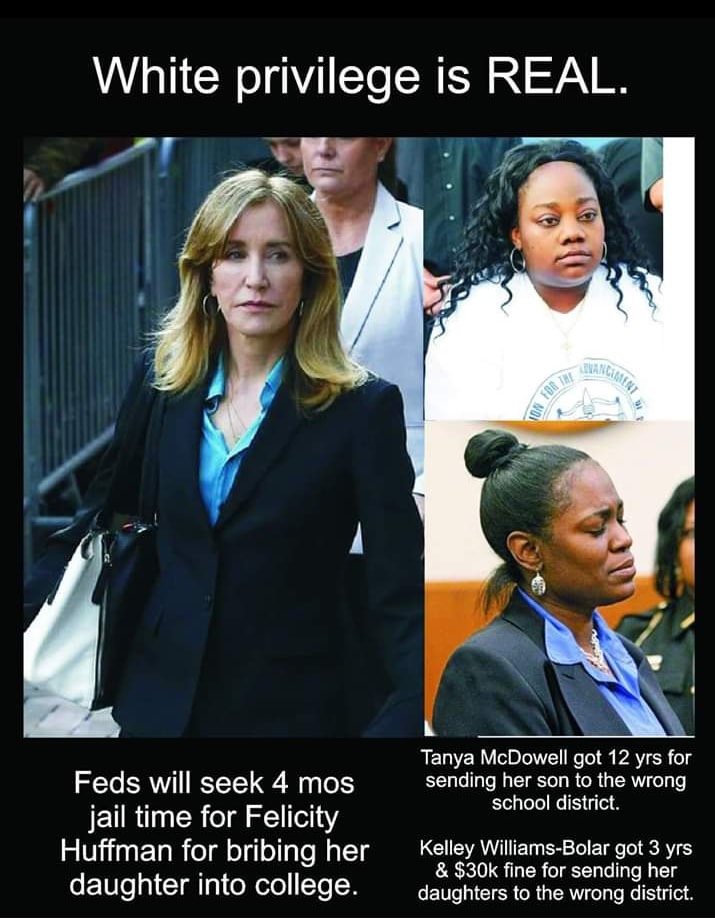
As the high-profile “Varsity Blues” scandal, featuring Felicity Huffman among others illustrates, rich people don’t always get into great schools because they are smarter and work harder. They are merely privileged players in a rigged system; one designed by them to benefit other people like them. Only the “poors” and poor suckers believe in the hard work ethic claptrap, while the rich laugh all the way to the bank, making sure their kids are positioned for advantage, thereby perpetuating already existing systems of social inequality.
Do Discussions of White Privilege “Trigger” You?
Does talking about White Privilege make you feel shame? If it does, that’s not a bad thing. The question is, how can you remain uncomfortable and at the same time become more accountable around this concept/fact?
To begin, you might want to try accepting the idea that people whose skin color identifies them as part of the majority group, who almost always holds power, do not face racial prejudice for reasons that they are marked by their skin color; that members of this group (even those who are less privileged) still face far fewer obstacles than other people (which is not to say they don’t also face obstacles), especially minorities. Yes, this is difficult for a lot of people.
Admitting that you have “privilege” does not require you to “confess” or wallow in “guilt” per se. It means that you are able to process a more nuanced understanding of a difficult concept: that while it may be true that we all struggle, some people struggle more than others for no other reason than the color of their skin, which makes life a little more difficult for them, as compared to others, who do not carry this burden.
The idea of ‘white guilt’ is highly problematic for a lot of reasons. Again, no one is saying that white people should all feel guilty about being white.
To be sure, race is not the only way in which people have faced obstacles. In light of this, it serves no productive purpose to encourage the notion of white guilt. More often than not, this causes people to become defensive and they close their minds to discussion. Put another way, it makes understanding race relations difficult and may create a barrier to progress in improving race relations.
Are You Saying that the Fact That I Am Privileged Means I Don’t Work Hard?
No.
Meritocracy for Who?
In an interview with The Atlantic, TV personality Tucker Carlson says: “Look, it’s really simple, the SAT 50 years ago pulled a lot of smart people out of every little town in America and funneled them into a small number of elite institutions, where they married each other, had kids, and moved to an even smaller number of elite neighborhoods. We created the most effective meritocracy ever. But the problem with the meritocracy is that it leeches all the empathy out of your society … The second you think that all your good fortune is a product of your virtue, you become highly judgmental, lacking empathy, totally without self-awareness, arrogant, stupid—I mean all the stuff that our ruling class is.”
Tucker Carlson may not be known as pioneer in race relations (more typically, he epitomizes white privilege, as he benefitted from being born into considerable wealth and attained his early career opportunities through highly placed family connections). So, we must bear this in mind, as the irony of him say this is pretty thick.
Despite this, we can still agree on this one point with respect to how privilege comes about: innumerable social forces work together in American society that have the effect of reproducing race as well as class privilege. Some of this may be unintended, but its not like we can’t see what the results are, which are almost always staring us un the face.
But rather, than resorting to simple homilies, indulging in “boot strapping” ideologies to explain them, you might want to hit the pause button and think critically about how you too may be caught up in a system, where you either act as an apologist or protest a system that might be working to hold you back from achieving your best life.
The Liberal State is Keeping Me Down!
Within some political ideologies, there is a tangible and consistent logic that you will pick up on, where there is an enormous about of hyperventilating about what some see are unjust and unfair “privileges” are being protected by the “government/liberal state.” People like Rush Limbaugh made it their trademark to scream foul about privileged union workers, tenured teachers, and public sector employees – note that these are all traditional members of the working classes, who continue to enjoy job protections and benefits in an era when many of those same benefits have been systematically stripped away from other workers over the course of the past four decades.
The current complaint du jour is to scream about people who collect unemployment benefits or those who access public assistance programs like Medicaid. So, the story goes: “They’re lazy and they don’t want to work, unlike me who always works hard!”
What is operating here is a logic that pits worker against worker and workers against the state, when the real enemies are the wealthy capitalists who financially underwrite large media enterprises and pay personalities like Limbaugh, Carlson, and others to divert attention away from the privileged wealth class, who maintain their structural advantage by keeping workers focused on fighting with each other.
Privilege politics, ultimately, is a game of smoke and mirrors, bait and switch, etc. The idea is to distract and render obscure where the real problems lie, which is almost always with wealth and power.
The bottom line is there are a lot of people, particularly in our news media, who are committed to investing an extraordinary amount of time and energy to convince you to ignore the wealthy ruling class at the top of the social hierarchy. They encourage you to look for explanations for all the problems in society somewhere else. That is, they want you to see the poor and less privileged people among us as the group who are the source of our worst problems.
Sadly, people easily fall for this sleight of hand. But why? Because it gives them permission to to be their worst selves; it feels good to judge, hate, and pat yourself on the back while you are doing it. People get to indulge their worst impulses when they judge people they think are “less than” them. Unfortunately, as part of this process they usually end up selling out their own best interests (i.e. they’d rather not have access to more affordable healthcare if it means that groups of people they don’t like will also get access to affordable health care).
This is a tried and true strategy that works every time. So what’s it going to take to get people to change? How can researchers and policy makers bring attention to (and try to fix) things like systemic racism and the inherent privilege it provides at the expense of less advantaged people, when there are so many people committed to keeping the system structurally unjust and unfair?
Sources
Answering questions on Trump & the Rust Belt, The Atlantic, 2017
We Can No Longer “Agree to Disagree” About White Privilege in America, Phillymag.com, 2017
Discussion Questions
Does hearing that you have undue privilege make you feel uneasy or angry?
Does hearing the words race, racism, and structural racism automatically make your head spin and feel like you being attacked by the “Woke” mob?
Do you find yourself wanting to change the topic when it comes to talking about race, bias, and prejudice?
Do you believe being reminded of the prevalence of racism is a form of reverse racism?
Do you ever have conversations about race with people who don’t share your own race?
Have you ever said racism is a thing of the past and folks should stop talking about it?
How does this post make you feel about yourself?
This is of course an American view. There are others. Social class is the prime marker of division in the UK, or was until very recently. And yes, class and race are indeed extremely intertwined.
If you are white and live in a forgotten town in many parts of the UK you are not much better off than anyone else, and the lionising by usually white middle class privileged well educated people of everyone ethnic minority bar the white working class is also a problem. I can’t imagine why a very privileged liberal middle class white person would not wish to talk about social class and socioeconomic class discrimination between white people, let alone anything else??!!
Class and racism and many other long enduring prejudices that benefit some and punish others are almost always underpinned by economic divisions. This is particularly so in the UK. No racism needed, just undercut the wages and benefits of the majority whilst making favourable tax arrangements and other things which hugely benefit the wealthy and corporations and the like.
Thank you for your perspective. Indeed, as you point out, this is a distinctly American view – this is for a class in Race, Ethnicity, and Culture in the U.S.
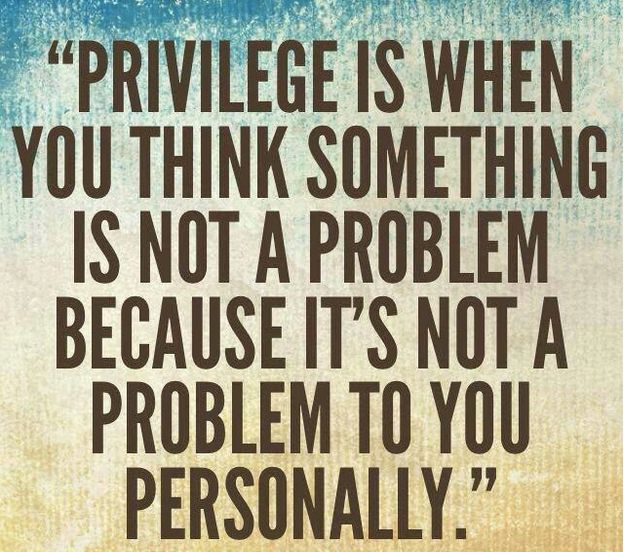
“Privilege is when you think something is not a problem, because it’s not a problem to you personally” is a statement that cannot be defined any better. Throughout the years of slavery and segregation, white privilege was just seen as just normal life. As a matter of fact, it was not even privilege. It was just the rule of thumb. I used to hear people joke and say “If it’s white it must be right” In white America this stands true in multiple areas. From employment, to run ins with the law, medical treatment, financial success and many others. You can see how white privilege moves like a well-oiled machine.
In the black community, we use a phrase called black tax. What that means is, blacks have to work twice as hard just to prove themselves equally qualified. We see how much white privilege plays a role in our court systems as well. Many men have lost their lives to being falsely accused of crimes they didn’t commit. The drug crimes in white areas compared to black areas was so unproportionate that black men were doing time at a significantly higher rate. The Anti-Drug Abuse Act of 1986 made a ratio of 100:1. This meant that 1 gram of crack cocaine was treated the same as 100 grams of powder cocaine. We all know that crack initially was in black low-income areas. Powder cocaine was found in rich white neighborhoods. Both drugs were cocaine, but blacks received a significantly high prison sentence.
The wealthy will always have an advantage over the less fortunate. Especially if you’re of white decent. Money talks, but it speaks multiple languages if your white with money. That’s the difference between doing 30 years in prison for rape, or daddy’s dollars getting you 10 years’ probation. The difference in going to an Ivy League school or doing a decade in prison for wanting your kids to have an equal education as whites. There is no real solution to this as long as the majority rules and makes the rules. You just learn to accept that this is how it is and find a way through the back door.
No, hearing that I have undue privilege does not make me feel uneasy or angry. Instead, it prompts reflection and a willingness to understand the structures and systems that shape different people’s experiences in society. Privilege is not an accusation; it’s a recognition that certain advantages may exist based on factors like race, gender, or socioeconomic status—often without one’s active involvement. Acknowledging privilege is an important step toward empathy and social progress, not a personal indictment. It allows for broader conversations about fairness, opportunity, and responsibility in creating a more just society. Similarly, hearing the words race, racism, and structural racism does not make my head spin or feel like I’m being attacked by the “Woke” mob. These are critical concepts that help explain real, historical, and ongoing inequalities in our world. Discussing racism—whether individual or systemic—is not an act of aggression, but an effort to recognize and address harm. Dismissing these discussions as attacks undermines important social dialogue. It’s possible to engage in these conversations thoughtfully and constructively, without defensiveness, and with a genuine desire to understand and improve conditions for everyone.
Does hearing that you have undue privilege make you feel uneasy or angry?
It makes me slightly uneasy, as this is something that I hadn’t given much thought to. As someone who is of mixed descent, I now realize that I do benefit from certain privileges, especially when I may be able to “pass” as non-asian in certain situations.
Does hearing the words race, racism, and structural racism automatically make your head spin and feel like you being attacked by the “Woke” mob?
No, I don’t feel attacked. I feel that these are revealing descriptors to real problems, systems, and experiences that many people face, even if discussing them may be uncomfortable.
Do you find yourself wanting to change the topic when it comes to talking about race, bias, and prejudice?
Admittedly I have not talked much about this topic, and I may feel slightly uncomfortable talking about it (especially if it may be about privileges that I enjoy), but I am totally willing to have these discussions and avoiding it only worsens the problem.
Do you believe being reminded of the prevalence of racism is a form of reverse racism?
No, I see it more as a call to awareness, not an attack.
Do you ever have conversations about race with people who don’t share your own race?
Yes, especially with friends of mine. I am a minority in my community, so whenever I have a discussion usually it’s with people who are of Caucasian descent.
Have you ever said racism is a thing of the past and folks should stop talking about it? – No. Even if racism has changed and laws have been created to protect people, the effects of racism and discrimination still remain and can be seen in various parts of society (income, education, housing)
How does this post make you feel about yourself?
It makes me more self-aware. I don’t feel guilty for who I am, but I do feel more responsible and empowered learning about how privilege works and not ignoring it just because I benefit from it while others are negatively affected.
When it comes to race as someone who is white and grew up in a privileged area, it does make me angry knowing that I have an inherit advantage from being white. I have heard the experiences of so many people in minority groups, I have witnessed it happen first hand, I know so many minorities in this country face abuses that most white people handwave.
This is not something made up by the “woke” mob. Racism is alive and well in America while we are fed propaganda of racism no longer exists in this country and it is a thing of the past. The reality is my parents grew up during segregation. They were teenagers when it was “ended”. They are in their early 70s now. They are younger than our presidents. Many people in congress lived through segregation and benefited from it yet we are to believe that these ideologies have been completely stamped out.
I am not really shy when it comes to this topic and have talked about it with people of different races. I have noticed it is mostly white people who are very uncomfortable about the topic of race. If you acknowledge the problem, you are labelled as a self-hating white when it is simply the reality that racism enshrouds this country in conniving ways. Reverse racism does not exist and what white people are feeling as reverse racism is, in my opinion, being uncomfortable.
The only true way to leave racism in the past is to fully acknowledge its existence and to listen to the voices of minority groups.
Honestly hearing that I have unearned privilege does make me uncomfortable, as I believe no one should have more advantages than others. It doesn’t feel fair, and most people would probably agree. When I hear those words, I don’t automatically think in a negative way, but I usually connect them with topics that people tend to avoid whether for valid or personal reasons. I don’t enjoy thinking about the racism that still clearly exists today, but it’s an issue that must be addressed, even though people have been saying that for a long time.
I’m open to hearing others’ perspectives on race, bias, and prejudice, but I admit I tend to want to shift the conversation if something clearly racist or offensive is said. I don’t view acknowledging racism as a kind of reverse racism. I see it as necessary awareness that this problem must end.
I’ve had a few discussions about race with people who are of different backgrounds, though we don’t usually get too deep or serious. I’ve never thought that conversations about racism should stop. I just wish racism itself didn’t exist. Reading posts like this makes me resent the unfair privilege white people are often given compared to the treatment of others.
White privilege is as a deeply rooted reality woven into societal institutions rather than an abstract idea. Especially when I read the Brandeis/Demos data showing the median white college graduate holds over seven times the wealth of the median Black college graduate, it felt like a punch illustrating that academic achievement alone cannot erase entrenched barriers. The illustration of the Varsity Blues scandal highlights how meritocracy rhetoric often conceals inherited advantages and systemic favoritism. As someone who can feel uncomfortable discussing race, this article motivates me to push past my hesitations, engage in honest dialogue, and leverage whatever opportunities I have to dismantle inequities. It reminds me that recognizing our privilege is only the first step; meaningful change requires concrete actions, like amplifying marginalized voices, advocating for policy reforms, and challenging everyday biases. These compel me to see addressing white privilege as both a duty and collective obligation toward building a fairer society.
Reading this article made me think more seriously about what privilege really means, especially white privilege. I used to think privilege only had to do with being rich or having an easy life, but this reading showed me that it’s more about the unfair advantages people have just because of things like their race or background. One part that really stood out to me was how the article explained that even when people work hard, their success can still be limited by systems that favor others. It made me realize that believing “hard work always leads to success” isn’t true for everyone, especially people of color who have to deal with more obstacles every day.
It was also eye-opening to read that just ignoring racism or saying it’s in the past is a form of privilege. I never really thought about how staying silent or not noticing inequality could mean I’m benefiting from the way things are, even if I didn’t ask to. The article challenged me to pay attention, not just to what I’ve gone through, but to what others have experienced, especially those who don’t look like me or come from the same background. This reflection showed me that having privilege doesn’t mean you didn’t work hard. It means your hard work isn’t blocked by the same barriers others face.
Hearing someone say that I have undue privilege could make me feel uneasy or angry, although, it comes down to the person saying it. Hearing the words race, racism, and structural racism do not automatically make my head spin or feel like I am being attacked by the “woke” mob. It makes me happy that this is a topic others may feel comfortable enough to discuss. I do not find myself wanting to change the topic when it comes to talking about race, bias or prejudice. This is an issue that touches my life, daily, an issue that needs to be discussed more openly. I do have conversations about race with people who do not share my own race. I enjoy hearing different perspectives on racial issues and injustices. In addition to getting to learn and hear different experiences from people who do not share the same race as I, it can also be taken as an opportunity to educate others. An opportunity to shine light on my perspective on life, one that people of other races may not understand or ever experience.
Whenever I find myself in a conversation where race is being discussed, I try to stay aware of my perspective and the privilege I carry as a white person. Reading Sandra Trappen’s article What is White Privilege? It helped me understand that white privilege doesn’t mean I’ve had an easy life—it just means that my race hasn’t made my life harder. It’s about the advantages I’ve had without even realizing it, simply because of my skin color.
I don’t believe racism is something that’s been left in the past. I still see and hear about it happening today in many forms. I know people who’ve had painful, unfair experiences just because they’re not white. It could be being treated suspiciously in stores, facing discrimination in school or at work, or being pulled over by police for no apparent reason. These are things I’ve never personally experienced, and that’s part of what white privilege looks like.
I also try to be respectful in conversations about race by not bringing up topics that might be uncomfortable or deeply personal unless everyone involved feels safe and okay talking about them. These conversations can be draining for people of color, especially when asked to explain or prove what they go through.
Reading the article made me realize that acknowledging white privilege isn’t about feeling guilty but is more of a reminder about being aware in certain situations. I believe it is about understanding how systems are set up in ways that benefit some and hurt others. I want to continue learning, listening, and doing better. I believe it’s essential to use my awareness to support fairness and speak up when I see injustice while ensuring I’m not speaking over those who experience it directly.
We are all born innocent—newborns just beginning to learn about the world. Yet, one persistent issue we continue to face is white privilege. This term describes the systemic advantages and benefits that white people often enjoy, privileges that many others can only dream of. The article “Privilege Politics” explores this in depth, explaining that white privilege isn’t just about individual acts of discrimination. Instead, it’s a deeply embedded structural system that maintains inequalities in wealth, education, and opportunity. It challenges the idea that hard work alone is enough to overcome racism, highlighting that racial disparities are built into our economic and social structures. For example, the article cites research showing that even Black families with higher education and stable employment still hold far less wealth than their white counterparts. This demonstrates that white privilege goes beyond personal interactions; it’s woven into the very fabric of our society. Ignoring or denying these realities only helps to perpetuate the cycle of racial injustice.
As a Black man in America, I’ve experienced racism from many directions, and it’s deeply frustrating. I know I have nothing but good intentions, but when people remain fixated on the past instead of addressing the real, ongoing inequalities in the present, it holds back the potential for a better, more equitable future.
I don’t think hearing that I have undue privilege makes me feel uneasy or angry, it makes me want to listen more to what the other person is saying. I think mostly the words race, racism, and structural racism have been used in the correct circumstances to describe or educate on an issue. I don’t find myself wanting to change the topic when it comes to talking about race, bias, or prejudice, however, I do find that I listen to the conversation more than I participate. Sometimes, in fear of saying the wrong thing, or I simply am not educated on the topic, and I’m listening to learn. I don’t believe being reminded of the prevalence of racism is a form of reverse racism. I would never say “racism is a thing of the past, and folks should stop talking about it”, because it is a current issue in our government and social hierarchies. This post confirmed beliefs I’ve already had on how I, as well as others I know, are perpetuating systemic racism overall.
I thought Sandra Trappen’s article did a good job providing a clear explanation of what white privilege means. She explains that white privilege isn’t about getting things handed to you or having lots of money, but about the ways white people often benefit from systems in society without even realizing it. These benefits can be small, like not being followed in a store. They can also be major, like being more likely to get picked for a job or receiving fairer treatment from the police. Trappen shows that white privilege is not just about individual actions, but about social structures that have a bias towards white people.
One point she makes that I believe it’s important to remember is that having white privilege doesn’t mean white people haven’t worked hard. It simply means their race has not been an obstacle for them. Meanwhile, people of color often face extra hurdles just because of how they are seen by society.
Reading this helped me see how privilege can be invisible to the people who have it. For example, when you see Felicity Huffman got 4 months for bribing a college, you may think that seems fair. However, when you compare to punishments African American females got for similar crimes, it is easier to recognize the white privilege. The best catalyst for change in this situation is spreading awareness.
I do not think that I have ever had a conversation about race with someone of the opposite race than I am other than in a classroom setting. This is not because I am scared or silenced by these conversations. I truly think that everyone, including myself, is intimidated by that subject, even when it is in a controlled environment. People are scared of saying the wrong things or even voicing their own opinions.I think that the conversation of race is out of the ordinary for most people, so they try to stay away from that topic. While I do find myself guilty of this, I do think that people need to try and bring the subject of race up more. Bringing up a conversation of this sort may not be the smartest when dealing with strangers or when time is not appropriate. But with friends and when the situation is appropriate, I think it would be just fine to
do so.
Whenever I am in a conversation and the topic of race comes up, I do not necessarily try to change the topic, but I do try to keep the conversation to a minimum because it can be a very personal topic at times and the conversation can lead to more than you expect. I think there is a time and place for that type of conversation because you will not know how people will respond to it.
I don’t think that racism is a thing of the past. I’ve heard many people say that before and although racism may not seem like a big issue to people, it still exists. For example, when I am out with my family, we will be treated differently and there are times when people will follow us or will whisper and harass us for no reason. I know a lot of people who have really bad experiences just because they are non white. Racism may not be the same as it used to be, but it still occurs to this day.
I often have conversations with people who don’t share the same race as me. The conversations sometimes involve us talking about any hardships in our families, but most of those conversations that deal with race are typically about what our traditions and culture and food are. If I am having a conversation about race, I will not talk about any struggles or things that may be sensitive unless both sides are comfortable with it. Not all conversations of race are bad, but I don’t think it should be a topic of conversation at times.
Hearing that I have undue privilege makes me feel no. It does not make me feel uneasy or angry because I don’t really care what people think of me .When I hear the words race, racism, and structural racism, I say to myself whatever because I don’t like to look at life like that also because why do people like people just by their race and more. I tend to change the topic or just leave the conversation because I hate when it comes to talking about race, bias, and prejudice. I believe being reminded of the prevalence of racism is justified; it highlights ongoing systemic inequalities that affect marginalized communities. Acknowledging the historical and present-day realities of racism encourages awareness, empathy, and responsibility for creating change. These reminders help foster meaningful conversations and ensure that society doesn’t become complacent in addressing racial injustice. I have conversations about race with people who don’t share my race. No, I don’t talk about race because it is stupid .Saying that racism is a thing of the past and that people should stop talking about it often comes from the idea that significant progress has been made, and that we should focus on moving forward. However, this view fails to recognize that systemic racism continues to impact marginalized communities in subtle yet significant ways. While legal changes like the Civil Rights Act and the end of apartheid were important milestones, racism is not just about laws or overt acts of hatred—it’s embedded in societal norms, implicit biases, and unequal opportunities across areas like education, healthcare, and the criminal justice system. When we claim that racism is no longer worth discussing, we close off opportunities for meaningful conversations that are necessary for creating real change. Acknowledging racism is not about dwelling on the past, but rather about understanding its ongoing effects and working toward a more equitable future. Ignoring the issue doesn’t make it go away; it simply allows it to persist without challenge. This post makes me feel the same way as I did before about myself.
This article is beneficial in being educated on these terms. Hearing that I have undue privilege might make me uneasy at first, but I do believe that white privilege is very real. It is a harsh realization because it makes me pause and recognize that some of the opportunities, I have had in life may not only be due to my actions but also because of my skin color. It is not easy to face, but it is an essential step toward understanding the bigger picture of privilege. I think it is easy to feel defensive or uncomfortable when you are told that things might have been easier for you because of something out of your control. It is an eye-opening moment, but also one that pushes me to think more deeply and get more educated on white privilege and the challenges others may face.
Hearing words like race, racism, and structural racism does not make my head spin, but it makes me want to learn more. I know these topics are essential, and while I may not have all the answers right now, I am genuinely interested in understanding them better. It is not about feeling attacked but realizing how much I still have to learn. The more I listen and educate myself, the better I will be at having thoughtful conversations and being part of a positive change.
The topic “white privileged” is in no way offensive to me. Reason being there have probably been many times in my life I’ve benefited from it and have not realized. This article brought that to my attention. I learned many things I was unaware of in the past and things I’ve never thought that deep about. It was very eye opening especially thinking deeper into the meaning behind white privilege such as the fact that white privilege isn’t a personal insult, it’s more directed towards white people as a whole. For example, on a job application seeing you’re white is automatically a privilege whether you’re aware of it or not. I’ve never thought to look into the tiny details behind this term. This article in general changed my perspective completely on “white privilege.”
I thought this was a fascinating read. I don’t get mad when people say that I do have privileges that are not afforded to all skin colors. If they start using it to belittle me or say that my achievements are fake, then I would, but this hasn’t happened to me. I do find myself wanting to change the topic off of race often, in my area most people hold beliefs that deeply contradict my own, and I don’t trust some of these people to stay civil. I do think reverse racism exists, though it is just racism, not its own thing. Racism is just treating someone differently based on the color of their skin, and anyone of any race can do it. I have tried to have conversations about it, especially when my parents, who I know aren’t bad people, just randomly be racist. They usually just play it off and continue, so I have kind of given up hope on that.
Talking about white privilege doesn’t bother me when it is mentioned. I am Hispanic but grew up in a diverse county and schools. I think I’ve had a good experience with both sides of the argument. I think That white privilege does exist in a lot of parts of the country, but maybe not as much as I’ve seen in my hometown. My parents are split and I’ve gone to a diverse school with more white students and I’ve gone to the city school in my county. I think I’ve definitely seen my share of white privilege used, but I don’t think I’ve recognized it and have thought to myself that I did see it until now. I think that I’ve also been lucky that I have a mixed friend group where I get to encounter these kinds of things around me. I don’t think I’ve personally been treated differently by anyone because of my race or skin color, or have seen it up close.
It does not make me feel uneasy when the discussion of white privilege is brought up. The reason is because there have been multiple times in my life where I have unknowingly benefited from it. Typically I don’t shy away from the topic of racism while discussing it with other races because it is impossible to truly understand the effects of racism if you only have input from people who are the same race as oneself. Another factor why I encourage people don’t be exclusive to only talking about racism with their own race is because the root issue of racism is centered around the races being separate from one another. So if every race only discussed the issues regarding themselves to other people who either experience similar benefits or consequences no progress regarding the issue would be made due to the lack of communication going on.
Feeling privileged as a white male can sometimes feel uneasy to talk about. I think at the end of the day its hard to come to terms with something that is out of your control. However, it’s easy to say that when you haven’t been given the short end of the stick your whole life based on your race. I have had conversations with people of other races before, one of which who is my best friend who is African American and we both mutually agree that racism and prejudice still exist in the world and effects minorities the most. Racism is certainly not a thing of the past. We still see it in the workforce, judicial system, and even education system. Minorities still continue to struggle more than white people in these areas because these things have been deeply rooted in our history. Although things are starting to get better, we still see minorities effected by these issues and it will take a while to make things more equal. This post makes me feel like white people, myself included, have had the edge over different races, which I do not believe is fair. I believe every race should have an equal shot at success, regardless of their upbringing.
When I hear the term ‘white privilege,’ I think of how it manifests in various aspects of society, particularly in relation to law enforcement and everyday establishments. For example, a person of color, especially a woman, may enter a clothing store with the intention of shopping, only to be closely followed by employees who may view her with suspicion. Meanwhile, white shoppers in the same store are often able to browse freely without experiencing the same level of scrutiny or being subjected to unfair assumptions.
This kind of behavior reflects the larger social dynamic where white individuals are typically not perceived as a ‘threat’ in the same way that people of color are, simply due to their skin color or the way they present themselves. White privilege gives white people more freedom, both in terms of physical space and opportunity, as they can move through society without the constant need to navigate negative stereotypes or discrimination. The privileges granted by whiteness are deeply embedded in various aspects of life—whether it’s in retail spaces, or interactions with law enforcement. People who benefit from this privilege often do so unconsciously, as they are not regularly forced to confront the challenges that people of color face daily.
This article educated me a lot on the real meaning behind white privilege and it is honestly terrible how some people view others. I don’t think anyone should judge someone or feel a certain way by the color of someone’s skin. Everyone is equal and it’s sad to see how some people get treated and not given opportunities because of their appearance. one thing that i realized that opened my mind was how white privilege isn’t directed towards certain white people and how they are treated but directed towards every white person as a race. I never really looked at white privilege that way and i think that really changed my perspective on the term. Addressing white privelage to some can be a challenge and can make some people self reflect not even realizing that they are getting white privilege because they have never experienced any racial problems or been around people of color. Some of my best friends are black that i have known for years and i have even experienced some issues one time getting pulled over. The cop was giving us a hard time mainly my friend trenton who was driving acting like we were getting into trouble and asked trenton if he was high but in reality we were doing any drugs or getting into trouble we were driving home from basketball and he was just taking me home. It is sad that our country is like this but sadly some people are too caught up in their own opinions and can’t find a way to see the good in everyone.
The term “white privilege” denotes the societal, economic, and political advantages that accrue to persons considered “white” merely on the basis of that designation, oftentimes without their being aware of such discernment. Ingrained within structures, institutions, and systems of society, these advantages make life much easier for whites than for persons of color. White privilege manifests in limited chances to be racially profiled by law enforcement processes; better access to quality education and health care; and generally being portrayed positively in the media and being appropriately represented in leadership roles. White privilege can simply mean that white persons have decreased chances of being discriminated against or prejudiced against in the job sector or discrimination against housing sales and such questions as day-to-day interaction with others. White privilege does not mean that all whites are rich or free of hardship, but it recognizes that race, not just class or individual circumstance, is a factor in determining a person’s chances and outcomes. Such knowledge of white privilege is of the utmost importance when trying to understand the systematic workings of racism and battling against inequality in the society.
I will admit I absolutely hate talking about racism and white privilege. I hate talking about how the system is not fair or properly balanced, I do feel like until recently not a lot of people cared about white privilege and race, until there recent 4 or 5 years no one really cared about what was wrong and what was right unless they were being effected. Sure there are those few but that’s simply what they are a few to the many. We sugar coat history and many people believe that telling themselves ‘If I was around back then I wouldn’t of acted like that’ or ‘i wouldn’t of owned slaves I would’ve helped free them’. I recently heard someone speak like that in one of my classes too, people find comfort in saying words like that so they could feel like good people but I also believe if you can find comfort in words like that you’re apart of the problem. As of late I’ve argued with a lot of my non-AA friends about white privilege and even lost a friend to their beliefs, even in classes there are things I would like to speak on or make a comment about but I’ve learned that no one genuinely wants to hear that, no one wants to hear correct terms and stories about history especially if it makes their race ‘look bad’. Social expectations are real, the idea that you have a better life in a two-parent household is so strong that its a joke that most African Americans grow up without dads. I think we should stop expecting everyone to be caught up in racism and white privilege and social norms and injustices and we should stop hating on them for it as well. Everyone talks about change and being ‘woke’ in this day and age but we also have to realize that we will truly never stop craving change. I might even have a closed mind on the subject because I believe that almost every white person has experienced white privilege even if they didn’t know, no matter how big or how far that privilege got them. We scream at minorities for not working or collecting money from the government only to realize there are more obstacles preventing them from working than normal. It’s more realistic and easier for me to criticize white people as a whole than individually, and that’s just my opinion for myself especially when talking about stuff like slavery and racism my mind is programmed to judge and not take seriously most of the stuff that is spoken especially in African American history classes and classes on race in general by people that are not of a certain race but I do say there are people- or that I know people who properly teach it as well. Comfortability it depends on the environment. But even reading back on this comment I wouldn’t be surprised if it’s considered racist but maybe I’m one of those people who’ve learned not to care. The American system is many things but colorblind isn’t one of them, the system cares more about color than anything else.
White privilege refers to the unearned advantages, benefits, or immunities that white people experience in societies where racial inequality exists. In Unpacking the Invisible Knapsack McIntosh describes white privilege as a series of everyday, often unnoticed benefits that white people receive simply because of their race. These include things like not being racially profiled, seeing people of one’s race widely represented in media and positions of power, having easier access to housing, jobs, and education, not being judged negatively based on racial stereotypes. white privilege doesn’t mean that white people don’t face hardships, it means their struggles are not caused by their race. A key point in discussions of white privilege is recognizing that systemic racism creates barriers for people of color while providing advantages to white individuals, often without them realizing it.
When I hear the words race, racism, and structural racism, it does not make my head spin. It definitely does not make me feel like I am being attacked by the “woke mob.” These words listed are very relevant topics because there is still an extreme amount of racism in America and especially with structural racism. I do not really find myself wanting to change the topic when it comes to race, bias, and prejudice because people need to be aware of what is going on when it comes to this stuff. Sometimes I think “what if I say something wrong?” But, I have started to quit worrying about that because if I do say something wrong, it is an opportunity for someone around me to educate me. Being reminded of the prevalence of racism does not make me mad, and I do not think it is reverse racism. I have had many of conversations about race with people that do not share my own race. They are some of my closest friends I have, and hearing their stories about the amount of racism they experience is heartbreaking. It is insane to me that there are people out there thinking racism is not a problem in our age. It is still a huge problem, because a huge amount of people deal with it. I have never said racism is a thing of the past because I know that is not true. This post made me feel like I got more educated.
It does not make me annoyed when I have to hear the words race, racism, and structural racism because we have to learn these terms and the leaning behind these terms since they are deeply rooted in American history. It doesn’t make me feel like I am being attacked by the “woke” mob considering it’s not something to be “woke” about, it’s a necessity. The only time I would want to change the topic regarding race, bias, and prejudice is when someone says that “all lives matter”, because most of the times they say it out of spite and even if they mean it, the context would be that “why does Black or Asian, etc. lives matter only, white lives matter as well, so all lives matter” if the topic where to be about racial discrimination and equality, they are brushing off the importance of awareness of their history and discrimination they have had to face in a predominantly white population.
Honestly, when I hear words like race, racism, and structural racism, it can be overwhelming at times. I don’t feel personally attacked, but I can see why some people might get defensive, especially with how divided things are. Sometimes, I even find myself wanting to change the topic because it’s such a heavy and complex issue, and I worry about saying the wrong thing. I don’t think being reminded of racism is reverse racism though I get why some might feel that way, it’s really about addressing bigger systemic problems. I’ve had a few conversations with people who don’t share my race, but they’re usually a bit awkward, since it feels hard to talk about without stepping on toes. In the past, I might’ve thought racism was something of the past, but now I see it’s still very much present in subtle and systemic ways. After reading something like this, I realize it makes me reflect more on my own role in all of this. Acknowledging privilege is tough, but it’s important if we really want to make progress. It’s a hard conversation, but we need to have it.
The issue of white privilege and race is still a big topic of discussion in America today. The article made it more clear to me on just how big it is. For example, as a white male, I am not afraid to get pulled over by the police. That is white privilege right there. Black men and women are worried to get pulled over police because they are afraid to make the wrong move and potentially be killed. Also, I do tend to get uncomfortable when talking about race mostly because nothing affects me. That is also another example of myself having white privilege. Plus, I have friends who think they are invincible just because of who their parents are. That mentality honestly disgusts me. We see white people who aren’t that smart get into big schools because their daddy has a lot of money. We have had to make rules over the years just so you can’t discriminate against black when applying for colleges.
Personally, I feel as to undue privilege makes me mad people are treated differently and it has been like this for a long time and people work hard to become successful and it gets in the way and why is this even a thing. When I am at my job, I actually observed how people treat workers depending on the race and it is gross to see how many people treat others because their race. When people talk about race to me it does not offend me, why you may ask I like to see the way other people think and to separate myself from those people. I do have conversations about race with people who do not share the same race more of like a perspective we do not take offense we just wonder why things are the way they are and unequal. Racism should not even be a thing nobody is better than the next because of there skin color it is stupid, but racism is always going to exist whether we like it or not sadly.
I think that this website post gave me more of an insight on the topic of white privilege and how it is seen today, almost in a way of people taking advantage of it knowingly. I think the quote “Privilege is when you don’t think something is a problem because it does not apply to you personally¨ helps the reader see that some people do take advantage of the privilege they are given, but this doesn’t just represent one person, it represents every white man or woman. For example, the case where Felicity Huffman bribed her daughter to attend college only resulted in a 4 month prison sentence, while a mother who sent their children to the wrong school district for a day received 12 years in prison. Yes these are two different levels of scenarios, but receiving 12 years more than someone of another skin color just doesn’t make sense to me.
The issue of racism in our society is one super complicated. We as Americans, often, consider our topic of racism to be unique than the rest of the world, but I see differently. I believe that’s incorrect, all nations, Black-majority, European-majority, etc, suffer from these decisions made centuries ago. To answer one of the discussion questions above: I do not believe being reminded of the prevalence of racism is the spirit of idea of reverse racism. Reverse racism means the opposite of what combined racism: which in most schools of thought is discrimination. I think the objectives of reverse racism mean being educated on the issue, understanding your privilege, and commit to reversing systemic and daily basis (as explained in the beginning of the article). The mention of meritocracy highlights a comment by Tucker Carlson to show how white privilege so elevated can lead to a lack of empathy and shows displays of ignorance on a topic perpetuated by White individuals many centuries ago. The acknowledgement, made throughout the article, of privilege in our society is not one to be confused as a guilty verdict but rather a comprehension of other classes and races recieving systemic discrimination and being left to suffer.
This post made me feel more aware of what is actually happening around the country. I could never understand why people complain about not having equal freedoms even though we live in “the home of the free”, but after reading this post it makes a lot more sense. I always get angry when I see people complaining about not having equal opportunities, but I need to understand that the system we are living in was meant to help the white male. That doesn’t mean that laws like the Jim Crow laws that were made were my fault, but I have to acknowledge that this system was meant to put people (typically African Americans) down and to make it harder for them. I can’t control what law makers did in the past to hurt people, but I can control how I understand and recognize why people get upset and how I can help them to get to a better place overall.
Indeed it is not about “fault” as you say, but is rather about simply acknowledging the power of systemic racism. We built it. To “un-build” it means it has to first be recognized.
Undue privilege refers to an unfair advantage that someone receives without necessarily deserving it. This goes by wealth, social status, or different connections. For me, knowing that I have undue privilege does make me feel uneasy and in certain situations angry, because in many cases someone can have all the qualities they need to get somewhere and have to work harder and still not get to where they want to be in life due to undue privilege. Hearing the words race, racism, and structural racism are things that I feel people should be more educated on and I feel should be talked about. Even though people want to disregard it because it may not directly affect them people do need to become more aware of it. With that being said, I never really find myself wanting to change the topic when it comes to race, bias, and prejudice. Learning and being reminded of the prevalence of racism is not a form of reverse racism. I do believe that it is a step in the right direction to ending racism though. Being biracial, I have some family members and even friends who don’t view some things the same as I do. So, I do have these conversations and will gladly try to educate them. Racism is apart of many major historical events and is still very well happening now, and without learning and talking about it, it causes a lot of ignorance. So, I never believed that people should stop talking about it.
Does hearing that you have undue privilege make you feel uneasy or angry?
I wouldn’t say that it makes me feel uneasy or angry. Although for some I could imagine that it may, They don’t understand the views or path that certain people have and how they view theirs. Personally, I feel as though acknowledging privilege is simply recognizing reality and a step towards understanding and addressing societal inequalities. Also, more people need to see it as an opportunity to learn and contribute to positive change rather than feel as if it’s a personal attack. I feel as though this could go a lot further rather than being pissy that someone said that I am privileged. Another thing is you have to be grateful for what has been given to you and know to take and act like that’s how life should be. Those are my thoughts on whether the word privileged makes me feel uneasy and angry.
Honestly, I feel like I have benefited from White Privilege. I understand how some others could get annoyed by the term “White Privilege”, but I don’t have any problem with it. I was born into a relatively well off 2 parent household that gave me many opportunities in life. Not many POC can say they’ve had all these things, so there is definitely privilege at work. I understand that other races and minorities go through many things that I simply don’t understand, so I don’t mind conversations about racism. Learning a bit more about it couldn’t hurt. If someone lives in a system where they are actively discriminated against, they have the right to talk about inequality. It’s pretty rare for me to have any deep conversations about race with anyone, let alone a person of a different race, but, the few times it has happened, I felt as though I had learned something. I’ve come to terms with having been born lucky a long time ago, so talking about White Supremacy doesn’t make me that uncomfortable.
Engaging in conversations about race, especially with individuals who do not share my racial background, is a part of my journey. These discussions often reveal the wide spectrum of understanding and sensitivity towards racial issues, highlighting the necessity of patience, empathy, and openness. It’s not uncommon to encounter resistance or denial about the existence and impact of racism and white privilege. Yet, these dialogues are crucial for fostering a deeper comprehension of the ways in which race and privilege intersect and affect lives, including the development and mental health of children.
The assertion that racism is a relic of the past is a perspective I’ve frequently encountered, yet it contradicts both historical evidence and contemporary realities. Such views show the ongoing need for education and awareness-raising about the systemic nature of racism and its effects on society. The idea that we’ve moved beyond racism is a comforting illusion for some, but it’s an illusion that perpetuates injustice and hinders progress toward genuine equality and understanding.
The discussions of white privilege, systemic inequality, and the call for a more profound acknowledgment of these issues resonate deeply with me. They reflect a reality that I, along with many others in my community, live with daily. Far from feelings of helplessness or despair, they reinforce my commitment to advocating for change, both within the field of child psychology and beyond. Understanding the layers of privilege and systemic barriers is essential for addressing the root causes of mental health disparities and for fostering environments where all children can thrive, regardless of their race or background.
I would say that hearing that I have undue privilege does make me feel uneasy as mostly everyone would say, I don’t find it equal for me or anyone else to be more privileged than others.
When hearing those words, I necessarily do not think like that. Typically, I just associate the words with something that most people don’t want to talk about or recognize, whether it be for a good reason or bad. I do not like to think of the racism that is so obviously still present in our society, but it’s something that needs to be addressed and taken care of, however people have been saying this for years.
I would like to hear others opinions on topics of race, prejudice, and bias, however I do find myself wanting to change the topic if I am hearing something clearly racist or inappropriate.
I do not think of the acknowledgment and recognizance of the prevalence of racism as a form of reverse racism, rather than trying to spread that this needs to end.
I may have had a few conversations about race with others who aren’t the same race, however we do not really discuss things in-depth or seriously. I have never believed that people should stop talking about racism, I just believe that racism shouldn’t exist at all. This post just makes me despise the privilege that white people receive in contrast to how others of a different race are treated.
So, when I was younger, as in beginning of high school, people (particularly my father) used to tell me that I was privileged and that I did not understand the chance that I had to be in the place that I am in today. Back then, it used to make me angry, because at the time we lived in a house in construction, I used to drive 45 minutes to school every morning, and I got back to my house so late after school that I would go to bed late because of all the homework that I had to do. And those are only a few examples. So, obviously hearing that I was privileged would make me angry because I did not see the privilege in what I had, I only saw the bad. However, as I grew older, I slowly started to understand what they were talking about. They meant, the fact that a lot of the things that I had, my father did not have when he was growing up. I am a first generation American in my family, and with that already comes a lot of privilege, even though I did not grow up here. So, it does not make me angry anymore because I understand in what way they meant it.
Hearing about racism does not make me feel any type of way if I’m being honest. Obviously, I do feel like part of the conversation because I have experienced from both white and black people. Seeing as I did not grow up here, when I moved here I did not speak English so many black girls used that to bully me and call me racist name and obviously I have experienced the typical profiling by police as many African Americans have experienced before. So, hearing about racism does not make me feel uneasy or like we have to change to subject.
I also do not feel like being reminded of the prevalence of racism is a form of reverse racism. Because I do not really believe that reverse racism is a thing. I think that people are either racist or they are not. And being reminded of the prevalence of racism is just like being reminded that there are wars and genocides going on all over the world. It is just to let people forget about a problem that it still ongoing.
When it comes to discussing issues of racism, bigotry, and prejudice, I don’t always feel like changing the subject. More than anything, I don’t think I could have a fruitful discussion on any of it since the public education system does a poor job of educating us about any of it. It wasn’t until I attended college that I had the chance to study more and become more knowledgeable about race. I definitely talk about race with people who are not of my own race because I believe that the greatest approach to educate oneself is to speak with someone who is likely to experience racism from others personally. I’m constantly curious about how people genuinely feel, rather than merely relying on social media or the news for everything. Given that it’s still a major issue in today’s culture, I believe that people should discuss it.
As a first generation immigrant, I have never heard anyone say that I have undue privilege. However, when I was a kid I used to watch American movies with white families like “Home Alone” and tell myself “they’re so privileged to have a nice house and go on family vacation overseas”. I would also think to myself “how can I achieve a level of success that movies portrayed”; the answer always was “hard work”. Then my parents immigrated to the US seeking to accomplish the “American Dream” and as hard as they have worked their entire life, they have not come close to the level of success that I had seen in movies. Consequently my parents have made education my priority number one because they believe that it is the number one factor towards success. Although it is somewhat true, it is through education itself that I came to learn about the structural system that keeps most non-white individuals from achieving their dreams. During all the years that I have lived in the US no one ever talked to me about the racial disparities that defined the nation’s past. In part I believe it is because of people who did not want me to know about the racially biased system that I lived in. Anytime I would start a conversation about racism it would be cut short by the phrase “it is a thing of the past”. Although it may not be as prominent as the slavery era or the jim crow era, there exists a racial system that favors people of the right color.
Personally, I am trying to obtain as much knowledge as I can about other peoples experiences with racial issues or dealing with others biased nature. I am from a nice neighborhood and very grateful to have been raised by parents who were able to put me through private school and even today continue to provide for me. White privilege is real, I have seen it first hand, and people really do struggle more than others for racial reasons. Sometimes it is hard for me to fully understand someone’s feelings through a screen or reading their stories on a page. Being able to talk with someone of a different race about real issues is a good way to really see true feelings. It is evident what has come from these prejudice and bias acts. Some people are scared to do their daily tasks and even feel as if they must be looking over their shoulder. I think everyone’s goal should be to take others into consideration too, even though you may both be walking down the same sidewalk there is a big chance they are not feeling the same way as you.
Do you find yourself wanting to change the topic when it comes to talking about race, bias, and prejudice?
I actually find myself intrigued when someone brings up the topics of race, bias, and prejudice. What people have to say about it tells you a lot about a person. This could be in a bad way if the person seems closed minded or such or in a good way I could learn about someone’s experiences or point of view. I enjoy learning about people’s different points of view most likely because I didn’t grow up with a lot of cultural exposure.
Do you ever have conversations about race with people who don’t share your own race?
I do very often actually. My best friend is mixed and we always talk about our different experiences growing up. She tells me things like what the right terminology is or why certain things are the way they are. For me it’s always just crazy to see how truly different our habits, ways of doing things, and even ways of thinking are.
How does this post make you feel about yourself?
This post honestly makes me feel somewhat guilty in a way. Although I don’t have any firsthand experience with white privilege, or at least haven’t recognized it as such, the statistics show the wage gap and the media shows the personal stories. It’s discouraging to see some people working just as hard as others but they don’t get rewarded or treated the same.
After reading this article and learning a little bit about white privilege I felt that hearing the things said in this article made me think about the impact that being a different ethnicity has on your life. After hearing this it did make me feel a little angry and uneasy because it makes me feel weird that just because I am white means that I have a bigger advantage in life than people of color. So, when the topic of race is brought up, I try my best to avoid it, but if the person really wants to hear my thoughts, then I will be honest to them about what I think. Talking about race is awkward and I don’t really do it often, but when I do I get nervous about saying something wrong. Which is what I think is the biggest reason why people tend to not talk about race, because if you say something wrong or something that person does not like then your life and career will be ruined. This is also probably a reason why they don’t teach race in school, because the parents might get offended about something the teacher says and they can lose their job.
As a person of colour, I am typically interested in conversations concerning race, bias, and prejudice. Often times, I have these conversations with people that I am comfortable talking to, rather than a complete stranger, so we are able to share experiences and opinions on the topic knowing that there won’t be much disagreement or criticism. When it comes to new people, I also enjoy hearing new perspectives and opinions, but I feel a bit less comfortable. I definitely find that it is easier to discuss race with those of the same race because there is a mutual understanding of topics and shared experiences to be discussed. Sometimes, however, I find that I have very similar experiences as those of other people of colour, regardless of race. With that being said, a large majority of my friends are white and we still have productive conversations of race. I do not think race acts as a barrier in such a conversation as long as the other person is understanding and open-minded, rather than establishing opinions based on stereotypes or judgement.
I very strongly disagree that bringing up the existence and effects of racism is a form of reverse racism. The main reason for this is because I do not believe in reverse racism. As we often discuss in class, racism is due to discrimination against a minority racial group , so when something concerning a white person’s race is said or done, it can be considered prejudice, but it is not considered racism. Also, discriminating against a racial group is always going to be racism, not reverse racism. Besides that, racism still exists; it is a systemic issue that we see the effects of currently. It is not at all racist to state this, since it is a fact that can be proven by a multitude of data.
When it comes to discussing race, racism, and structural racism, it is not uncommon for some individuals to feel overwhelmed, defensive, or attacked. The mere mention of these words can evoke strong emotions and reactions, often leading to discomfort and defensiveness. This is due to the sensitive and complex nature of these topics, as well as the deeply ingrained societal constructs and biases surrounding them. For many people, the idea of race and racism can be a difficult and uncomfortable topic to discuss. The notion of race can be regarded as a social construct, with varying definitions and implications depending on one’s perspective. Racism, on the other hand, refers to the belief that one racial group is inherently superior or inferior to another, often leading to discrimination, prejudice, and systemic inequalities. When discussing structural racism, we are delving into the deeper, more ingrained forms of racism that permeate our institutions, policies, and societal norms. Structural racism refers to the systemic and institutionalized practices that perpetuate racial inequalities, often resulting in limited opportunities and resources for marginalized communities. This form of racism is often less overt but can have far-reaching and long-lasting impacts on individuals and communities. The mere mention of these words can trigger a range of emotions and reactions, from denial and defensiveness to guilt and anger. Some individuals may feel as though they are being attacked or criticized for their beliefs or actions, leading to a sense of discomfort and unease. This can stem from a lack of understanding, awareness, or acknowledgment of the pervasive nature of racism in our society. Additionally, the rise of the “Woke” movement, which advocates for social justice and equality, has further fueled discussions around race, racism, and structural racism. Some individuals may feel overwhelmed or bombarded by the constant discourse around these topics, leading to a sense of fatigue or resistance. The notion of being “Woke” can evoke feelings of pressure or judgment, as individuals may feel compelled to align with certain beliefs or behaviors to be deemed socially aware or conscious. However, it is important to recognize that addressing these issues is crucial for promoting understanding, empathy, and change. Ignoring or dismissing conversations around race, racism, and structural racism only perpetuates existing inequalities and injustices. By engaging in open and honest discussions, we can work towards dismantling systemic barriers and creating a more equitable and inclusive society for all.
In conclusion, while the words race, racism, and structural racism may evoke strong reactions and discomfort for some individuals, it is essential to confront these issues in order to address systemic inequalities and create positive change. By listening, learning, and engaging in respectful dialogue, we can work towards building a more equitable and just society for all.
Hearing “undue privilege” always strikes a bit of curiosity from me to the person who says that statement. I usually ask them what makes them think someone has that privilege and I try to hear them out. It doesn’t necessarily make me angry or uneasy unless it is in a serious or professional setting because then it may seem like they’re escalating a conversation. People usually have privileges as a result of their socioeconomic status so if someone is claiming privilege from another class, it intrigues me to know more of what they’re talking about.
Hearing anything about race in the United States is controversial which I don’t understand. I understand the cultural and social issues underpinning the country in the past and present which partially explains its controversy. Growing up as a minority, it has always been a conversation in my life no matter if I like it or not so I am quite used to it. I guess I don’t feel attacked, just indifferent because it has come up so many times in my life.
In general, I am happy to talk to someone about their or my viewpoints on race and racism. If they want to learn and understand my point, that is fine and I want to do the same with their viewpoint. I tend to sway away from the conversation if someone has deeply rooted beliefs that cause the casual conversation to maybe become more serious and become more of an argument but I am fine talking about it to learn more about it.
Being reminded of the prevalence of racism isn’t a form of reverse racism. It really depends on the context and situation in which one brings it up. It is perfectly fine to acknowledge and understand the issue of racism as it is deeply connected with the United States and it’s an ongoing problem we as a society try to always correct. I don’t think we will ever “fix” racism but we always strive to get closer to a solution but there is never a “one and done” fix.
I have conversations about race with other races as much as possible! I like it if someone else has that kind of open mindset where they’re willing to listen to opinions and then voice their own. It is ok to disagree or agree, no one is right or wrong. I find it fascinating to learn about different viewpoints and thoughts about the issue. Sometimes, people are too protective of their own opinion and don’t like to talk about race which is fine too so I don’t bring that topic up with them.
Racism will never be a thing of the past so having active conversations about it is always good. I don’t think it’ll ever be fixed, just that we will be a better society as a whole and adapt to it better. The more people talk about it, the more people understand the complexities and underlying issues, but at the same time may spur ideas and solutions to guide society as a whole to a better position.
Reading this post doesn’t make me feel much different from my current stance. Yes the system is “rigged” against me, just like we have been taught that life isn’t necessarily fair. However, it doesn’t mean that we can’t make it more “fair” and strive to change the underlying systemic and racial issues. It doesn’t mean to give up and not work hard because the deck is stacked against you.
Hearing the words race, racism, and structural racism does not make my head spin or feel like I am being attacked by the “woke” mob. I am very attentive when these words appear in conversation because they have existed in our society for an exceptionally long time and are still at work today. It is particularly important to have conversations about race because it is important to learn/know how these work in our society. It irks my nerves when people think they are being “attacked by the woke mob” because they are using that as an excuse not to listen or partake in conversations about race. Essentially, it’s the coward’s way out.
I have never found myself wanting to change the topic when it comes to talking about race, bias, and prejudice. I found myself listening and paying attention when it comes to conversations about race, bias, and prejudice. These conversations are important to have because they give you an understanding of how these three things have affected racial groups in our country. These conversations also could change people’s perspectives.
Do you find yourself wanting to change the topic when it comes to talking about race, bias, and prejudice?
I would say it depends. I have and actually enjoy sharing views and having a discussion with someone, I love learning new things I’m interested in and having it be explained by someone who is knowledgeable on a topic always makes for a good discussion. When I want to change the topic it normally derives from someone who comes into it with hostility, looking for a reaction, or they don’t actually want to discuss, they want to debate, demean, humiliate. I think if someone isn’t informed on a subject and is giving you their time and attention to listen and learn you should not demean, but often this is the case in almost any sense I have seen when one person knows something the other does not they get a complex and shift from a discussion or a teaching opportunity to a chance to humiliate someone. This is not exclusive to topics on race, bias, or prejudice I keep this same rule of thumb for any discussion I am involved in.
Does hearing that you have undue privilege make you feel uneasy or angry?
No, because it is the truth. I would not have been where I am today or even who I am today had I not been lucky enough to be born into the circumstances that I was. Being a only child allowed for my parents to put me in the best schools possible as well as dedicate all resources to me that they would have otherwise divided over multiple children. On top of that, I have never had to worry about if I am going to get to eat all 3 meals during a day or if I will not be able to afford a particular thing. The only thing that hearing that I have due privilege makes me feel is grateful as well as motivated in ensuring that in the future as well as in the present, the amount of people who grow up with similar privilege as myself grows exponentially.
Does hearing the words race, racism, and structural racism automatically make your head spin and feel like you being attacked by the “Woke” mob?
No because many times I am the one trying to initiate that conversation, especially if somebody were to make an ignorant comment that places an entire race of people into one box of stereotypes. I think those who feel this way do not want to acknowledge that the reason they run from these conversations is that they are afraid of the truth, and they are afraid that the propaganda they have been using to justify their beliefs is in fact, propaganda.
Do you find yourself wanting to change the topic when it comes to talking about race, bias, and prejudice?
It depends because if the person I am having this conversation truly wants to have an honest conversation in good faith then I am more than happy to have said conversations. On the other hand, if it is somebody who intends to purely delve into these topics to make bad faith straw man arguments as well as making dehumanizing hypotheticals, then I find discretion to be the better part of valor in that situation.
Do you believe being reminded of the prevalence of racism is a form of reverse racism?
I think reverse racism is the most bizarre concept that has ever existed. The reason it exists as a concept is to distract people from the perpetrators of racial injustice as well as systematic injustice, the ruling class that exploits everybody below them. In addition, this concept is meant to erase history so that future generations can be easily fed propaganda of what were crimes against humanity.
The words race, racism, and structural racism are perfectly normal to me. As a black person in America, these are just the things that you get used to; experiencing microaggressions and being told that you cannot be mediocre and have to work twice as hard as your white counterparts are something that won’t make me bat an eye since I’m so used to it at this point. As a person of color, these are just things that you see while growing up, you notice how the world is built to be against you. When talking about race I understand how it can become uncomfortable, but since America is a country that is built upon race, I feel like it is a conversation that everyone needs to go through no matter how uncomfortable or “bad” it makes them feel. Racial disparities are not just something that the “woke liberal media” came up with, it’s something that people of color have to face almost every day while growing up in America. Personally, I have never said that racism is a thing of the past but I have heard and seen others say that. I think that it’s completely absurd. There are people of color that are constantly facing hardships just because of their race whether it’s in the workplace, the healthcare industry, or even a place like a park. Just because something isn’t happening to or doesn’t directly affect you, doesn’t mean that it isn’t happening to another person somewhere else. When people say that racism is a thing of the past, it makes me view them as ignorant and as someone who lives in their own bubble and won’t even take the time out of their day to see how the other people around them are living. I have had conversations about race with people of different races and I have found that I feel more comfortable speaking on this topic with other people of color because they understand. It feels awkward to talk about race with white people because there’s a sense of understanding that they’ll never be able to relate to.
Hearing someone say I have “Undue Privilege” does not make me feel angry or uneasy. I see where that statement comes from, and how over the course of history white people have had more privileges over other races. I have heard this phrase used but I always assumed it was meant for previous times in history, but after reading this article and realizing that many of the systems and policies that are in place today still benefit white people over other races means that this term is just as relevant as it was in the early 1900s. Whenever race is brought up I used to feel hesitant to engage because I wasn’t educated enough to participate in the conversation without sounding ignorant. Now I feel more confident to understand where some of the terminology is coming from and what events or ideas back them up. I have a better understanding of where these terms such as “white privilege” come from and why they are constantly being used.
Knowing that I have undue privilege does make me angry because I don’t feel that I deserve to have a certain privilege over others. I know that white privilege does unfortunately exist, and that does make me feel uneasy because I don’t think that we should have these privileges just because of the color of our skin. Additionally, hearing the words race, racism, and structural racism does not make me feel like I’m being attacked by the “woke” mob. I believe these topics should be discussed because if issues such as racism and structural racism are ignored, then it will never improve. That’s why I do not believe that learning about the prevalence of racism is a form of “reverse racism.” Acknowledging that discrimination exists against minority groups of people does not make people “anti-white.” Instead, it is a step in the right direction to ending racism. When discussing race, bias, and prejudice, I find myself a little nervous because I never accidentally want to say the wrong thing to offend someone else. However, I feel a little more relieved anytime a conversation occurs because having those types of conversations are so important in becoming anti-racist. I believe we still see many forms of racism taking place today, especially in the media since that has become such a prevalent source for spreading information and messages today. Therefore, discussing the issues of racism and prejudice with others will help them understand the type of messages that they see, and to take a stand against these types of ideologies.
Hearing the words of saying that I have “undue privilege” does not really make me feel upset. But hearing it makes me realize about people who might think of me having that type of privilege. I agree in the world that there is privilege that makes certain cultures have more of an advantage, including white. I don’t find myself wanting to change the topic about race, bias, and prejudice if it comes up in a conversation. I think that it’s still an issue today and still should be talked about. Even the conversations can come up with those who aren’t the same race and it’s still not a bothering issue. You always want to come to an understanding of those and what they’re struggles are. Like I said before, racism is and will always be a thing of the past, present, and future. No matter what day and age it is, it will be apart of people of who they are now and where they will be. This post really makes kind of think to myself of who I really am and who I look at things. White privilege is a deciding factor of who you are. The color of your skin determines of how you will make it out to be in the future. It is upsetting that the color of your skin dictates who you are in life.
The topic of white privilege is the elephant in the room because it is real and it is backed by structural racism, whether you choose to acknowledge its existence or not. With the prevalence of social media today racism is no longer a topic that can be disputed on whether it still exists or not. Social media has shown everyone social injustices at the hands of government bodies, such as police forces, in the undeniable form of video evidence. Social media has also shown us the power of words and how dangerous making remarks online can be, and most recently how people will no longer tolerate such hate speech. While I do not go out of my way to discuss racism and social injustices as I feel it makes people uncomfortable, I have partaken in them before. As a society that likes to point out racism, we do not do a lot to initiate discussions that are beneficial towards making progress. Rather we tip-toe around what truly needs to be discussed, which inevitably leads to no changes. A part of this could be due to how cut-and-dry people try to make issues, such as trying to politicize everything. Racism still survives in our culture today and is not something we can turn a blind eye to.
Do you find yourself wanting to change the topic when it comes to talking about race, bias, and prejudice?
When these topics come up, changing them will not positively impact their “bringing up of”. Simply ignoring or looking to escape these topics in itself describes the listener. Racism, bias, prejudice, and others are all issues that have existed for a very long time and continue to exist in our society. Ignoring them can be equated to ignoring a leaking roof. The roof has been leaking for a long time, but ignoring is never going to help it. The first step in helping that leaking roof is identifying the leak as an issue. When it comes to racial topics, perspective holds a lot of weight. Sit back and listen to what someone has to say about these issues. Whether you agree with them or not, at least hear them out if they aren’t exuding these topics themselves. For example, if someone were to bring up one of these topics and proceed to bash other races then an obvious stop is needed. Discussing these topics rely on cooperation, listening, and honesty. Outward racism in this setting does absolutely no help in identifying the prevalence of these topics. On the other hand, respectfully discussing real world issues or personal experiences can be very beneficial from an education stand point. These conversations can be uncomfortable, but consider that these topics are also uncomfortable for people to experience and discuss about daily as well.
I do not find myself changing the topic or being scared because I want to learn more, and hear about different peoples experiences and situations. Even though I may not be knowledge able everything when it comes to other races I want to learn more so that I can have a better understanding when discussions are around me.
I personally don’t go out looking to have conversations about race with someone from another race but if it presents itself then I am always open to having the conversation so that I can learn.
I personally have never said that racism is something of the past and we should stop talking about it because frankly everyday society is reminded of it whether people want to believe it or not. Whether it be on social media, Tv, or personal experiences racism is something that still happens every day sadly.
This post reminds me that I always have room to grow and it reminds to always be open minded and hear the other sides of people stories because it is important gain the knowledge from someone who knows more about a topic than I do.
This is a very interesting article because whether you think it’s true or not, this is a real thing and it’s a thing that is still happening in today’s age. Whenever I have heard any talk about racism in the past I always kind of thought like it isn’t a real thing anymore and it is a woke type of thing. Now that I have been in this criminal justice program, I have realized that is totally wrong. Now I don’t automatically think of that because I know it’s a real problem in the United States and it should be talked about because of this problem. As I said before, I used to want to change the topic of that stuff in the past because I never really looked as it as a personal problem because it never affected me, now that I have looked at this stuff in a different perspective, I have realized that I can’t just turn my head to this problem in today’s world. I think I have said before racism has only been a part of the past and people should drop it, but that was before I looked at different perspectives of different lives and different races. This post makes me feel like this is truly a problem that should be worried and talked about.
I have felt the need to change the topic when it comes to talking about race. When it comes to race, I would prefer not to say much about it because I was nervous to say the wrong thing. I would change the conversation if it was going the wrong way, or if something that was said might’ve offended someone. However, I now feel more comfortable talking about it, and educating myself more on race. I feel like there’s such a deeper level to it than what people think. I find it weird that some white people deny having white privilege, most of the time the people who denied it, have it. I think it’s even more visible in today’s society because people are more open to their beliefs. The police are a big example of it. Most white people are pulled over, will feel completely safe. If an African American is pulled over, they will fear if they are going to live through that encounter. The color of skin is a factor if we end up living or dying, and that is so sad. It is unfortunate that white privilege exists in our society.
Yes, hearing that I have undue privilege would make me feel angry because I feel like I shouldn’t have undue privilege for anything in the world today. Hearing the words race, racism, and structural racism makes me feel annoyed because of the meaning of the words and the history of the words. It doesn’t make me feel like I’m being attacked by the “woke” mob because I am already knowledgeable of it myself. When talking about race, bias, and prejudice I don’t find myself wanting to change the topic because I am comfortable talking about those topics. Talking about race doesn’t make me feel nervous or anything because I know the history of it which I think is a deeper topic to talk about. No, I don’t think being reminded of the prevalence of racism is a form of reverse racism because we are reminded every day through the internet and social media that we are way past those days because of the things that the black race is accomplishing. No, I’ve never had a one-on-one conversation with someone from a different race about race, but I’ve had class discussions about it. No, I’ve never said racism is a thing of the past and people should stop talking about it because it still happens in the world today.
I have found myself wanting to change the topic when it comes to talking about race, bias, and prejudice. I’ve always been afraid that I’ll say something wrong because I’m not knowledgeable on the topic. Also, I hate when conversations turn political because it can cause division and conflict which I don’t enjoy. I’d prefer to have a civil conversation without one another bashing each other for their opinions. No, I have never said that racism is a thing of the past and folks should stop talking about it. It is still very much around today and it doesn’t seem like it’s going away any time soon with all these hateful groups that are around today and continuing to increase. We need to make sure that we keep talking about racism to make sure that people are aware that thousands are affected by it daily. People need to be educated and understand that racism is not okay. Racism is not a thing of the past and it’s not okay for folks to stop talking about it.
When it comes to talking about race, bias, and prejudice, I do not not think about wanting to change the subject. Although, sometimes I do find myself staying quiet due to the fact I do not want to say the wrong thing or say something offensive. This was a subject we talked about in class not too long ago and it makes me feel better that I am not alone. But, obviously becoming more educated to erase the awkwardness or fear is something I definitely want to change. I grew up in an area close to campus where there were predominantly white students. This is a huge factor as to why people, including myself, fear they might say the wrong thing in front of people of different race. It is eye opening to take a step back a realize that things that happen in our lives may be terrifying for people of color like encounters with police officers. This post has motivated me to become more aware of the discrimination happening in the real world and to further educate myself to feel confident when talking about race with others who do not share my own race.
White Privilege has been one of the most controversial and disputed topics in American culture. Furthermore, it has divided millions of Americans against each other over its ramifications. Overall, a mere discussion of White Privilege tends to bring more harm than good.
Discussing White Privilege for me is extremely awkward. Additionally, I try to do everything at my disposal to avoid the conversation. Since my blood is mostly white, I feel that I end up on the wrong side of the conversation. On the contrary, as I am part Filipino, I feel that I can somewhat sneak through the cracks to avoid that conversation. Overall, I feel conversations of White-Privilege have pulled me in different directions.
To an extent, I believe White Privilege does exist in the present day. However, I believe one must investigate a situation deeply before making any conclusions. If one were to make achievements off the work they put in, they deserve to be credited for their work. Likewise, if one were to be handed everything on a silver platter, perhaps a discussion of the association of white privilege would be warranted. Nonetheless, if society pinpoints the achievements of others on white privilege, then what truly constitutes white privilege?
The arching conclusions of White Privilege stem from racism. Since the United States is filled with different races, these conversations can be complex and varying. Most, including myself, have not participated in conversations of race with people outside of our race. Perhaps breaking the ice would allow others to move forward for a better tomorrow.
Hearing I have white privilege personally doesn’t bother me as I know where I come from and what I have. I personally come from an average middle class family. White privilege is something that people think all white people are aware they have and not all of them are. As stated in the article “privilege is when you think something is not a problem because it’s not a problem to you personally”. Some people see their power of white privilege and abuse it, others abuse it, but sometimes just don’t know it. White privilege isn’t just assigned to particular people or just one said person, but the whole race of white people. I personally have never been handed anything because I am white and have had to work for everything in my life as for my parents and family members. I agree some people struggle, but we all struggle no matter the race. I know the article says people who deny it are just afraid of accepting and admitting it, but for me personally I struggle just like the regular American and do not use any type of privilege to get me there. Overall, there are some people who try to use this so-called privilege to their own advantage, yes, but I don’t think all white people do and I think there are some who work for everything they’ve got and will get.
When the conversation is talking about race, bias, or prejudice I do not find myself changing the conversation unless I know it is going in a negative direction. I enjoy talking about race with people that experience racism, are victims of bias or prejudice, or want to communicate what everyday people do that offend them. I would change the conversation though if it was with somebody that I know is gonna bring negative light to these topics and try to twist racism or try to get reassurance that the bias and prejudice things they do are not racist. I never have or never will say that racism is a thing of the past and we should stop talking about it because it is not a thing of the past and racism exists everywhere. Racism being a thing of the past would have to mean there is no bias or prejudice actions occurring because of other people’s race and hate crimes would not be existent. Holding conversations about race with other races helps show this and is the reason I enjoy these conversations with other races.
I have wanted to change the topic when it comes to talking about race, bias, and prejudice. When it comes to race, there have been times I was nervous to say something wrong. I feel I have developed more confidence in discussing topics such as this one from educating myself and because of college. I found it pathetic that some white people deny having white privilege while reading this website post. It is mostly visible in today’s society. White privilege is based on being treated better than others of a different race. When it comes to the police, an obvious example of white privilege can be found. When a black person is stopped, they are afraid for their lives. When a white person is pulled over, they laugh and reach for their license and registration without hesitation. It is unfortunate that white privilege exists in our society, but it is even more awful that some people are unaware of it.
I do have conversations about race with people who aren’t the same race as me. The reason why I don’t mind it and feel comfortable talking to them about it is maybe because they understand their role in life. They know that they may get away with certain things I can’t and understand that they may experience more privilege but they aren’t happy about it. They understand equality and the struggle. What I also like is the fact that they also may have experienced things that I have like living in certain neighborhoods and struggled. Having those things in common make you not even bother to focus on skin color. It makes you ‘woke’ in a way and realize that anyone can struggle, anyone can have the same job as you, and anyone can have more or less than you. It humbles you. Which is why I feel comfortable talking to a certain group of people who aren’t the same color as me, and aren’t the same race as me. Racism is a sensitive subject. Regardless, some people get it, and some people don’t.
I honestly believe that white privilege is present in our society. The people who said they are not privileged are the ones who benefit from it the most. All white people are privileged and the reason is because of the color of our skin. Most white people when they are stopped by a police officer they are trying to think of how to get out of ticket, or knowing they will be fine. That is where this differs between race. For example, If an African American is pulled over they fear for their life knowing there is a high chance for them to be murdered. As a white person, we have the privilege to not have to worry about what will happen to us because of the color of our skin. African Americans have to worry if they will die simply because they are getting pulled over by the police. If that does not prove white privileged then I do not know what else does. But comparing and contrasting these two scenarios show many differences in the term of being white privileged.
It’s interesting to read about how some white people deny that they have white privilege. I think it ties back to white guilt. It’s easy to say ” well I personally don’t get any form of white privilege, so this isn’t my issue.” The act of being able to dismiss a system of inequality all because you feel you are not actively contributing to it is a form of privilege itself.
I don’t believe that being reminded of the prevalence of racism is a form of reverse racism. Black people are reminded everyday how unfair our systems can be and we will never be able to fix it if we try to ignore racism because it makes white people ‘uncomfy.’
While reading this article, I have learned so much more about white privilege than I have before and honestly really enjoyed it. This article has taught me that white privilege is not just attributed to one person, and differing from person to person, and really opened my eyes that it is actually a term attributed to white people as a whole. I honestly think that white privilege is more prevalent because of the racial history in the US, even though we are all supposed to be equal in the end. I also did not realize even something as simple as a parent putting their child in a private school that is put in a gentrified neighborhood it enforces the wealth gap. Just this small article had really opened my eyes to how many aspects of society are impacted by white privilege and that many people see white privilege as something that many people are aware they have it and take advantage of it.
The funny thing about white privilege is that the people who benefit from it the most, are the ones who deny that it exists. They’ll say things such as “I got to this high position all on my own without any outside influence. Anyone can get to the same point as me if they just try hard enough.” This is sadly not the case. “The median white household that includes a full-time worker has 7.6 times more wealth than the median black household with a full-time worker.” This line from the post proves that point instantly. These stats show that even though they are both working full-time, the white household will earn 7.6 times as much as the black household. I will not lie, I fit into the description of someone benefiting from white privilege, being a white male in a white household with two parents. Since I have grown up in these conditions, for most of my life I assumed this was the standard. I never had to face the barriers that come with having a certain color of skin. Now that I am much older and understand much more about the topic, I now see it is not the standard. White privilege is a thing, you just need to not be blind to it.
I actually enjoy having conversations about race and ethnicity because I feel they are so important to have. What I do not like is when someone who is not particularly educated on the topics and are not trying to take the conversations seriously. Like someone who does not face problems because of their race light the ones who benefit from white privilege. I do not agree with the statement that being reminded of the prevalence of racism is a form of reverse racism. I think racism has been swept under the rug for way too long and it should be talked about a lot because there needs to be steps forward to stop these patterns. I have conversations about race with lots of different people, I’m mixed with black and white so sometimes I will get asked questions about that. I don’t think there should be a limit or boundaries of what races to talk about this topic with. The thought has never even crossed my mind that racism is not still present and that blows my mind that some people really believe it is not still a big issue. The ones who deny talking about race are the ones who are not affected by it and the ones who get neglectful and defensive about the conversations are the ones who don’t want the system to change. I think the fact that white privilege is still a thing and beneficial to white people is in itself proof that there is still racism. Black people and other people of color are afraid to leave their houses because they fear for their lives, I think that should definitely say everything it needs to.
The idea that “if this angers you, that is a bad thing” really hits me hard. I’ll have to admit, I fit the criteria of white privilege pretty perfectly. I’m a white male born into a white family in a middle class neighborhood. Now that doesn’t mean I haven’t had to work hard for all that I accomplished, because I absolutely have. At first I compared having privilege to being called lazy, but then I realized the two were not one in the same. Hard work and privilege are not proportional. Sure, white billionaires had to work hard for their wealth. In fact, they may have worked harder than most. But despite their hard work, they are still at the tip of the spear for privilege. I think the reason why white privilege is such a hot topic is that people haven’t really explained it well. People are misunderstood, both those who have privilege, and those who don’t. Those on the bottom end of white privilege cannot use it as a scapegoat to exhibit racist behavior to white people while those on the receiving end of privilege cannot use it as a way to deem minorities lazy. Just as the website stated, the simple fact of not knowing or understanding privilege tells you a lot about how a person will react to it. Because chances are, if you don’t know how it affects you, you probably are at the receiving end of it. In today’s society, the people who want to claim that they are “colorblind” are the ones most affected positively by white privilege. It’s easier to say equality has been achieved from the top rather than when you’re in the hole constantly digging yourself out only to be buried by the consequences of the past. White privilege is like the dirt that keeps falling on minorities no matter how hard and fast they try to dig themselves out of the hole of past racism.
White privilege is one of those things that happens but as people, we cannot identify if it happens to ourselves. When society grants a privilege it is inevitable to follow it. Specifically when we talk about white privilege. Even more so in America which is such a diverse place and seeing people who are born, grow up and talk just like you it becomes inevitable to ignore when they discriminate against someone because of their skin color. Whites have long been the beneficiaries of the privileges that their skin color gives them. I can even say that in Hispanic countries you can see this because of the great diversity in skin color. Which should not be so common because of the diversity of these countries. Every person has obstacles throughout their life but it is obvious that being white takes a lot of obstacles out of the way. It is sad to see how they take advantage of this and many do not realize they have that privilege and therefore think they are not part of the problem or that it does not exist. When the reality is that when there is a problem and you can’t see it, it’s because you are obviously part of the problem.
Hearing that I have undue privilege would make me feel uneasy. I would be disappointed by the fact that I have an advantage over other races and cultures. However, I would be motivated to do anything and everything in my power to use my privilege to benefit others. Hearing the word racism or anything related to it makes me think that we are about to have a controversial conversation. Most times when we mention the word “race” or anything in the same category, there is a difference of opinion. Sharing that opinion makes you feel as if you are being attacked, or crucified, dependent on your answer. So once again, most of the time we change our answer to something that satisfies the answer of the person whom we are conversing with. When I am in these types of conversations, I find myself wanting to change the topic because not only do I not want to enter an unwanted argument or conversation but also this topic can be stressful to discuss with others.
I do indeed have conversations about race with people who do not share my own race on an everyday basis. Many of the conversations that I have about race are typically with someone not of my own race. Within these conversations, I have heard the phrase “Racism is a thing of the past and folks should stop talking about it.” When I hear this statement, it makes me mad because nowadays people try to forget about our history and the hardships that many of our ancestors had to endure. One way that our society does this is by refusing to add Black history into the textbooks that our youth study, or the small numbers of African American teachers and professors in schools. We should not forget how racism has affected our history and instead should learn about its significance in our everyday lives.
I agree with how the notion of ‘white privilege’ often cause people to feel personally attacked even though that is often not the case. I think that the white people who are attacked by that term are not secure with their own beliefs surrounding race. There should be no problem with one admitting that the color of their skin has historically caused the to have certain advantages in life. It is important to understand how their race and ethnicity work within society. It personally does not anger me to hear that I have white privilege. While the privilege is not something that is always visible to me, I have seen times where someone who is not white suffer from a lack of white privilege. It is also annoying and redundant when while trying to make certain commentary on on society treats whites better than others based on race, there are groups of white people refusing to listen and think critically about race.
Having conversations about race does bother me in ways of anger and disappointment. Being Native American and the fact that indigenous peoples land was taken over by white settlers and had white people bring in slaves to rebuild the country is upsetting and not just for us natives, especially black people not to get treated the same because of how the social system or structure made it hard throughout the years because of their skin color. Latinos brought in for labor work and put in hard working conditions. The privilege that was built on from the past and now has created the gaps that we experienced in today’s society along the lines of education, income, housing, and working condition.
It is impossible for me to pinpoint the circumstances within my life that helped to formulate my views on the subjects of race and ethnicity, however as of now, hearing that white people, like myself, have access to a privilege that allows us not to contemplate the effects of skin color on our individual lives does, in a way, bother me. It does not upset me to know that I am privileged, I’ve known and accepted this a long time ago. What bothers me is the fact that many, if not all, people of color suffer every single day because of the existence of this privilege. White privilege plagues the actions of many people within this country, especially those of higher financial and political bearing. It is what allows people to get away with predatory lending, the killing of people of color, and the overall disenfranchisement of people of other races, ethnicities, social classes. Hearing about race and racism does not anger, rather it makes me want to talk more about race relations within America as a whole, because only by talking about race and racism can we begin to address injustice. Ignoring, changing the subject, or outright denying the impact of race and bias within society only allows for ignorance and for the problem to persist. What really pisses me off is when one tries to engage in a conversation about race and someone makes one of two claims: they are colorblind to race, or America is a colorblind society, both of which are false. It is extremely easy to prove the latter false, as many researchers and social scientists have already done so. Regarding the former, one may claim to be colorblind, however by doing so, they perpetuate racism within society by choosing to ignore the impact that race has had on the lives of many as well as the racial disparities present today. Furthermore, we all have implicit biases that operate within our heads, meaning that as one claims to be colorblind towards race, they still very much notice it and act according to what they see. The term “reverse racism” is something I’ve thought about in the past as having a real presence within society, however, after a while, I’ve realized that it’s merely a methodology of disengaging or hiding from conversations about race. It is likely that those who use this term are complicit with keeping racial disparities alive, even they are not consciously aware that they are. Any time the chance presents itself, I try to have conversations about race with people not of my race, because race has most likely negatively impacted their lives, thus I want to learn about their experiences to further my understanding of race as a whole. I am not personally of the belief that racism within America is in the past and no longer exists, as it still harms many people today, as can be illustrated through news stories about police brutality towards people of color and research on racial disparities in this country. This post (and class) as a whole makes me want to talk to more people about race, because the sharing of information and experiences allows us as humans to grow, and through critical conversations of race, we can consider its impact on the lives of many and try to incentivize policies that target the institutions and people who try to perpetuate inequality within the United States while also providing methods and services to help those who have been disenfranchised.
This post does not make me feel angry or uneasy, because it really hard to say that there is no such thing as white privilege, when there are so many instances every day. I might not have a direct experience with my white privilege, but I’m sure i will soon. It is so frustrated to see that things like this still happen today. Getting ahead in life should have nothing to do with the color of your skin. And having a diverse friend group I would hate to be put up against one of my friends and be given the job over them just because of my skin color. I just think if a white personal thinks that white privilege doesn’t exist that they would abuse that privilege because there are so many form of evidence that can prove this wrong. Like even about that book we talked about in class where a white fell on would get a job over an educated black man. To me that evidence is undeniable.
Depending on who I am talking to depends on if I want to change the topic when it comes to talking about race, bias, and prejudice. Like if a person can sit down and we can hear each other out about it then I feel like that is a good conversation. But if a person is gonna sit there and make jokes about it or be rude then I honestly would not even want to talk to them anymore. I always have conversations about race with people who do not share my own race. People always have questions and are curious about my race sometimes. I think it is a good thing to ask about it then assume because assuming can maybe cause problems. Racism is definitely still a thing in today’s society. Which is honestly very sad because some people are scared to even step outside their own house.
I don’t necessarily find myself wanting to change the topic when it comes to talking about race, bias, and prejudice. It’s more so that I do not feel as though I could have a constructive conversation about any of it because the public education system fails to adequately teach us about any of it. I only started having the opportunity to learn more and be educated on race when I got to college. I absolutely do have conversations about race with people who do not share my own race because I feel as if talking to directly someone who is prone or at risk to have people be racist towards them is the best way to get educated. I always want to know how people truly feel, not just base everything off of the news or social media. I have never said racism is a thing of the past. I think that people SHOULD talk about it since it is still a serious problem in today’s society.
I do have conversations with a person of a different race. I have an adopted cousin who is African American. We often talk about problems in society when it comes to racism and just the different ways of how we live daily. I do believe white privilege still is a thing in society today. Whether it’s the data we look at in class that shows it or the personal stories I hear from my cousin. Seeing the things he has to worry about daily is sad, and it’s even worse that we still haven’t fixed this issue in society. I haven’t said that racism is a thing of the past ever because I know it’s still a thing today. I would say this post makes me uneasy because i know that white privilege is a thing and I’ve experienced it while being pulled over with my cousin so knowing what people who arent white have to deal with every day makes me feel uneasy since no one should have to deal with this problem in 2022.
When I hear the words race, racism, and structural racism, it does not automatically make my head spin and I do not feel like I am being attacked by the “woke” mob. Being “woke” involves being aware of and actively noticing important facts and problems, such as racial and social justice issues. I am well aware there are issues of racial and social justice in our world today. There is a huge race problem causing racial discrimination and racial inequality. Individuals are divided into categories based on physical traits. People of color experiencing a discerning amount of racial discrimination and inequality soley based on their skin color. Racism exists in our world today. Racism is the notion that distinct groups of individuals have different behavioral qualities matching inherited characteristics, and that these groups can be segregated based on race supremacy. White supremacy is an act of racism where white people believe they are the superior race, and as such, they should rule society, often to the exclusion or suffering of other racial and ethnic groups. Structural racism has been cemented in our world since the beginning of time. This racism is ingrained in a society’s or organization’s laws and regulations. Discrimination of people of color are in areas including criminal justice, employment, housing, health care, education, and political representation. So no, I do not feel I am being attacked by the “woke” mob. The “woke” mob is trying to wake others up to show race, racism, and structural racism are major issues in our society.
I often have conversations about race with people that do not share my race. I have never really been introduced to this topic until this class which is weird because it is brought up all the time today. I believe having these conversations with people who are educated on the topic and/or of a different race gives me real perspective. I have never said that racism is in the past because I still see it happening in my own life. No one ever explained to me why racism still happens or a solution to it. I always believed that if everyone was more humanistic and more understanding of each other, maybe it would get resolved. Now I see that it is deeper than that. People are constantly assuming things about others and don’t live with their own truth. Many do not see how they can be harming others and get annoyed when they see new movements that can improve the lives of people that are oppressed
I personally believe that white privilege does exist in American society today. This makes me angry because why in today’s society can we not all be equal and all share basic human rights. The reason I believe white privilege is such an issue today is because white people do not have to go outside and fear being attacked by racists, cops or anyone that dislikes them for their color of their skin. The “Woke” mob of white people, I believe, are not educated enough to speak on racism, race or even structural racism. I truthfully do not like talking about race and prejudice because I do not know enough about these subjects to have an educated conversation with another person. I do not think being reminded of the prevalence of racism is reverse racism because, white’s are not being targeted due to their skin color. Race and racism is still a huge contributor in American society today. People should be still talking about this and the problems many face due to their skin color. This post does not make me angry but sad because as a white female I believe I need to help others be educated on white privilege and that it is real.
I believe there are various forms of privilege, however in American society today, white privilege does exist. White people don’t wake up every day with the fear of being racially profiled or targeted out in public. They have the privilege of being able to roam freely without constant fear or anxiety just because of the color of their skin. I believe many white people don’t think about these kinds of social circumstances from the perspectives of people of color, simply because they have never experienced racial discrimination. Only those who have experienced it first-hand, can truly know what it feels like to get mistreated simply because they’re a minority. As the article states, to be white, creates a form of social dominance in society. This “social hierarchy” makes it harder for black people to succeed or get ahead in society. For centuries, white people have had more advantages than black people; getting a job, finding a seat on public transport, medical treatment, etc. The lives of white people in American society, are seen as more important than black people and it has constantly been proven when innocent black lives have been taken simply because they were black. Black women dragged from their cars and ending up dead for not obeying police authority, unarmed black boys killed, and countless black women left to die while waiting for medical support in the emergency rooms. A white person would never know what it is like to have their life be chosen over someone else’s just because of the color of their skin. This is the reality we live in and I believe when you deny your privilege, you make it worse for others causing more stigma and racial tension – making it harder to have conversations about race. When you’re aware of your own privilege, you are able to feel for those who don’t get treated the same, you are able to speak up for those who don’t have a voice, who are unable to be seen or heard, but without self-awareness, there will never be change. White people will continue to live with the “it’s not my problem” or the, “get over it” mindset, and the lives of minorities will continue to be mistreated and lost. Being able to deny that racism still exists today, shows how much privilege a white person has, when you have not endured the suffrage or heartache caused by years of brutal abuse you cannot understand from the perspective of a black person. Empathy is what the world needs, and I believe if white people could simply open their minds to the lives of a minority, racial tensions would decrease.
White privilege can be broken down into 3 different categories; privilege, white and race. Having privilege means a person has advantage or favor granted to them. White as referring to people can be described as a political and economic legal concept that was established by the colonial slave owners to separate the Europeans and Africans. Race can be established as a classification of human beings created by Europeans which assigns human worth and social status. Having this “White privilege” is a social status that being white is a model of humanity and the height of human achievement for the purpose of establishing privilege and power.
It is so frustrating to think that white people feel that they are being oppressed, especially in situations when blacks or Latinos out perform them intellectually, financially, or in the job market. Often, white people feel that reverse racism is at work because . . . “he/she only got the job, promotion, grant/scholarship, because they were black or Latino.” It is very difficult for many white people to acknowledge that blacks and Latinos, despite the overwhelming hurdles they face, have bested them. Oh, then there’s those with privileged white privilege, Trump. Trump’s sad attempts to discredit Obama because, in his eyes as well as many other white American’s eyes, he does not have the qualifications to be president . . . he’s not white. Up to that point that was the apex of white privilege in America. To discredit Obama, Trump created birther claims and said that Obama lied about his education. When Trump took office, he systematically dismantled everything that Obama did to negate worth of Obama’s presidency. Oh, then there’s the charade about the inauguration crowd size . . . yes, a black president had more attendees.
This article contains a large a mount of educational information that can help one understand what white privilege is seen as , as compared to what it truly is. Many people see white privilege as something that many people are aware they have it and take advantage of it. “Privilege is when you think something is not a problem because it’s not a problem to you personally”. This quote is very accurate because it does show that there are some people that see this privilege and abuse their power with it. However, I learned from reading this article that white privilege is not referenced to just one person, but represents white people as a whole. I personally have witnessed many times where white privilege was very much present. The case where Tanya McDowell, an African American woman, was sentenced to twelve years in prison for sending her son to the wrong school district; as compared tp a white woman named Kelley Williams-Bolar who got three years and a thirty thousand dollar fine for the same offense.
This article was an interesting read about the privileges white people have and even the hypocritical tendencies that they have. All white people have white privilege no matter what status or class. When you are born white you are already seen as more important and ahead of every black person that is born. When white people are called out on having white privilege, they seem to get irritated and defensive. When saying that a white person has white privilege, we aren’t trying to say that they’re the only one with the privilege it is the entire race. Just think about how easy applying for a job is for white people, you don’t worry about someone not hiring you because of your skin color but black people do and even when we don’t want to make our color known on an application they still know it’s not a white person when someone selects “other” or “prefer not to answer”. Personally, I can not tell you what it is like to have white privilege so I can not relate to how nice it is. What I can tell you is how it feels to be put down by white people and even disrespected because of my roots and skin color. Looking at the news and seeing how white people get lesser sentences while black people get maximum sentences for the same crime is just completely racist and shows the very same white privilege that I stated earlier. White people have a great advantage in this world because of their privilege but black people will always rise and be great. I personally don’t believe that black people can be racist, if you treat a race of people as bad as white people did and still do why would we like you? White people are racist because they didn’t and don’t like us because of our color we don’t like certain white people because of what they’ve done to us.
While reading this article, I have learned so much more about white privilege than I have before. This article has taught me that white privilege is not just attributed to one person, and differing from person to person, it is actually a term attributed to white people as a whole. One of the pictures in this article that explains it so much is the one featuring Felicity Huffman. She bribed a college to help get her daughter into it. She is only facing 4 months in prison for that. Meanwhile, Tanya McDowell got convicted for 12 years in prison for sending her daughter to the wrong school district. That example is a big explanation and definition for white privilege. While I used to get upset at the fact that people said I had white privilege, I never believed it because I did not feel that way. No getting older and seeing the world for how it is, I can see now that it is real and a thing.
I feel like everybody at a point in time in their life has felt privileged, whether it was a place they were, or if it was who they were at a certain time. In todays society, everyone has their own social bubble that they stay confined to. White privilege is more prevalent because of the racial history in the US, which is wrong because everybody is equal. I enjoyed this article and it taught me a few things that I did not know in the past. They got to say that white privilege is directed to white people as a whole, which I understand. I feel like certain people will abuse their power in society, whether they are black or white due to their profession. People will think down on others if they are not making the same as them or have the same title, such as doctor or manager.
I have learned a lot from this post and I also really enjoyed reading the article from start to finish. One thing that really caught my attention was when it mentioned how white privilege is not necessarily directed at each individual white person but white people as a whole. I will admit thay before reading this article that I would be one of the white people who would get offended by saying I had white privilege because my life has not been privileged at all. After reading this I realized there is a lot more that I did not realize about white privilege. I did not realize even something as simple as a parent putting their child in a private school that is put in a gentrified neighborhood it enforces the wealth gap. Just this small article had really opened my eyes to how many aspects of society are impacted by white privilege.
I have researched reversed racism and I can see both sides of the argument. Truthfully, I have experienced more prejudice from black people than white people, at least publicly. Not that is not to say white people don’t do it, but I have never experienced it in such an open matter. I think a good example of what could be considered “reverse racism” is when I watched a documentary on ViceLand TV channel about racism. Hate Thy Neighbor is a TV show that explores racial, prejudiced, and controversial issues between different people around the world. The one episode was about a similar group related to the Black Panther Party, which had protested about the movement #blacklivesmatter. One white woman, who had a biracial child wanted to join the protest for her child, and for her own beliefs. She was then told by a black lady that she was “the blue eyed devil” and her child, as well as herself was told to leave. I think this confuses a lot of people about reverse racism and how it could not exist, despite events like this happening. For me, I don’t think reverse racism is real but I can see how many people would think it does. From what I have experienced African Americans seem to be more prejudice, such as name calling publicly. When those things happen, how would approach someone that says something discriminatory towards you race without being precieved as racist or without starting a fight? I think this is why white people get upset about race conversations, when anything they say can be used against them.