
Media Matters
With the rise of social media in addition to the fact that almost everyone is carrying a camera device in the pocket (cell phone) the question arises: What impact is social media having on the world of policing?
As your course book points out, some people argue that the increased scrutiny of police officers is a positive development. And one, quite frankly, that is long overdue. In many respects, the result is better law enforcement and support for civil rights, as officers are now more accountable to the public for their behavior.
Others argue, like the former FBI Director, James Comey, that this scrutiny is potentially having the effect of increasing crime. Officers are worried about being filmed and thus avoid confrontations with the public. This, he says, sends the wrong message to criminals. When the police retreat, crime steps in to fill the void.
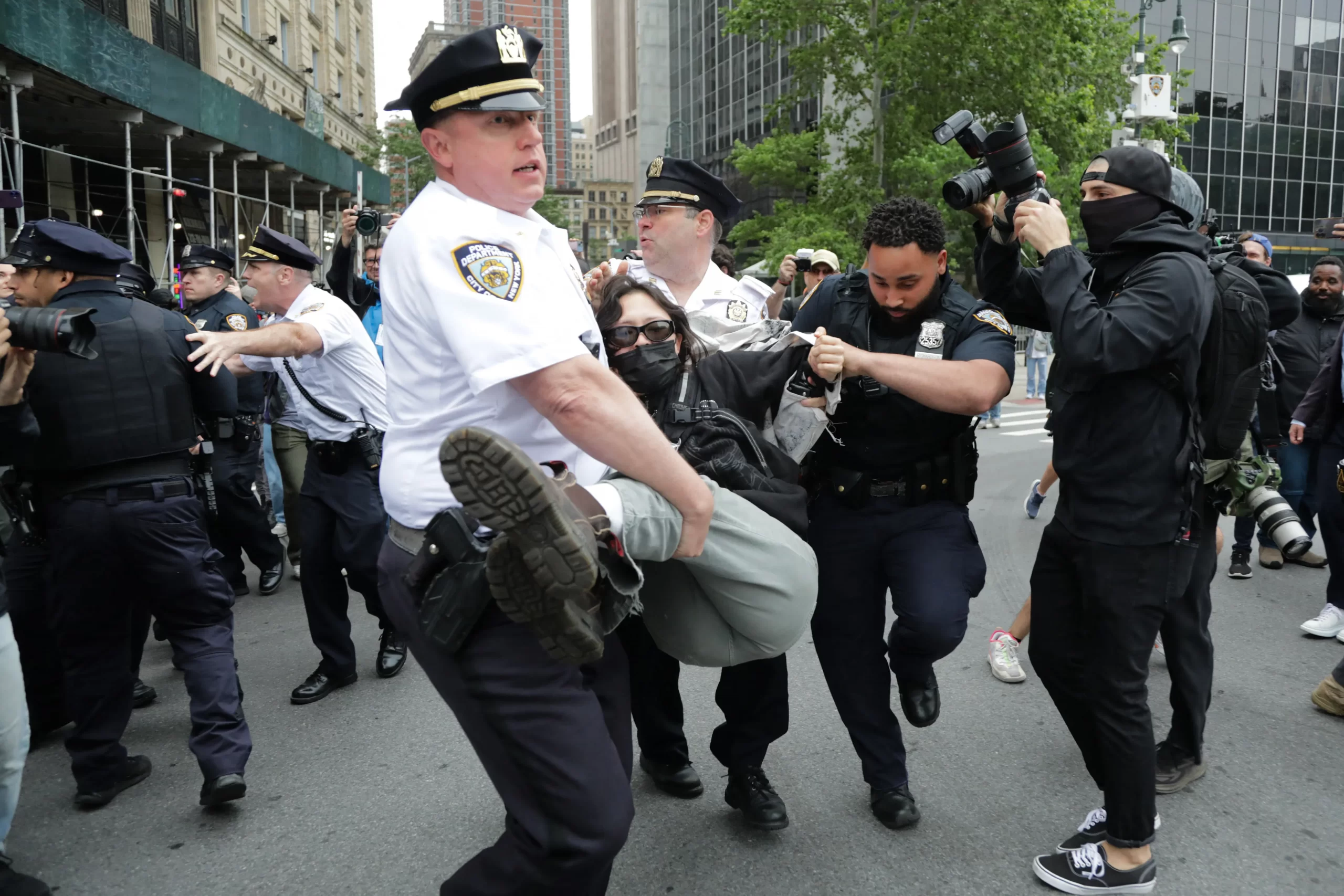
A protester is arrested during an “ICE Out of NYC” protest in New York City on June 9. Photo: Leonardo Munoz/AFP via Getty Images
Social Media as a Tool to Build Relationships
When the FBI Director takes such an oppositional stance to the developing media landscape, opportunities to fight crime can be missed. More recently, there are calls to moderate this view, as social media can be understood to be a tool that law enforcement agencies might leverage to reach more people than ever before.
Customarily, the mission of the police is stated as one focused on “to serve and protect.” Police departments are further required to have a deep understanding of their community — one that includes the “digital town square,” which encompasses platforms like X (formerly Twitter), Facebook, and Instagram. Given this, there may be new opportunities for agencies to connect with wider audiences and forge strong relationships with the public through messaging and education. The question is though, how can law enforcement find ways to get beyond screen names and anonymity to connect in ways that will resonate? How can they improve communication and, in the process, become better crime fighters?
Implementing techniques like researching an audience’s demographic and psychographic characteristics can help agency communicators craft higher impact messages that can fundamentally shift the reception of a post from “listening to someone shout into a crowd with a megaphone” to “information meant just for me.” (Mendoza, 2024). Ultimately, learning how to target an audience to develop insights to create better messaging is a skill that should be cultivated, as this can transform the social media landscape from a simple tool used to share announcements, post cat pictures, and other memes, to one that is a critical asset that be used to build and strengthen community relationships.
Reflection & Discussion
What do you think about these developments? Do you think social media helps or harms the police? Does it make them more accountable to the public? Or does it increase crime?
Sources
Social Media Spotlight: A Tool for Relationship Building, by Marin Rulas Mendoza, 2024
Social media and the rise of cameras and cell phone use as a whole is good for policing. I believe there are many positives with this such as an increase in social networking in policing as well as showing a more public view of law enforcement. However social media can have its drawbacks. In some cases, social media paints a poor picture for police and can add a bias when making an opinion on policing.
The advancements in technology and the use of social media does hold the police more accountable. The increase of technology including body cams helps to hold police to higher standard which benefits the public. When the police are examined more closely it can prevent problems like abuse of power and things of that nature.
In conclusion, while it has its drawbacks, I believe social media in policing is overall a good thing in the force.
When asking the question, does social media help or harm the police, there are many different ways to answer. From the point of view of the systems, lobbyists, powerful land-owning white men, or whatever you want to call them, social media is harmful to their plan to keep white capital and property safe at the cost of black, latinx, arab, and other minority groups. On the other hand, for us, it is helpful for a plethora of reasons. First of all, it has allowed a conversation to open amongst the people. White citizens who have not faced the harassment from the police get a good look at it. Many have finally come along to the idea that we aren’t yelling for no reason, and things need to change for the safety of all civilians. The plethora of video evidence show that misconduct by police is not just an issue of “a few bad apples” and in reality there is a huge systemic problem. This can either be positive or negative for honest officers who watch these videos. It gives them the opportunity to see that they may be upholding the poor behavior of other officers or it could act as confirmation bias in the sense that they themselves are not causing the problems and haven’t seen it in front of their own eyes, so it is just those few bad guys. At the end of the day, they can’t control the presence of cameras and social media so they must find a way to work with it instead of running away from their duties. If they truly act with integrity, then there should be no fear of a camera. They can’t do whatever they want with impunity. The role they chose puts them in a fishbowl, eyes are on them at almost all times when in uniform. If officers have an issue with that they should consider a new career!
The rise of social media and the prevalence of smartphones have undeniably transformed the relationship between the public and law enforcement. On one hand, these tools have increased transparency and accountability. On the other, they’ve also introduced new challenges for officers trying to navigate highly visible and often volatile public interactions.
I believe that overall, social media has helped the police by making them more accountable to the communities they serve. Body cams and bystander videos have exposed misconduct, but they’ve also shown positive and professional interactions. This kind of public visibility encourages officers to act in ways that reflect the values of community policing. When used well, social media can also be a direct communication line between departments and the public, allowing agencies to share safety alerts, clarify misinformation, and even humanize the badge through community engagement posts.
That said, I also understand the concerns raised by figures like James Comey. If officers feel overly scrutinized or afraid to engage, it might lead to hesitation in situations that require decisive action. However, I don’t believe this fear should justify avoiding scrutiny. Instead, better training, clearer policies, and leadership support can help officers feel both empowered and responsible in the digital age.
Most importantly, I think police departments need to see social media as a tool to build trust, not just a PR platform or surveillance tool. As mentioned in the course reading, learning how to communicate effectively to diverse audiences, using psychographic insights, can make a huge difference. When police show up in the “digital town square” with transparency, authenticity, and consistency, they have a better chance of being seen not just as enforcers of law, but as partners in public safety.
The writing was very interesting because it demonstrated that being anything other than a white male makes you a target in society, metaphorically and physically. It seems like states find state-sanctioned violence productive because of structural racism. Many violent officers probably began their careers as racists, but as time went on, their beliefs were reinforced. The article talked about how many white people automatically view black people as being stronger, more violent, and more aggressive overall. So seeing them in a white neighborhood raises alarms, and it makes them more willing to take action. It is disgusting that this “state-sanctioned” violence can likely be entirely avoided if racism were looked down upon in the police academy. Poor people, people of color, and women are victims of this because many people in authority believe they are better. It was also interesting seeing the intersection of race and gender regarding this issue because it made Serena Williams a target for just existing. It is absolutely an institutional problem that needs to be fixed immediately because it is becoming too normalized to see black bodies’ lives taken by the government.
The media can be both harmful and beneficial to police officers. It can be a way for officers to share their stories and experiences, or for others to share the good of what they’re doing for their community. But then there’s the downside to officers on social media, which often outshines the good. Personally, if officers pop up on my feed, it’s for racial profiling, taking a life, or assaulting individuals with no actions leading to these ends. I don’t believe officers are taking accountability for these actions out of the kindness of their hearts, but mainly for the social media world. Because in the situations where officers use excessive use of force when not necessary at all, where was the empathy for that person then? And if this continues the cops that are there to “serve and protect” will create a bigger division between them and their communities leading to further crimes.
Social media and the policing world can sometimes go together and sometimes be really hurt by it. Policing in this world is always changing and social media can help them with showing them they did something good. For example, saving someone from a car that they just got into a serious accident with. Or being first on scene to a fire and rushing in saving someone in the process. But social media always has a way to hurt people and it can hurt the policing world a lot. For example, when pulling a person over and they might not have the clearest reason and the officer uses his force pulling a person from the car. Some police officers abuse the power they have and when they try to make sure they are not caught, there are cameras and people everywhere. With the entire ICE situation right now it makes them highly accountable for all their actions due to reporters and people of the community always around. With making them accountable for their actions, crime and increase as well. Crime can increase at any time about anything but if police are being caught and held accountable for their actions, there could be more crime for them to attend to. Social media helps and hurts the policing community, but you never know who can record it and post it online. Not everything we see happen is good and not everything we see is bad. It is interchangeable in the environment of the policing community.
My view on social media and how it affects the police is just on the view that you are seeing. For example the George Flyod incident, the view that was given was the police officer that killed him used excessive force and eventually killed him. What is not shown is that Flyod was not cooperating with the officer and was resisting what the officer was asking. The officer suspected that he was on drugs but the video did not show this and we weren’t informed of this until you learned about it in the court case. When the body went over an autopsy the drugs he was suspected of taking were found in his system. I’m not saying the officer was in the right or the wrong but that with the limited information that we are shown on social media can change the perception of someone and what they think. So with this given information social media affect the view on police with just small clips being the changing point of what a person sees.
I think that these developments are beneficial and something that needed to happen. This holds officers accountable for their actions and keeps most dirty cops off the streets. Social media helps the police by connecting with communities and use this resource for educational purposes. Social media also helps individuals keep tabs on the police when people start filming. One way this can harm this officer is by allowing something to be taken out of context and using it against them with reporting it to their superior even if they did nothing wrong. I believe this proves that not all police are bad and we have some good ones out on the street even if they may be uncomfortable with being filmed. At the end of the day police are also people with families and they have a life outside of work. People should not abuse social media just to try and get their way when the proper protocols are in place. Opportunities to fight crime are not taken away by social media, and if anything it decreases the crime rate.
Inside the realm of social media, a lot of things we view can either affect the way we feel or think about that subject. Social media also creates reactions. Everyone’s emotions run differently, but how we react is important. When we are discussing policing and social media, typically you would hear strong opinionated debates on the topic of police brutality and injustice. I believe that the way some people view police is due to social media.
It’s quite common to open any app on your phone such as TikTok or Instagram and see harmful actions committed towards civilians by police officers and ICE agents that leave negative connotations for people to react to. In the past when social media had not existed, most illegal actions that took place happened behind closed doors.
They didn’t have screens or cameras always on the police to hold officers accountable. So, now that we have evolved into a digital era of fast information, we are able to define what is wrong and right. Social media should be used for the goodness of others, but that’s not how it always works especially for police departments. Usually, technology is more harmful than helpful for the police. Logically there are plenty of things it can do to help police departments such as sharing vital information out to the public promptly, taking surveys to count for communities and hearing discussions from around the world.
Crime doesn’t increase because of social media and the police officers. It builds into the emotional states of people and how it affects their mindsets beyond what they see. Criminal activity is everywhere and it’s always been rising or falling, but now it’s become more digitalized that people can access this information anywhere and misinformation also gets tied up into that where people will honestly believe anything unfortunately.
I think that there are lots of different affects on policing from social media. For example I feel like cops in highly populated areas are much more likely to be recorded even if nothing bad is happening at all. This could change their behavior and make them possibly be more cautious with what they do. It is unfortunate that the presence of a camera is needed to stop police from abusing their power though. Lots of police are also required to wear body cameras for this same reason. I do think that social media has sort of put a very bad rap on police officers however. For every one good video of a police officer you see three of them doing something disgusting, at least in my personal experience . I feel this has greatly impacted he public opinion of police and I feel most do not like them or are scared of them because of things they have seen on the internet.
Documenting police-civilian interactions with the emergence of smartphones is positive because it will allow both parties to be held accountable. Social media may inherently “harm” the police, but this just means that officers will not be able to get away with as much as they did in the past. Documentation on social media makes it so both sides of the story can be told in controversial interactions. In the past decade, videos of police interactions have gone viral countless times, and this makes it so officers crossing the line can be effectively punished due to scrutiny. But when it comes to the claim that it will increase crime, it just serves as a poor excuse for problematic officers not doing their job. If the chance of online scrutiny makes an officer not confront a crime, then that individual is not following his or her orders. The fact that this may make the police not do their job demonstrates a greater issue in the force. In conclusion, the emergence of social media is positive for folks involved in the criminal justice system because it will increase accountability.
I personally believe that social media can help but also hard police officers. It can help police officers by being able to criminals. For some reason many people decide to show their crimes or do stupid stuff over social media. Social media can also show the good that our police our doing in this world. On the other hand social media can be harmful or bad for our police. It doesn’t take much for our society to put something on social media when a higher power does a wrong act. Prime example look at the George Floyd case. The video hit social media in a matter of seconds. I feel like whenever there is a situation like police brutality, a bad traffic stop, and etc some sort of video or message will be put on social media. This can hurt the police because it will give our society the impression that police are all bad. I do believe that this could help our police system though. When videos like this emerge it can hold our police to a higher standard. In today’s society it’s hard to get away with anything. So this can help keep our police to the higher standard that they need to be. I believe that having social media is a good and bad thing. Yes it can hurt our police but also it can help them.
Social media has had both a positive and negative impact on policing. In a positive light, police are able to ask for help and share information. For example, they can post about missing people, traffic alerts, or safety tips, which can help the community feel more involved. Also, it lets people report problems and share videos of police officers. Social media can make their job more difficult. Sometimes videos are shared without full context, which can make people judge police officers unfairly. Police can also get false information and have unnecessary pressure put on them. Also, I think how police use social media to track people is an invasion of privacy. Overall, social media can be good and bad depending on how it is used. It gives more people a louder voice and helps police stay in better communication with their communities. When used correctly, it can be a very helpful thing to both the community and police.
In my opinion, social media can be both beneficial and a disadvantage to the police. On one hand, social media can be a tool to make poor policing tactics known and reach a broader audience when injustice is being carried out at the hands of the police. I think if a police officer is acting in accordance with policy, they should have no reason to fear being captured on a social media post. It may even help their situation; if someone were to make a false complaint about an officer, social media footage could potentially prove the reality of the situation. However, I also see that if there’s an intense situation happening, someone immediately utilizing social media may only serve to escalate the tension.
Social media also allows a place for people to discuss and critique the police system if traditional avenues for such conversation aren’t accessible to them. By widening the net of who is involved in these conversations, social media has given the general public an easier way to make it known what they feel is working and what’s not. By having access to a diverse range of input, we have more opportunities to improve the police system and how it works.
Social media also has the potential to connect the police with their communities. In building relationships with the community they serve, they would be able to build more trust so that people feel more comfortable contacting the police if necessary.
I think that social media is helpful to the police. I agree with the article that stated, social media helps hold police officers accountable. Realistically, if an officer isn’t doing anything wrong, they shouldn’t have anything to worry about. Personal anecdote, the police department in my hometown would post updates on Facebook letting the public know if there was a dangerous person to watch out for, or if there was an uprise in theft crimes in certain areas. I believe that is a good way for the police force to use social media. This would be difficult to maintain in larger cities like LA or New York, however. It is also heartwarming to see posts about police officers that go to schools or randomly play a game of basketball. Today, the majority of people are so easily focused on the negatives that we forget to find the positives. I also believe that while social media is beneficial to police, it can be harmful. There are people who try to instigate problems with police officers for “5 minutes of fame.” Now, I also believe that the public should be made aware of wrongdoings by police, however, I think it should be publicized similarly to how court hearings are publicized. If an officer makes an honest mistake, I don’t think that they need to be scrutinized by everybody. Although, I think when an officer is blatantly in the wrong, they could benefit from public criticism. It just needs to be governed, like a court hearing some details are meant for the people in the court room. Social media is forever and if not used for the right things, it is a weapon.
I think social media can both positively and negatively affect police work. I believe it can prove an officer innocent or guilty if accused of misconduct, but it can also hold the police accountable for wrongdoing. However, social media has a strong tendency to highlight the negative aspects of things rather than the positive. The good news becomes almost a chore to find. So this can push a narrative that cops are all just violent people, creating fear in people. However, I think we could focus on highlighting the good while holding the officers accountable for the wrong. Social media can also have an impact on how we as a society can begin to enact change, and spreading awareness could be a good way to start.
I believe that although it could be used as a tool to build a better connection between communities and their law enforcement, often times out of fear or ego, lawful stops are made which cause people to record and even at times edit out critical information before posting it online. This tends to portray the police in bad light, and because of that the police tend to back of trying to protect their image and job, but alongside that with them not being as persistent, it is opening a door for crime whether big or small to happen and eventually escalate. I also believe that it can be useful especially when law enforcement officers abuse their power with the thought that nobody is watching and are forced to deal with the proper repercussions for acting unlawfully while on or off duty.
In my opinion, I think social media can affect the job of an officer in both good and bad ways. it can help an officer show that what he or her are doing is proving, and that there is no here in say involved, but that can also harm in officer in the ways of if he or her is using their power more than what they’re supposed to do that they the person who took the video has evidence that they that the officer is in the wrong and is doing something wrong. It is good that social media can be used for good and bad in the fact of seeing the truth of what is happening in the issue, but it can also harm in the fact that it brings a bad image to police officers and that police officers are always in the wrong and are bad people when really it’s 50-50 and all the good moments of a police officer is barely shown on the Internet because everyone wants to victimize police officers and thinking that they’re all bad and that there are not some good police officers in the world. I think, depending on the situation there are a lot of negative and positive things that can come out of a video when a officer is dealing with the situation, but for the most part, my favorite part of having everything recorded is that both parties, police officer and human being both have their point of view, recorded to show their side of the story.